
[Paper Review] SDR-Former: A Siamese Dual-Resolution Transformer for Liver Lesion Classification Using 3D Multi-Phase Imaging
This paper proposes SDR-Former, a Siamese Dual-Resolution Transformer for 3D multi-phase liver lesion classification in CT and MR imaging. It uses a weight-shared Siamese network with a hybrid 3D CNN-Transformer backbone and an Adaptive Phase Selection Module to enhance feature representation and phase-specific fusion, achieving state-of-the-art performance on both 3-phase CT and 8-phase MR datasets while releasing the first publicly available multi-phase MR dataset for liver lesion analysis.
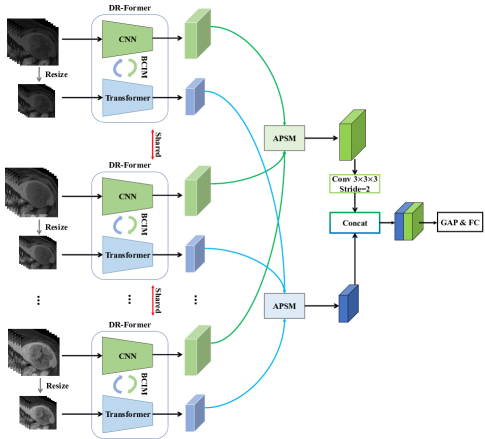
Automated classification of liver lesions in multi-phase CT and MR scans is of clinical significance but challenging. This study proposes a novel Siamese Dual-Resolution Transformer (SDR-Former) framework, specifically designed for liver lesion classification in 3D multi-phase CT and MR imaging with varying phase counts. The proposed SDR-Former utilizes a streamlined Siamese Neural Network (SNN) to process multi-phase imaging inputs, possessing robust feature representations while maintaining computational efficiency. The weight-sharing feature of the SNN is further enriched by a hybrid Dual-Resolution Transformer (DR-Former), comprising a 3D Convolutional Neural Network (CNN) and a tailored 3D Transformer for processing high- and low-resolution images, respectively. This hybrid sub-architecture excels in capturing detailed local features and understanding global contextual information, thereby, boosting the SNN's feature extraction capabilities. Additionally, a novel Adaptive Phase Selection Module (APSM) is introduced, promoting phase-specific intercommunication and dynamically adjusting each phase's influence on the diagnostic outcome. The proposed SDR-Former framework has been validated through comprehensive experiments on two clinical datasets: a three-phase CT dataset and an eight-phase MR dataset. The experimental results affirm the efficacy of the proposed framework. To support the scientific community, we are releasing our extensive multi-phase MR dataset for liver lesion analysis to the public. This pioneering dataset, being the first publicly available multi-phase MR dataset in this field, also underpins the MICCAI LLD-MMRI Challenge. The dataset is accessible at:https://bit.ly/3IyYlgN.
Motivation & Objective
- To address the challenge of accurate and efficient liver lesion classification in 3D multi-phase CT and MR imaging, where manual analysis is time-consuming and prone to error.
- To overcome limitations of existing image-level and feature-level fusion methods, which either dilute phase-specific features or incur high computational costs.
- To develop a scalable, computationally efficient, and robust deep learning framework capable of handling variable numbers of imaging phases.
- To introduce a novel Adaptive Phase Selection Module (APSM) that dynamically weights phase contributions based on diagnostic relevance.
- To support open science by releasing the first publicly available multi-phase MR dataset for liver lesion analysis, enabling broader research and benchmarking.
Proposed method
- The SDR-Former employs a Siamese Neural Network (SNN) with shared weights to process each imaging phase independently, preserving phase-specific representations while ensuring computational efficiency.
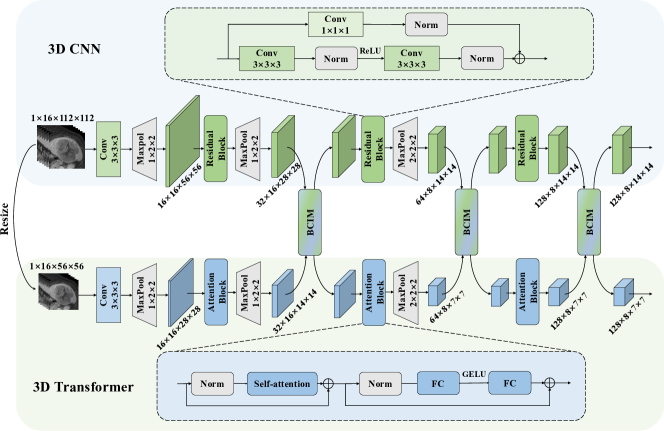
- A hybrid Dual-Resolution Transformer (DR-Former) is introduced, combining a 3D CNN for high-resolution local feature extraction and a 3D Transformer for low-resolution global context modeling.
- The DR-Former fuses high- and low-resolution features through element-wise concatenation and a global average pooling layer, enhancing both local detail and long-range dependency understanding.
- An Adaptive Phase Selection Module (APSM) is designed to dynamically adjust the contribution of each phase to the final classification by learning phase-specific attention weights.
- The framework integrates a Cross-Modal Interaction Module (BCIM) to facilitate feature interaction between the CNN and Transformer branches, improving feature representation.
- The model is trained end-to-end using cross-entropy loss and evaluated on two clinical datasets: a 3-phase CT dataset and an 8-phase MR dataset.
Experimental results
Research questions
- RQ1Can a Siamese dual-resolution Transformer architecture effectively capture complementary features across multiple phases in 3D multi-phase liver imaging?
- RQ2How does the integration of a hybrid 3D CNN-Transformer backbone improve feature representation compared to standalone CNNs or Transformers?
- RQ3To what extent does the Adaptive Phase Selection Module enhance classification performance by dynamically weighting phase-specific features?
- RQ4How does the proposed framework generalize across datasets with varying numbers of imaging phases, such as 3-phase CT and 8-phase MR?
- RQ5Can the DR-Former backbone be effectively transferred to other 3D medical image classification tasks beyond multi-phase liver lesion analysis?
Key findings
- On the 3-phase CT dataset, SDR-Former achieved an accuracy of 0.8915, AUC of 0.7830, F1-score of 0.8915, and Kappa of 0.7830, demonstrating strong performance.
- On the 8-phase MR dataset, the model achieved an accuracy of 0.9536, AUC of 0.7910, F1-score of 0.7467, and Kappa of 0.7467 when pre-trained on CT data.
- The DR-Former backbone outperformed state-of-the-art models on MedMNIST v2, achieving 96.23% accuracy on OrganMNIST3D and 90.32% on NoduleMNIST3D.
- The model showed robust generalization across datasets with different phase counts, maintaining high performance without requiring architectural re-design.
- The ablation study confirmed that the APSM and BCIM components significantly improved performance, validating their role in phase-specific feature weighting and cross-branch feature interaction.
- The release of the first publicly available multi-phase MR dataset for liver lesion analysis is expected to accelerate research and standardize benchmarking in the field.
Read this paper
Open the full text in the Nubint reader and ask about any passage as you read.
Read this paper on NubintThis review was generated by AI from the original paper. Please check the paper before citing it.