
[Paper Review] SeaLLMs -- Large Language Models for Southeast Asia
SeaLLMs introduces a suite of large language models specifically fine-tuned for Southeast Asian (SEA) languages, enhancing Llama-2 through continued pre-training with extended SEA-focused vocabulary, hybrid multilingual instruction tuning, and self-preferencing alignment. The models achieve state-of-the-art performance in low-resource SEA languages, outperforming both open-source LLMs and ChatGPT-3.5 in non-Latin languages like Thai, Khmer, Lao, and Burmese while maintaining strong performance in English.
Despite the remarkable achievements of large language models (LLMs) in various tasks, there remains a linguistic bias that favors high-resource languages, such as English, often at the expense of low-resource and regional languages. To address this imbalance, we introduce SeaLLMs, an innovative series of language models that specifically focuses on Southeast Asian (SEA) languages. SeaLLMs are built upon the Llama-2 model and further advanced through continued pre-training with an extended vocabulary, specialized instruction and alignment tuning to better capture the intricacies of regional languages. This allows them to respect and reflect local cultural norms, customs, stylistic preferences, and legal considerations. Our comprehensive evaluation demonstrates that SeaLLM-13b models exhibit superior performance across a wide spectrum of linguistic tasks and assistant-style instruction-following capabilities relative to comparable open-source models. Moreover, they outperform ChatGPT-3.5 in non-Latin languages, such as Thai, Khmer, Lao, and Burmese, by large margins while remaining lightweight and cost-effective to operate.
Motivation & Objective
- To address the linguistic bias in large language models that favors high-resource languages like English at the expense of low-resource and regional languages.
- To develop a family of large language models specifically optimized for the linguistic and cultural nuances of Southeast Asian (SEA) languages, including Thai, Vietnamese, Khmer, Lao, Burmese, and others.
- To improve performance in multilingual tasks—especially in low-resource SEA languages—while preserving strong performance in high-resource languages like English.
- To create a lightweight, cost-effective, and culturally aware AI assistant that respects local norms, customs, and legal frameworks in SEA regions.
- To demonstrate that specialized fine-tuning and self-supervised alignment can outperform generalist models in region-specific language understanding and generation tasks.
Proposed method
- Continued pre-training of Llama-2 using an extended vocabulary and curated multilingual corpora from public sources such as Common Crawl, CC-News, Wikipedia, and scholarly publications, filtered for SEA languages using FastText.
- Hybrid fine-tuning using a mixture of multilingual pre-training data and English-dominant instruction tuning data to balance multilingual capability and instruction-following performance.
- Specialized instruction tuning on a balanced, custom-built multilingual supervised fine-tuning (SFT) dataset covering 10 SEA languages to improve zero-shot and few-shot generalization.
- Self-preferencing alignment optimization using the SeaLLM model itself, eliminating reliance on human annotators or more powerful LLMs for reward modeling.
- Use of a multi-stage training pipeline: continual pre-training → hybrid fine-tuning → SFT → self-preferencing alignment.
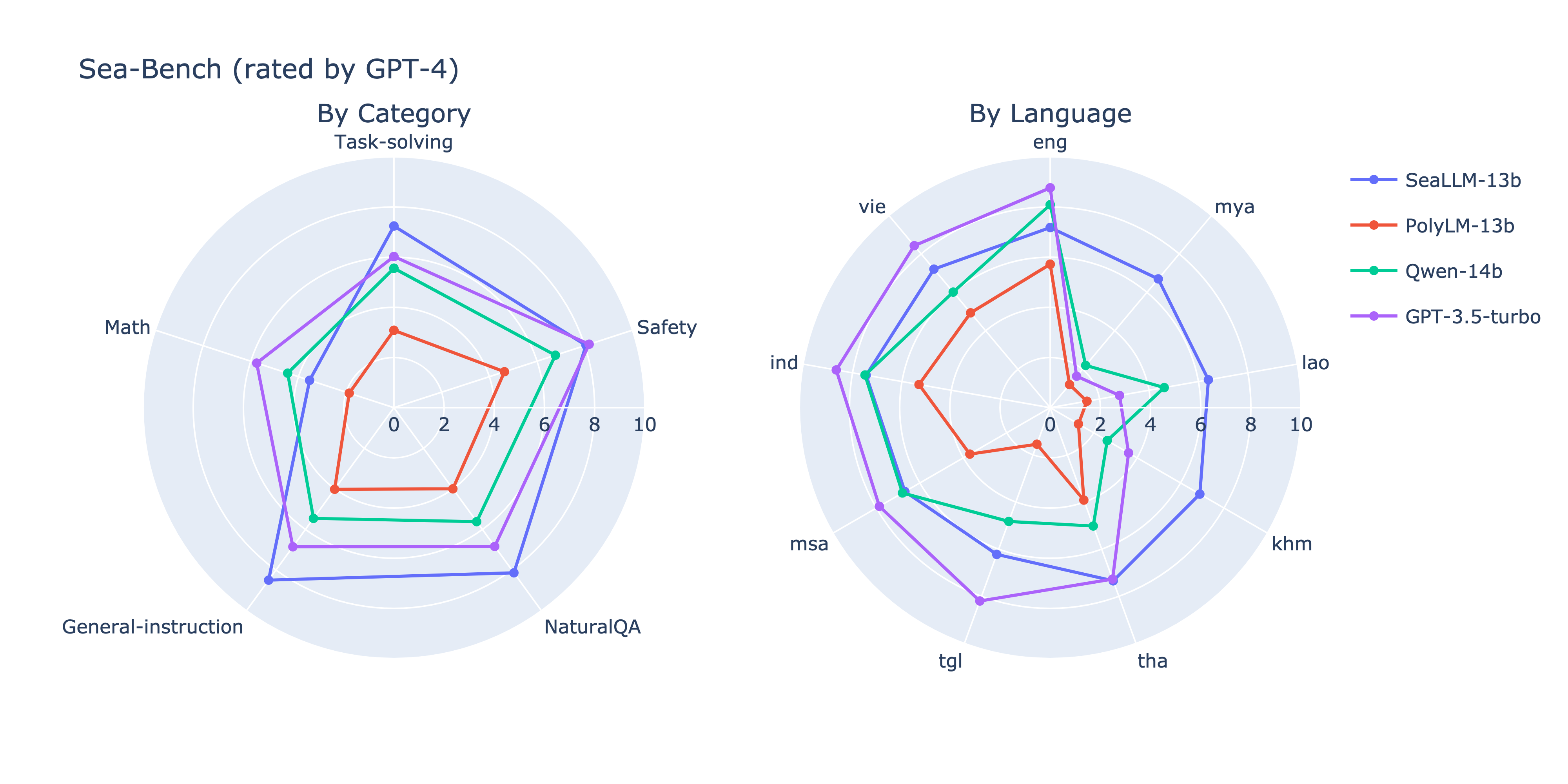
- Evaluation with GPT-4 as a judge on a comprehensive benchmark (Sea-bench) covering 9 languages and 5 task categories, including world knowledge, reading comprehension, and machine translation.
Experimental results
Research questions
- RQ1Can continued pre-training with extended SEA language corpora significantly improve performance on low-resource Southeast Asian languages compared to base Llama-2 models?
- RQ2To what extent can hybrid and specialized instruction tuning improve multilingual instruction-following capabilities in diverse SEA languages?
- RQ3Can self-preferencing alignment without human-annotated rewards achieve competitive performance on assistant-style tasks compared to models fine-tuned with human preferences?
- RQ4How does SeaLLM-13B compare to state-of-the-art models like ChatGPT-3.5 in non-Latin SEA languages, particularly in low-resource settings?
- RQ5Does the inclusion of culturally and legally sensitive tuning improve model behavior in real-world assistant applications across Southeast Asian cultural contexts?
Key findings
- SeaLLM-13b-5L achieves the highest world knowledge benchmark score (63.20) among 13B-parameter models, outperforming Llama-2-13b (61.17) and other open-source models across 5 SEA languages.
- In reading comprehension, SeaLLM-13b-10L achieves an F1 score of 59.50 on Thai in the XQuAD benchmark, significantly outperforming Llama-2-13b (25.73) and approaching ChatGPT-3.5’s performance in English (69.18).
- For machine translation, SeaLLM-13B outperforms ChatGPT-3.5 in 8 out of 10 translation directions involving low-resource languages such as Lao and Khmer, with higher chrF++ scores in En→Lao and En→Khmer.
- In direct translation between SEA languages, SeaLLM-13B achieves higher chrF++ scores than ChatGPT-3.5 in 7 out of 10 language pairs, especially excelling in low-resource combinations.
- SeaLLM-13b-5L achieves a 55.23 score on the Sea-bench assistant evaluation, outperforming ChatGPT-3.5 in non-Latin languages while maintaining strong performance in English.
- The self-preferencing alignment method enables the model to achieve high performance without human-annotated preference data, demonstrating the feasibility of self-supervised alignment in multilingual settings.

Read this paper
Open the full text in the Nubint reader and ask about any passage as you read.
Read this paper on NubintThis review was generated by AI from the original paper. Please check the paper before citing it.