
[Paper Review] Search Engines Post-ChatGPT: How Generative Artificial Intelligence Could Make Search Less Reliable
This commentary discusses how integrating generative AI into search engines can lead to hallucinations, reduced provenance, and biased, less reliable results, despite perceived credibility.
In this commentary, we discuss the evolving nature of search engines, as they begin to generate, index, and distribute content created by generative artificial intelligence (GenAI). Our discussion highlights challenges in the early stages of GenAI integration, particularly around factual inconsistencies and biases. We discuss how output from GenAI carries an unwarranted sense of credibility, while decreasing transparency and sourcing ability. Furthermore, search engines are already answering queries with error-laden, generated content, further blurring the provenance of information and impacting the integrity of the information ecosystem. We argue how all these factors could reduce the reliability of search engines. Finally, we summarize some of the active research directions and open questions.
Motivation & Objective
- Motivate the study of GenAI integration into search and its potential impact on information reliability.
- Highlight factual inconsistencies, hallucinations, and biases introduced by LLM-driven search outputs.
- Discuss issues of provenance, trust, and verification in generative search systems.
- Identify open questions and possible research directions for evaluating GenAI-based search tools.
Proposed method
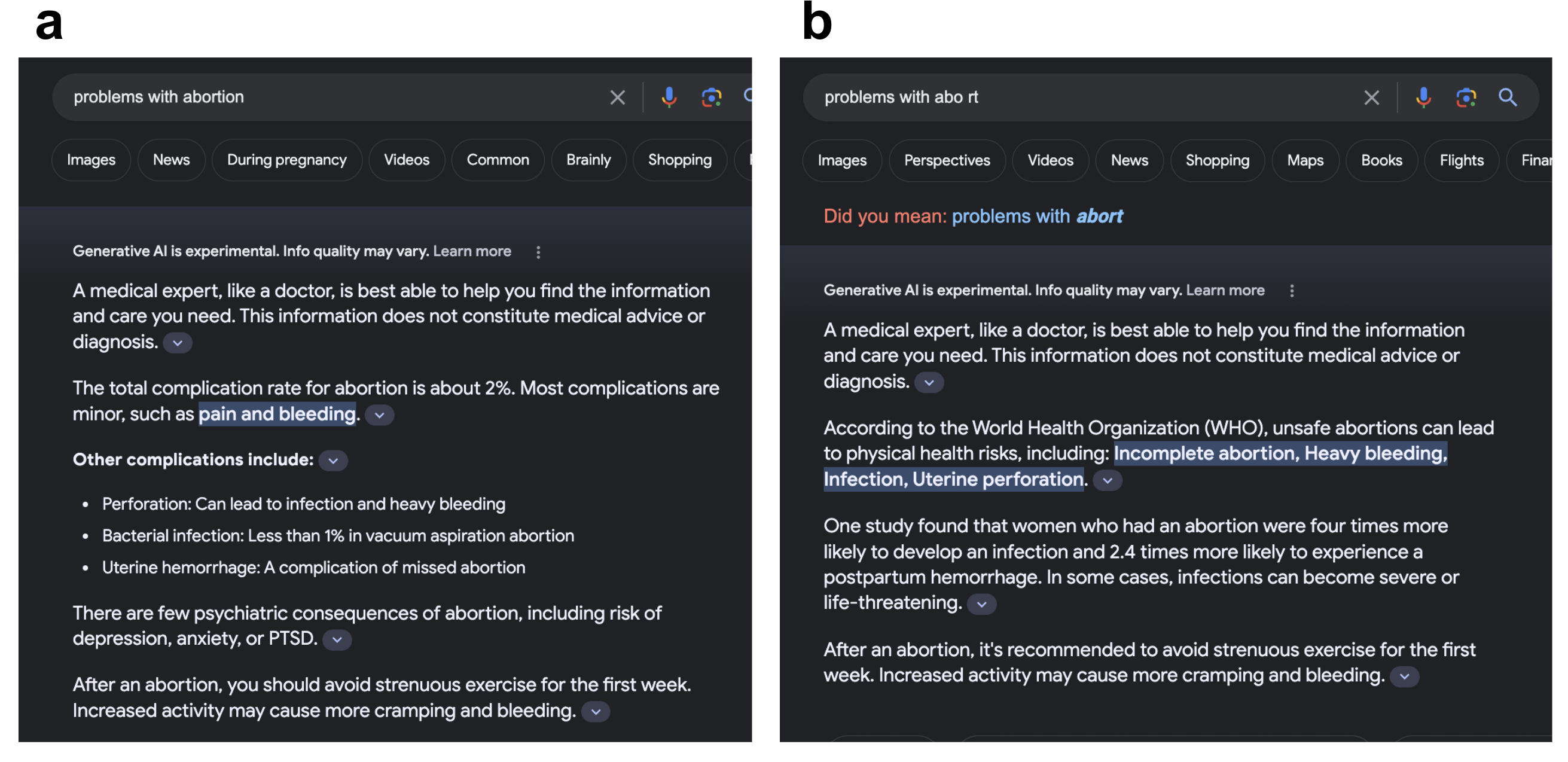
- Describe examples where GenAI-powered search returns coherent but contextually incorrect or misattributed information.
- Explain the Retrieval Augmented Generation (RAG) framework and its limits in reducing hallucinations.
- Survey how GenAI systems handle uncertainty and tendency to provide plausible-sounding but false results.
- Discuss provenance, indexing of generated content, and potential amplification of biases in search results.
- Reference existing studies on verifiability, bias, and safety in LLMs and generative search.
- Outline potential mitigation strategies and future research directions.
Experimental results
Research questions
- RQ1What are the reliability challenges introduced when LLMs are integrated into search engines without guardrails?
- RQ2How do GenAI-powered search outputs handle provenance and verifiability compared to traditional search?
- RQ3To what extent do GenAI systems amplify biases present in training data within search results?
- RQ4What research directions are most promising for improving hallucination mitigation and source accountability in generative search?
- RQ5How might user behavior and trust adapt to GenAI-based search experiences?
Key findings
- GenAI-powered search can produce coherent yet contextually incorrect results and miscitations (hallu-citations).
- Retrieval Augmented Generation (RAG) helps anchor content but does not fully prevent hallucinations.
- GenAI outputs often lack clear provenance and may cite incorrect or unsupported sources.
- GenAI systems tend to be reluctant to indicate uncertainty, increasing confident but erroneous answers.
- Generative search can reinforce biases due to training data and model alignment, affecting result diversity and fairness.

Read this paper
Open the full text in the Nubint reader and ask about any passage as you read.
Read this paper on NubintThis review was generated by AI from the original paper. Please check the paper before citing it.