
[Paper Review] Search for dark matter annual modulation with DarkSide-50
This study searches for annual modulation in dark matter interactions using the DarkSide-50 liquid argon time projection chamber, analyzing 2.0–6.0 keVee and extending down to 0.04 keVee for the first time in such a search. No significant modulation signal was observed, setting stringent limits on dark matter scattering cross-sections and demonstrating the detector's low threshold and stability for future experiments.
Dark matter induced event rate in an Earth-based detector is predicted to show an annual modulation as a result of the Earth's orbital motion around the Sun. We searched for this modulation signature using the ionization signal of the DarkSide-50 liquid argon time projection chamber. No significant signature compatible with dark matter is observed in the electron recoil equivalent energy range above $40~{ m eV_{ee}}$, the lowest threshold ever achieved in such a search.
Motivation & Objective
- To search for annual modulation in the dark matter event rate using the DarkSide-50 liquid argon time projection chamber.
- To probe the low-energy region down to 0.04 keVee, the lowest threshold achieved in any annual modulation search to date.
- To test the compatibility of the DAMA/LIBRA signal with a dark matter origin by searching in the same energy window.
- To evaluate the sensitivity of the detector and background modeling over nearly three years of stable operation.
- To demonstrate the viability of dual-phase liquid argon technology for future, larger-scale dark matter modulation searches.
Proposed method
- Acquired data from the DarkSide-50 detector over nearly three years of continuous operation.
- Performed background modeling using a detailed fit to the time-dependent event rate, accounting for radioactive decays and other known sources.
- Applied a Lomb-Scargle periodogram analysis to data residuals after background subtraction to search for sinusoidal modulations.
- Propagated uncertainties from the background fit into the data errors to ensure robust significance estimation.
- Used the Bootstrap method to calculate false alarm probabilities and assess the significance of any detected sinusoidal signals.
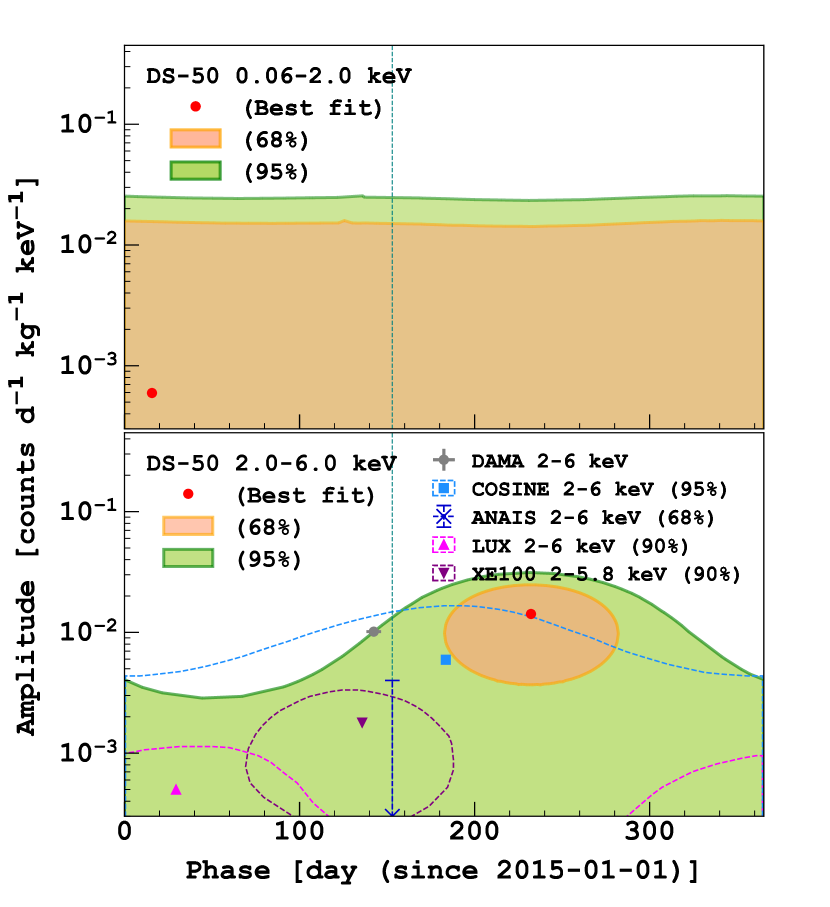
- Evaluated sensitivity by injecting simulated annual modulation signals into 1000 pseudo-experiments, determining a median 1σ significance threshold of 0.03 counts/(d·kg·keV).
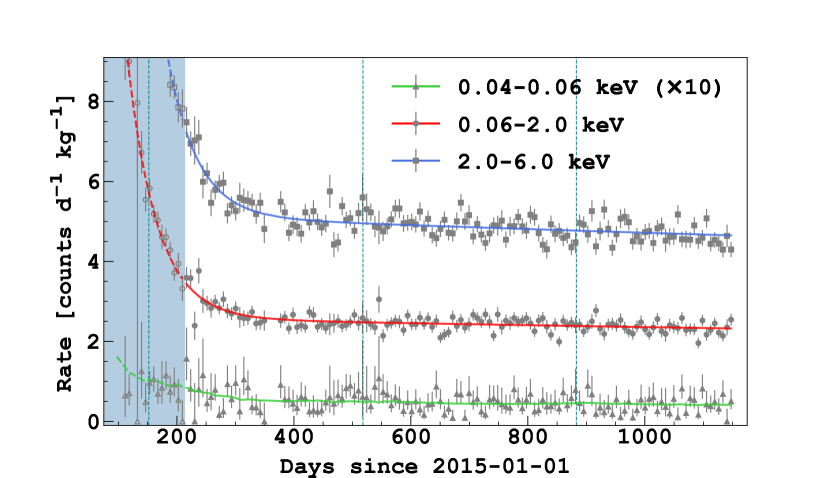
Experimental results
Research questions
- RQ1Is there evidence for an annual modulation in the event rate in the 2.0–6.0 keVee energy range, consistent with dark matter scattering?
- RQ2Can the DarkSide-50 experiment detect a modulation signal at energies below 1 keVee, extending the reach of previous searches?
- RQ3Does the observed data support the annual modulation signal reported by DAMA/LIBRA in the same energy window?
- RQ4What is the sensitivity of the DarkSide-50 detector to annual modulation signals, given its background model and threshold?
- RQ5How stable and reliable is the detector’s performance over long-term operation for such a sensitive search?
Key findings
- No significant annual modulation signal was observed in any of the analyzed energy intervals, including the 2.0–6.0 keVee range where DAMA/LIBRA reported a signal.
- The experiment achieved a low-energy threshold of 0.04 keVee, the lowest ever reached in an annual modulation dark matter search.
- The sensitivity of the analysis was quantified as a median 1σ significance threshold of 0.03 counts/(d·kg·keV) for injected modulation signals.
- The detector demonstrated high stability and accurate background modeling over nearly three years of operation.
- The absence of a signal rules out the DAMA/LIBRA observation at a significance level insufficient to confirm or reject it, but sets new constraints.
- The results validate the dual-phase liquid argon TPC technology as a promising platform for future, larger-scale dark matter modulation experiments with improved exposure and background suppression.
Read this paper
Open the full text in the Nubint reader and ask about any passage as you read.
Read this paper on NubintThis review was generated by AI from the original paper. Please check the paper before citing it.