
[Paper Review] Searching for Best Practices in Retrieval-Augmented Generation
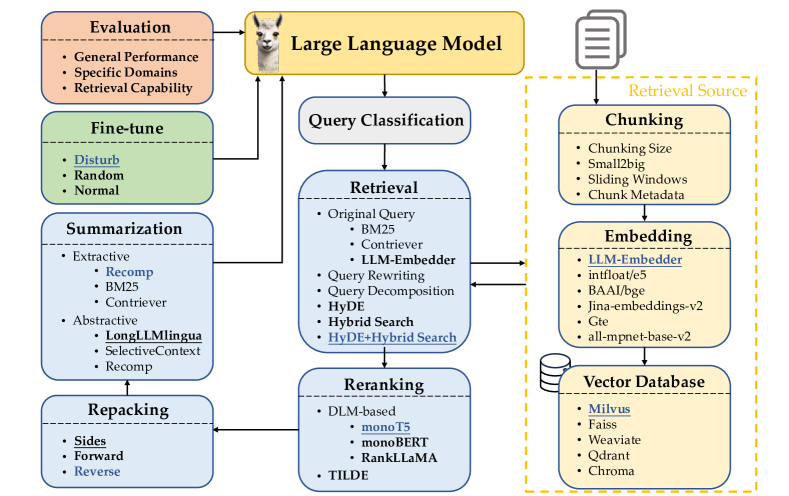
This paper systematically investigates the best practices for building retrieval-augmented generation (RAG) pipelines, evaluating component choices across query classification, chunking, embedding models, vector databases, retrieval methods, reranking, repacking, summarization, and generator fine-tuning, with multimodal retrieval and efficiency-focused configurations highlighted.
Retrieval-augmented generation (RAG) techniques have proven to be effective in integrating up-to-date information, mitigating hallucinations, and enhancing response quality, particularly in specialized domains. While many RAG approaches have been proposed to enhance large language models through query-dependent retrievals, these approaches still suffer from their complex implementation and prolonged response times. Typically, a RAG workflow involves multiple processing steps, each of which can be executed in various ways. Here, we investigate existing RAG approaches and their potential combinations to identify optimal RAG practices. Through extensive experiments, we suggest several strategies for deploying RAG that balance both performance and efficiency. Moreover, we demonstrate that multimodal retrieval techniques can significantly enhance question-answering capabilities about visual inputs and accelerate the generation of multimodal content using a "retrieval as generation" strategy.
Motivation & Objective
- Identify optimal RAG workflow components and their combinations through extensive experiments.
- Provide a comprehensive evaluation framework and datasets to assess RAG performance across general, domain-specific, and multimodal tasks.
- Demonstrate that multimodal retrieval can enhance QA on visual inputs and speed up multimodal content generation using a retrieval-as-generation approach.
Proposed method
- Three-step selection of candidate methods per RAG module by performance on representative tasks.
- One-at-a-time ablation to measure each module's contribution to overall RAG performance.
- Empirical exploration of combinations prioritizing performance or efficiency for different scenarios.
- Evaluation uses a diverse suite of tasks (commonsense, fact-checking, open-domain QA, multi-hop QA, medical QA) with metrics including Faithfulness, Context Relevancy, Answer Relevancy, and Answer Correctness.
Experimental results
Research questions
- RQ1What are the best-performing methods for each module in a RAG pipeline (query classification, chunking, embedding, vector store, retrieval, reranking, repacking, summarization, and generator fine-tuning)?
- RQ2How does each module contribute to overall RAG performance, and which combinations yield the best trade-offs between accuracy and efficiency?
- RQ3Can multimodal retrieval significantly improve QA over visual inputs and accelerate multimodal content generation via a retrieval-as-generation strategy?
Key findings
- Hybrid search combining sparse (BM25) and dense retrieval with HyDE-based query/document transformations yields strong performance with reasonable latency.
- Query rewriting and query decomposition are less effective than HyDE or hybrid strategies in retrieval performance under the evaluated setup.
- Best overall RAG performance on standard benchmarks is achieved with HyDE plus Hybrid Search, using LLM-Embedder embeddings and a strong reranker (monoT5).
- A few relevant plus randomly selected documents during generator fine-tuning improves robustness and effectiveness compared to using only relevant documents or random documents alone.
- Multimodal retrieval significantly enhances QA on visual inputs and speeds up generation of multimodal content via a retrieval-as-generation approach.
Read this paper
Open the full text in the Nubint reader and ask about any passage as you read.
Read this paper on NubintThis review was generated by AI from the original paper. Please check the paper before citing it.