
[Paper Review] Searching for High-Value Molecules Using Reinforcement Learning and Transformers
This paper introduces ChemRLformer, a reinforcement learning framework using Transformers and text-based molecular representations (SMILES/SELFIES) to discover high-value molecules. By combining pretraining on aligned datasets, targeted algorithmic components like hill-climbing replay buffers and KL regularization, ChemRLformer achieves state-of-the-art performance across 25 molecular design tasks, including complex protein docking simulations, while simplifying prior approaches through empirical ablation of effective design choices.
Reinforcement learning (RL) over text representations can be effective for finding high-value policies that can search over graphs. However, RL requires careful structuring of the search space and algorithm design to be effective in this challenge. Through extensive experiments, we explore how different design choices for text grammar and algorithmic choices for training can affect an RL policy's ability to generate molecules with desired properties. We arrive at a new RL-based molecular design algorithm (ChemRLformer) and perform a thorough analysis using 25 molecule design tasks, including computationally complex protein docking simulations. From this analysis, we discover unique insights in this problem space and show that ChemRLformer achieves state-of-the-art performance while being more straightforward than prior work by demystifying which design choices are actually helpful for text-based molecule design.
Motivation & Objective
- To develop a more effective and streamlined reinforcement learning approach for molecular design using text-based representations.
- To identify which architectural and algorithmic choices in text-based RL significantly improve performance in molecular generation.
- To evaluate the impact of pretraining on diverse datasets and reward function design on molecular optimization outcomes.
- To analyze the stability and performance of Transformers in online RL for molecular generation.
- To demonstrate that simpler, ablation-driven designs can outperform complex prior methods in high-value molecule discovery.
Proposed method
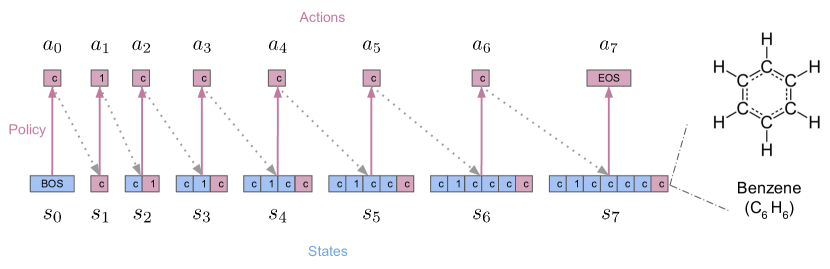
- The method employs a Transformer-based policy network trained via reinforcement learning to generate molecules token-by-token in SMILES or SELFIES format.
- It uses a pretraining phase on large-scale, aligned molecular datasets to initialize the policy, improving sample efficiency and performance.
- The algorithm incorporates a hill-climbing strategy in the replay buffer to prioritize high-reward, diverse molecules during training.
- KL regularization is applied to prevent large deviations from the pretrained policy, promoting stable training and efficient exploration.
- A composite reward function combines molecular docking scores with penalties for non-drug-like and non-synthesizable properties to guide realistic molecule generation.
- The framework is evaluated across 25 diverse molecular design tasks, including computationally intensive protein-ligand docking simulations.
Experimental results
Research questions
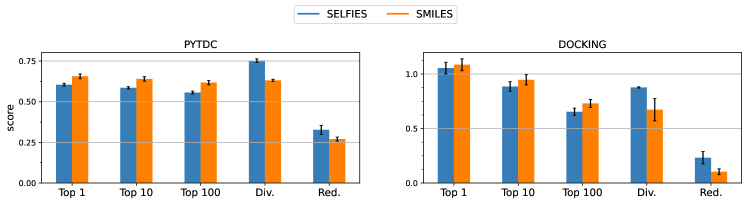
- RQ1Which text-based molecular representation (SMILES vs. SELFIES) yields better performance in RL-based molecular generation?
- RQ2How does pretraining on aligned datasets influence the sample efficiency and final performance of RL agents in molecular design?
- RQ3What algorithmic components—such as replay buffer design, regularization, or likelihood penalties—most significantly improve RL performance in text-based molecular generation?
- RQ4Why do fully connected networks exhibit reward-hacking behavior in text-based RL, and how can this be mitigated?
- RQ5How does the choice of neural architecture (e.g., Transformer vs. RNN) affect stability and performance in online RL for molecular design?
Key findings
- ChemRLformer achieves state-of-the-art performance across 25 molecular design tasks, including protein docking simulations, outperforming prior methods despite a simpler architecture.
- Pretraining on smaller, high-quality datasets (e.g., ZINC 1M) significantly outperforms training on larger, lower-quality datasets, demonstrating the importance of data quality over quantity.
- The hill-climbing replay buffer design leads to a substantial performance boost, while standard replay buffers provide minimal benefit.
- KL regularization with respect to the pretrained policy does not improve performance, suggesting it is not necessary for effective exploration in this setup.
- Fully connected networks exhibit reward-hacking behavior, generating unrealistic molecules with long sequences of carbon and nitrogen atoms to exploit the reward function.
- Despite theoretical advantages, PPO-based algorithms underperform vanilla policy gradient methods in molecular optimization, indicating that simpler RL algorithms may be more stable and effective in this domain.
Read this paper
Open the full text in the Nubint reader and ask about any passage as you read.
Read this paper on NubintThis review was generated by AI from the original paper. Please check the paper before citing it.