
[Paper Review] Second Euler number in four dimensional synthetic matter
This paper introduces the second Euler number as a topological invariant in four-dimensional synthetic matter, proposing two novel tight-binding models that realize nontrivial 4D Euler phases with robust gapless boundary states. The key result is the identification of a bulk nodal structure composed of triplets of linked nodal surfaces within a four-band subspace, realizable in ultracold atom setups via a Grassmannian construction of the minimal Bloch Hamiltonian.
Two-dimensional Euler insulators are novel kind of systems that host multi-gap topological phases, quantified by a quantised first Euler number in their bulk. Recently, these phases have been experimentally realised in suitable two-dimensional synthetic matter setups. Here we introduce the second Euler invariant, a familiar invariant in both differential topology (Chern-Gauss-Bonnet theorem) and in four-dimensional Euclidean gravity, whose existence has not been explored in condensed matter systems. Specifically, we firstly define two specific novel models in four dimensions that support a non-zero second Euler number in the bulk together with peculiar gapless boundary states. Secondly, we discuss its robustness in general spacetime-inversion invariant phases and its role in the classification of topological degenerate real bands through real Grassmannians. In particular, we derive from homotopy arguments the minimal Bloch Hamiltonian form from which the tight-binding models of any second Euler phase can be generated. Considering more concretely the gapped Euler phase associated with the tangent bundle of the four-sphere, we show that the bulk band structure of the nontrivial 4D Euler phase necessarily exhibits triplets of linked nodal surfaces (where the three types of nodal surfaces are formed by the crossing of the three successive pairs of bands within one four-band subspace). Finally, we show how to engineer these new topological phases in a four-dimensional ultracold atom setup. Our results naturally generalize the second Chern and spin Chern numbers to the case of four-dimensional phases that are characterised by real Hamiltonians and open doors for implementing such unexplored higher-dimensional phases in artificial engineered systems, ranging from ultracold atoms to photonics and electric circuits.
Motivation & Objective
- To extend the classification of topological phases in higher dimensions by introducing the second Euler number as a robust invariant in four-dimensional systems.
- To construct explicit tight-binding models in 4D that support a non-zero second Euler number and exhibit unique gapless boundary modes.
- To establish a general framework for classifying topological degenerate real bands using real Grassmannians and homotopy theory.
- To provide a minimal Bloch Hamiltonian form from which all second Euler phases can be systematically generated.
- To demonstrate experimental feasibility by showing how such phases can be engineered in four-dimensional ultracold atom systems.
Proposed method
- The authors define a 4D tight-binding model by pulling back the tangent bundle of the four-sphere via a map from the Brillouin zone to the Grassmannian manifold of real 4-frames.
- They construct a unitary frame from hyper-spherical coordinates on S⁴ to define a smooth section of the tangent bundle, which is then used to build a real Hamiltonian with finite hopping range.
- The model is realized by approximating the momentum-space Hamiltonian using finite Fourier series expansions of cosine and sine terms in the hopping amplitudes.
- The second Euler number is computed via the Chern-Gauss-Bonnet theorem, linking it to the curvature of the Grassmannian bundle over the Brillouin zone.
- The minimal Bloch Hamiltonian is derived from homotopy group analysis of the real Grassmannian, ensuring topological robustness under continuous deformations.
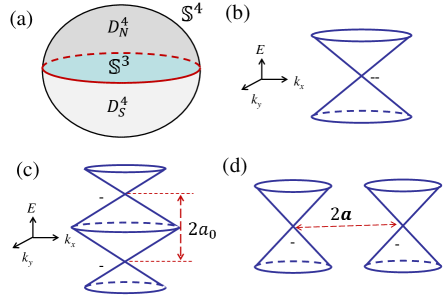
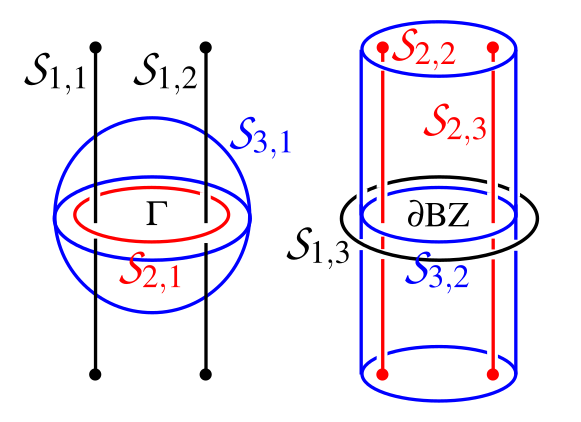
- The construction is validated by showing that the nontrivial 4D Euler phase hosts triplets of linked nodal surfaces formed by successive band crossings in a four-band subspace.
Experimental results
Research questions
- RQ1Can the second Euler number, a known invariant in differential topology and 4D gravity, be realized as a topological invariant in condensed matter systems with real Hamiltonians?
- RQ2What is the minimal Bloch Hamiltonian form that supports a nontrivial second Euler number in four dimensions?
- RQ3How do the bulk band structures of such phases manifest, particularly in terms of nodal topology?
- RQ4What is the role of spacetime-inversion symmetry in stabilizing the second Euler invariant?
- RQ5Can such 4D topological phases be engineered in synthetic quantum systems like ultracold atoms?
Key findings
- The nontrivial 4D Euler phase is characterized by a bulk band structure that necessarily exhibits triplets of linked nodal surfaces, formed by the crossing of three successive band pairs within a single four-band subspace.
- The second Euler number is robust in spacetime-inversion invariant phases, indicating topological protection under such symmetries.
- The minimal Bloch Hamiltonian for any second Euler phase is derived from homotopy invariants of the real Grassmannian manifold, providing a universal construction framework.
- The model realizes a finite-hopping-range tight-binding Hamiltonian by approximating the momentum-space Hamiltonian using finite Fourier series in the reciprocal lattice.
- The system supports peculiar gapless boundary states that are protected by the second Euler invariant, analogous to edge modes in lower-dimensional topological insulators.
- The phase can be experimentally realized in four-dimensional ultracold atom setups by engineering the appropriate hopping amplitudes and band structure via the Grassmannian-based construction.
Read this paper
Open the full text in the Nubint reader and ask about any passage as you read.
Read this paper on NubintThis review was generated by AI from the original paper. Please check the paper before citing it.