
[Paper Review] Secure Computation Offloading in Blockchain based IoT Networks with Deep Reinforcement Learning
This paper proposes a blockchain-secured, deep reinforcement learning (DRL)-based computation offloading framework for mobile edge-cloud IoT networks, jointly optimizing offloading decisions, edge resource allocation, bandwidth, and smart contract usage to minimize latency, energy, and cost. The proposed ADRLO scheme with a double-dueling Q-network achieves superior performance over baselines in real and simulated environments.
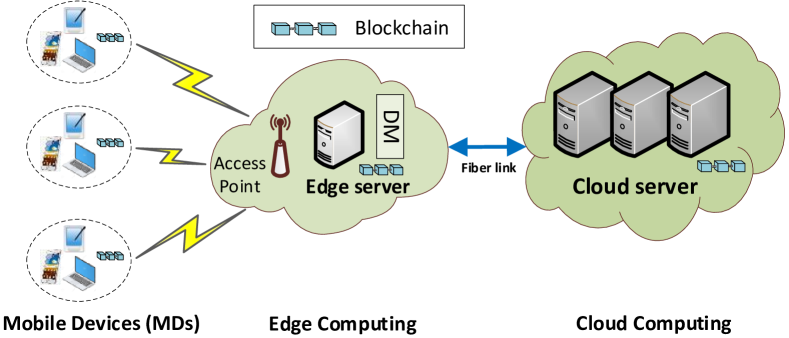
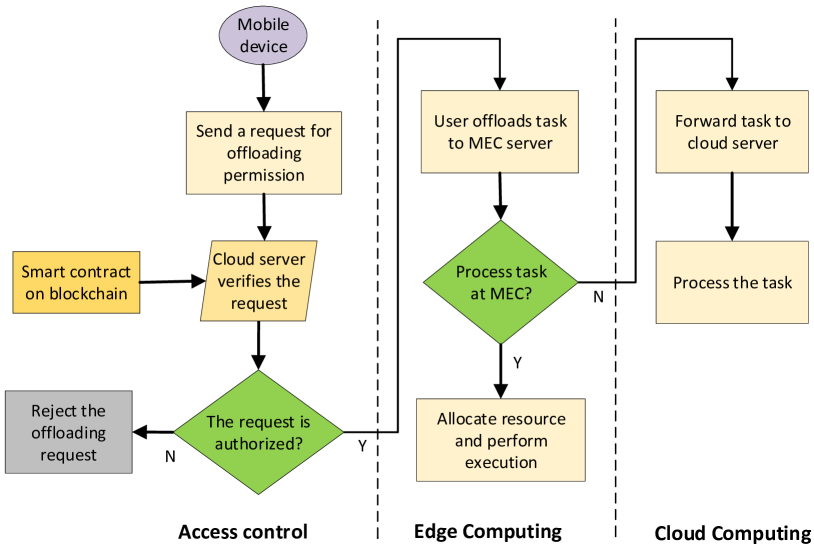
For current and future Internet of Things (IoT) networks, mobile edge-cloud computation offloading (MECCO) has been regarded as a promising means to support delay-sensitive IoT applications. However, offloading mobile tasks to the cloud is vulnerable to security issues due to malicious mobile devices (MDs). How to implement offloading to alleviate computation burdens at MDs while guaranteeing high security in mobile edge cloud is a challenging problem. In this paper, we investigate simultaneously the security and computation offloading problems in a multi-user MECCO system with blockchain. First, to improve the offloading security, we propose a trustworthy access control using blockchain, which can protect cloud resources against illegal offloading behaviours. Then, to tackle the computation management of authorized MDs, we formulate a computation offloading problem by jointly optimizing the offloading decisions, the allocation of computing resource and radio bandwidth, and smart contract usage. This optimization problem aims to minimize the long-term system costs of latency, energy consumption and smart contract fee among all MDs. To solve the proposed offloading problem, we develop an advanced deep reinforcement learning algorithm using a double-dueling Q-network. Evaluation results from real experiments and numerical simulations demonstrate the significant advantages of our scheme over existing approaches.
Motivation & Objective
- To address the security vulnerability of mobile edge-cloud computation offloading (MECCO) in IoT networks due to untrusted mobile devices (MDs).
- To design a trustworthy, decentralized access control mechanism using blockchain and smart contracts to prevent unauthorized offloading and protect cloud resources.
- To jointly optimize offloading decisions, edge resource allocation, radio bandwidth, and smart contract usage in a multi-user MECCO system.
- To minimize the long-term system cost, including computation latency, energy consumption, and smart contract fees, across all MDs.
Proposed method
- Proposes a blockchain-based access control system using smart contracts to authenticate and authorize MDs before offloading, ensuring trust and integrity.
- Formulates a joint optimization problem for offloading decisions, edge resource allocation, bandwidth allocation, and smart contract usage to minimize total system cost.
- Develops an advanced DRL algorithm using a double-dueling deep Q-network (DDQN) to learn optimal offloading policies in high-dimensional state-action spaces.
- Employs a double-dueling Q-network architecture to improve learning stability and convergence by decoupling value and advantage estimation.
- Uses real-world IoT data and simulations to train and evaluate the DRL agent in dynamic, multi-user MECCO environments.
- Compares the proposed ADRLO scheme against baselines: one without edge allocation and one without bandwidth allocation, to validate resource-aware optimization.
Experimental results
Research questions
- RQ1How can blockchain and smart contracts be leveraged to establish a trustworthy, decentralized access control mechanism for securing computation offloading in IoT networks?
- RQ2What is the optimal joint strategy for offloading decisions, edge resource allocation, bandwidth allocation, and smart contract usage to minimize total system cost in a multi-user MECCO environment?
- RQ3How does a deep reinforcement learning agent with a double-dueling Q-network architecture perform in learning optimal offloading policies under dynamic and high-dimensional constraints?
- RQ4To what extent does the proposed DRL-based scheme reduce system costs (latency, energy, smart contract fees) compared to conventional optimization and baseline DRL approaches?
Key findings
- The proposed ADRLO scheme achieves the lowest total offloading cost across all MDs by jointly optimizing offloading decisions, edge resources, and bandwidth allocation.
- Compared to baseline schemes without edge or bandwidth optimization, the ADRLO scheme reduces total offloading costs significantly, as shown in Fig. 11.
- The smart contract cost under ADRLO is consistently lower than the DRLO baseline across different numbers of MDs, due to an optimized learning policy that reduces redundant contract executions.
- The DRL-based ADRLO algorithm achieves an average execution latency of 5.891 seconds per offloading realization with 60 MDs, which is 5× and 14× faster than the RL and exhaustive search baselines, respectively.
- The double-dueling Q-network architecture enables stable and efficient learning in high-dimensional state-action spaces, overcoming the curse of dimensionality faced by table-based Q-learning.
- The proposed scheme outperforms existing works in intelligent offloading, advanced DRL design, smart contract integration, and blockchain-based offloading services, as summarized in Table III.
Read this paper
Open the full text in the Nubint reader and ask about any passage as you read.
Read this paper on NubintThis review was generated by AI from the original paper. Please check the paper before citing it.