
[Paper Review] Secure Semantic Communications: Fundamentals and Challenges
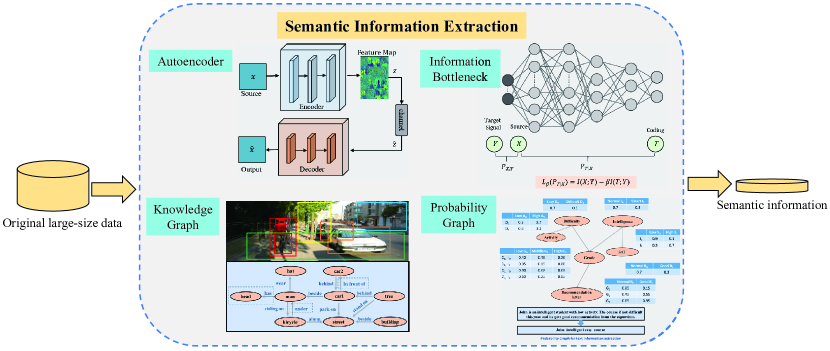
This paper presents a comprehensive framework for secure semantic communication by addressing two unique security challenges: information security and machine learning (ML) model security. It proposes methods to define semantic information using autoencoders, information bottleneck, knowledge graphs, and probability graphs, and outlines countermeasures against semantic adversarial samples, backdoors, data poisoning, and privacy leakage in ML-based semantic systems, offering a holistic guide for designing secure semantic communication in real-world wireless networks.
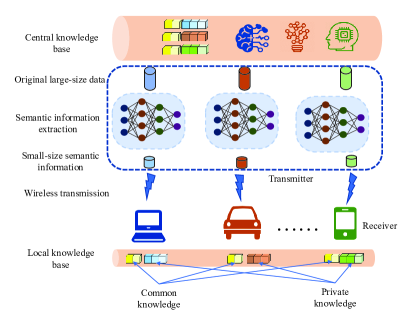
Semantic communication allows the receiver to know the intention instead of the bit information itself, which is an emerging technique to support real-time human-machine and machine-to-machine interactions for future wireless communications. In semantic communications, both transmitter and receiver share some common knowledge, which can be used to extract small-size information at the transmitter and recover the original information at the receiver. Due to different design purposes, security issues in semantic communications have two unique features compared to standard bit-wise communications. First, an attacker in semantic communications considers not only the amount of stolen data but also the meanings of stolen data. Second, an attacker in semantic communication systems can attack not only semantic information transmission as done in standard communication systems but also attacks machine learning (ML) models used for semantic information extraction since most of semantic information is generated using ML based methods. Due to these unique features, in this paper, we present an overview on the fundamentals and key challenges in the design of secure semantic communication. We first provide various methods to define and extract semantic information. Then, we focus on secure semantic communication techniques in two areas: information security and semantic ML model security. For each area, we identify the main problems and challenges. Then, we will provide a comprehensive treatment of these problems. In a nutshell,this article provides a holistic set of guidelines on how to design secure semantic communication systems over real-world wireless communication networks.
Motivation & Objective
- To address the unique security threats in semantic communication systems, which differ from traditional bit-wise communications by focusing on semantic meaning rather than just data quantity.
- To identify and analyze the dual security challenges in semantic communication: information security and machine learning model security.
- To provide a systematic overview of semantic information representation methods and their vulnerabilities in real-world deployment.
- To propose countermeasures for key threats such as adversarial examples, data poisoning, backdoors, and privacy leakage in ML-based semantic systems.
- To offer a unified design framework for secure semantic communication systems in future wireless networks.
Proposed method
- Uses four semantic information representation methods: autoencoders, information bottleneck (IB), knowledge graphs, and probability graphs, each with distinct advantages and limitations.
- Analyzes semantic communication systems as end-to-end frameworks where both transmitter and receiver share common knowledge to extract and reconstruct meaning.
- Identifies two main attack surfaces: (1) semantic information transmission and (2) ML models used for semantic extraction.
- Proposes countermeasures categorized into three branches: anti-poisoning (e.g., trigger inversion, data-free knowledge distillation), adversarial robustness (e.g., adversarial training, differential privacy), and privacy preservation (e.g., federated learning, confidential computing).
- Integrates model watermarking and authentication techniques to protect intellectual property in ML-based semantic systems.
- Maps known threats and countermeasures across the ML lifecycle using a visual framework (Fig. 5), highlighting attack vectors at training, inference, and deployment stages.
Experimental results
Research questions
- RQ1How can semantic information be formally defined and extracted using machine learning-based methods such as autoencoders and information bottleneck?
- RQ2What are the unique security threats in semantic communication that do not exist in traditional bit-wise communication systems?
- RQ3How do adversarial examples, backdoors, and data poisoning specifically compromise the integrity and confidentiality of semantic ML models?
- RQ4What are the most effective countermeasures for securing ML models used in semantic communication, especially in black-box and real-world deployment scenarios?
- RQ5How can privacy leakage be prevented when transmitting or storing semantic representations derived from sensitive data?
Key findings
- Semantic communication systems face dual security threats: attacks on transmitted semantic content and attacks on the underlying ML models used to extract meaning.
- Traditional security models are insufficient for semantic systems because attackers target not just data volume but also semantic meaning, making semantic integrity a critical concern.
- Adversarial examples and backdoors in vision transformers and other deep models pose significant risks to real-time semantic communication systems.
- Anti-poisoning techniques such as trigger inversion and data-free knowledge distillation are effective in black-box settings where model training access is unavailable.
- Differential privacy and federated learning help preserve privacy but may reduce model accuracy, highlighting a trade-off in secure design.
- Model watermarking and authentication are essential for protecting intellectual property in commercial semantic communication systems.
Read this paper
Open the full text in the Nubint reader and ask about any passage as you read.
Read this paper on NubintThis review was generated by AI from the original paper. Please check the paper before citing it.