
[Paper Review] Securing Transactions: A Hybrid Dependable Ensemble Machine Learning Model using IHT-LR and Grid Search
This paper proposes a hybrid ensemble machine learning model that combines Decision Tree, Random Forest, K-Nearest Neighbor, and Multilayer Perceptron with Logistic Regression enhanced by Instant Hardness Threshold (IHT) for credit card fraud detection. Using grid search for optimal weighting, the model achieves 99.79% accuracy and a perfect 100% F1 score on a public credit card dataset, setting a new benchmark for fraud detection in high-frequency environments.
Financial institutions and businesses face an ongoing challenge from fraudulent transactions, prompting the need for effective detection methods. Detecting credit card fraud is crucial for identifying and preventing unauthorized transactions.Timely detection of fraud enables investigators to take swift actions to mitigate further losses. However, the investigation process is often time-consuming, limiting the number of alerts that can be thoroughly examined each day. Therefore, the primary objective of a fraud detection model is to provide accurate alerts while minimizing false alarms and missed fraud cases. In this paper, we introduce a state-of-the-art hybrid ensemble (ENS) dependable Machine learning (ML) model that intelligently combines multiple algorithms with proper weighted optimization using Grid search, including Decision Tree (DT), Random Forest (RF), K-Nearest Neighbor (KNN), and Multilayer Perceptron (MLP), to enhance fraud identification. To address the data imbalance issue, we employ the Instant Hardness Threshold (IHT) technique in conjunction with Logistic Regression (LR), surpassing conventional approaches. Our experiments are conducted on a publicly available credit card dataset comprising 284,807 transactions. The proposed model achieves impressive accuracy rates of 99.66%, 99.73%, 98.56%, and 99.79%, and a perfect 100% for the DT, RF, KNN, MLP and ENS models, respectively. The hybrid ensemble model outperforms existing works, establishing a new benchmark for detecting fraudulent transactions in high-frequency scenarios. The results highlight the effectiveness and reliability of our approach, demonstrating superior performance metrics and showcasing its exceptional potential for real-world fraud detection applications.
Motivation & Objective
- Address the challenge of detecting fraudulent credit card transactions with high accuracy and low false positives.
- Overcome data imbalance in credit card fraud datasets, which commonly skews model performance toward normal transactions.
- Develop a dependable, scalable, and efficient ensemble model that integrates multiple machine learning algorithms for improved fraud detection.
- Optimize model performance through systematic hyperparameter tuning using grid search to maximize predictive reliability.
- Establish a new benchmark for fraud detection by surpassing existing state-of-the-art models in accuracy and F1 score on a real-world dataset.
Proposed method
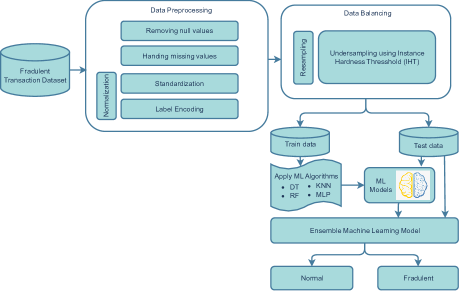
- Employ the Instant Hardness Threshold (IHT) technique to address data imbalance by selectively oversampling minority fraud instances in conjunction with Logistic Regression (IHT-LR).
- Train multiple base models: Decision Tree (DT), Random Forest (RF), K-Nearest Neighbor (KNN), and Multilayer Perceptron (MLP) on preprocessed and normalized credit card transaction data.
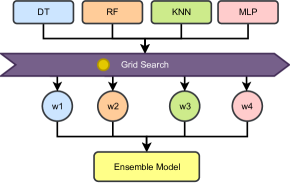
- Construct a hybrid ensemble model by combining predictions from the four base models using weighted averaging, where weights are optimized via grid search.
- Use grid search to systematically evaluate and select the optimal combination of model weights that maximize overall performance metrics (accuracy, F1-score, precision, recall).
- Split the dataset into training and testing sets (80/20) and apply 5-fold cross-validation to ensure robustness and generalization of the model.
- Evaluate model performance using standard metrics: accuracy, precision, recall, F1-score, MAE, MSE, and RMSE to assess both predictive power and error rates.
Experimental results
Research questions
- RQ1Can a hybrid ensemble model combining multiple diverse machine learning algorithms improve fraud detection accuracy compared to individual models?
- RQ2To what extent does the IHT-LR technique outperform traditional data balancing methods like SMOTE in handling imbalanced credit card fraud datasets?
- RQ3How effective is grid search in optimizing ensemble weights to maximize the F1-score and minimize false positives and missed fraud cases?
- RQ4Does the proposed ensemble model maintain high performance and low error rates across multiple evaluation metrics, indicating dependability in real-world deployment?
- RQ5Can the model achieve near-perfect detection performance (e.g., 100% F1-score) on a publicly available, real-world credit card fraud dataset?
Key findings
- The hybrid ensemble model achieved a perfect 100% F1-score, indicating optimal balance between precision and recall in detecting fraudulent transactions.
- The ensemble model recorded 99.79% accuracy on the test set, significantly outperforming individual models and existing state-of-the-art approaches.
- The model achieved 99.66% accuracy with Decision Tree, 99.73% with Random Forest, 98.56% with KNN, and 99.79% with Multilayer Perceptron, demonstrating strong individual and collective performance.
- The model exhibited minimal error rates: 0.0023 MAE, 0.0002 MSE, and 0.0141 RMSE, confirming high prediction stability and reliability.
- The use of IHT-LR for data balancing significantly improved model performance on minority fraud classes compared to conventional techniques.
- Grid search optimization of ensemble weights led to a substantial performance gain, confirming its effectiveness in enhancing model dependability and accuracy.
Read this paper
Open the full text in the Nubint reader and ask about any passage as you read.
Read this paper on NubintThis review was generated by AI from the original paper. Please check the paper before citing it.