
[Paper Review] Security Analysis of Filecoin's Expected Consensus in the Byzantine vs Honest Model
This paper provides the first formal security analysis of Filecoin's Expected Consensus (EC), proving it is secure against Byzantine adversaries controlling up to a threshold of βm < 1 − e^{-(1−β)m} of total storage power, with m=5 in practice. It identifies the n-split attack as a critical vulnerability when βm ≥ 1 − e^{-(1−β)m}, demonstrating the threshold is tight, and proposes two fixes—consistent broadcast and a modified block selection mechanism—of which consistent broadcast is being implemented as a Filecoin Improvement Proposal (FIP).
Filecoin is the largest storage-based open-source blockchain, both by storage capacity (>11EiB) and market capitalization. This paper provides the first formal security analysis of Filecoin's consensus (ordering) protocol, Expected Consensus (EC). Specifically, we show that EC is secure against an arbitrary adversary that controls a fraction $β$ of the total storage for $βm< 1- e^{-(1-β)m}$, where $m$ is a parameter that corresponds to the expected number of blocks per round, currently $m=5$ in Filecoin. We then present an attack, the $n$-split attack, where an adversary splits the honest miners between multiple chains, and show that it is successful for $βm \ge 1- e^{-(1-β)m}$, thus proving that $βm= 1- e^{-(1-β)m}$ is the tight security threshold of EC. This corresponds roughly to an adversary with $20\%$ of the total storage pledged to the chain. Finally, we propose two improvements to EC security that would increase this threshold. One of these two fixes is being implemented as a Filecoin Improvement Proposal (FIP).
Motivation & Objective
- To formally analyze the security of Filecoin’s Expected Consensus (EC) under a Byzantine adversary model.
- To identify the exact threshold of adversarial storage power (β) beyond which EC becomes insecure.
- To propose and evaluate practical improvements to EC’s security, particularly against novel attacks like the n-split attack.
- To establish a foundation for future work on incentive compatibility, dynamic networks, and complex weight functions in EC.
Proposed method
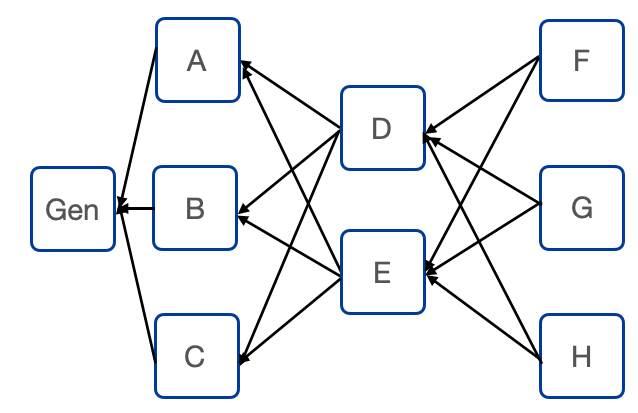
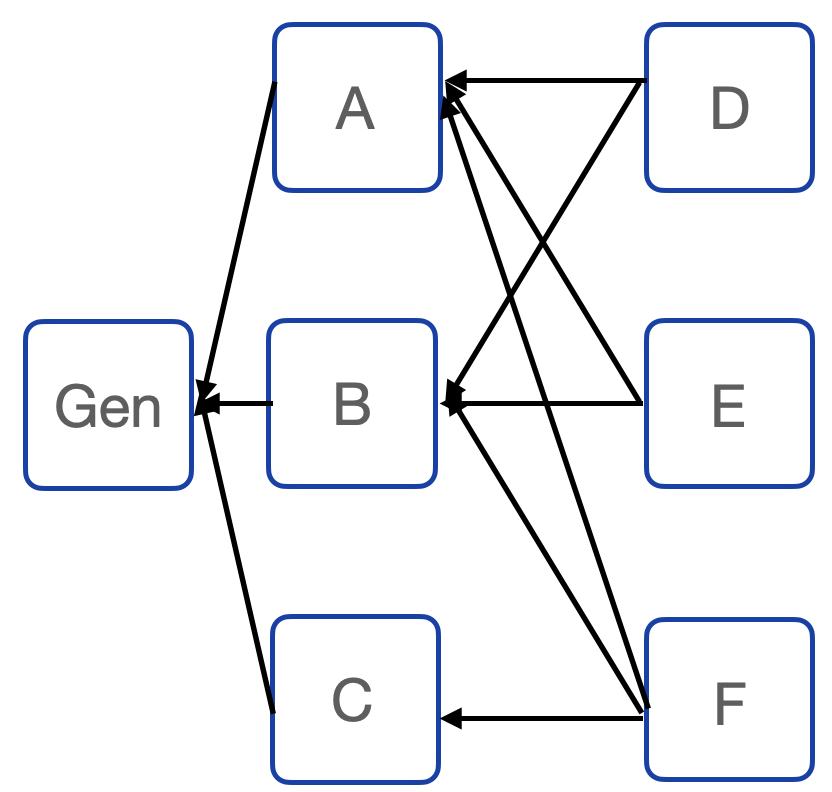
- Extends proof techniques from prior work [14] to analyze EC’s security in a DAG-based, tipset-based consensus model.
- Models EC as a stochastic process where block creation per round is Poisson-distributed with mean m=5, and derives the probability of adversarial chain growth.
- Introduces a sufficient condition for a block to remain in the main chain forever, accounting for DAG structure and tipset dependencies.
- Proposes consistent broadcast as a mitigation to prevent equivocation, ensuring all honest nodes agree on block validity.
- Analyzes the n-split attack, where an adversary splits honest miners across multiple chains to create competing heaviest chains.
- Evaluates the impact of a non-equivocating adversary on the security threshold, hypothesizing a higher threshold (~40%) under such conditions.
Experimental results
Research questions
- RQ1What is the exact security threshold for Expected Consensus under a Byzantine adversary controlling β fraction of storage power?
- RQ2How does the n-split attack exploit EC’s tipset structure to undermine chain consistency?
- RQ3Can consistent broadcast effectively prevent equivocation and mitigate the n-split attack in EC?
- RQ4What is the impact of a non-equivocating adversary on EC’s security threshold, and how does it compare to the equivocating case?
- RQ5How do simplifying assumptions—such as static weights and synchronous networks—affect the validity and generalizability of the security analysis?
Key findings
- The security threshold for Expected Consensus is tightly bounded at βm = 1 − e^{-(1−β)m}, with m=5 in Filecoin, corresponding to approximately 20% adversarial storage power.
- The n-split attack is successful when βm ≥ 1 − e^{-(1−β)m}, proving that this threshold is tight and cannot be exceeded without breaking security.
- The proposed mitigation using consistent broadcast is formally sound and is being implemented as a Filecoin Improvement Proposal (FIP).
- With consistent broadcast, the adversary’s ability to equivocate is eliminated, significantly increasing the difficulty of launching a successful n-split attack.
- Under a non-equivocating adversary, the security threshold is hypothesized to rise to approximately 40% for m=5, though a formal proof remains open.
- The current analysis assumes static weights and synchronous networks; future work is needed to extend results to dynamic, asynchronous, and incentive-compatible models.
Read this paper
Open the full text in the Nubint reader and ask about any passage as you read.
Read this paper on NubintThis review was generated by AI from the original paper. Please check the paper before citing it.