
[Paper Review] Security and Privacy Challenges of Large Language Models: A Survey
A comprehensive survey of security and privacy challenges in large language models, detailing attack types (prompt hacking, jailbreaking, adversarial, data poisoning, PII leakage) and defense mechanisms, across training and application domains.
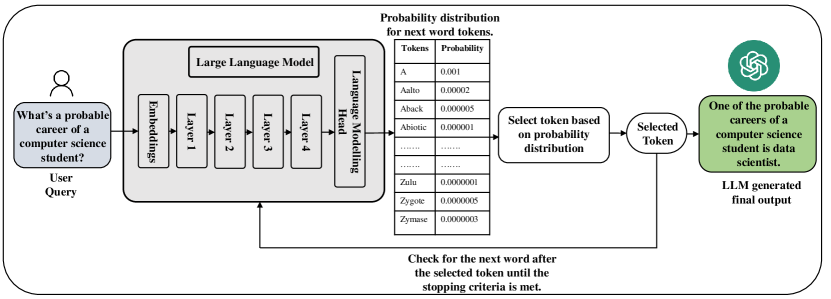
Large Language Models (LLMs) have demonstrated extraordinary capabilities and contributed to multiple fields, such as generating and summarizing text, language translation, and question-answering. Nowadays, LLM is becoming a very popular tool in computerized language processing tasks, with the capability to analyze complicated linguistic patterns and provide relevant and appropriate responses depending on the context. While offering significant advantages, these models are also vulnerable to security and privacy attacks, such as jailbreaking attacks, data poisoning attacks, and Personally Identifiable Information (PII) leakage attacks. This survey provides a thorough review of the security and privacy challenges of LLMs for both training data and users, along with the application-based risks in various domains, such as transportation, education, and healthcare. We assess the extent of LLM vulnerabilities, investigate emerging security and privacy attacks for LLMs, and review the potential defense mechanisms. Additionally, the survey outlines existing research gaps in this domain and highlights future research directions.
Motivation & Objective
- Provide a thorough review of security and privacy issues in LLMs for training data and users.
- categorize and analyze existing attacks and defenses targeting LLMs.
- Identify application-specific risks and real-world implications across domains such as transportation, education, and healthcare.
- Highlight research gaps and propose future directions for evaluation protocols and defenses.
Proposed method
- Systematic literature review of recent work on LLM security and privacy.
- Taxonomy development of security and privacy attacks and defenses for LLMs.
- Comparison with existing surveys to highlight novel contributions and gaps.
- Discussion of domain-specific risks and practical mitigation strategies.
- Outlining future research directions and open challenges.
Experimental results
Research questions
- RQ1What are the main security attacks targeting LLMs and their characteristics?
- RQ2What are the main privacy risks associated with LLMs and how can they be mitigated?
- RQ3What defense mechanisms exist against known attacks, and how effective are they?
- RQ4What application-specific risks do LLMs pose in domains like healthcare, education, and transportation?
- RQ5What are the gaps and future directions for evaluating and securing LLMs?
Key findings
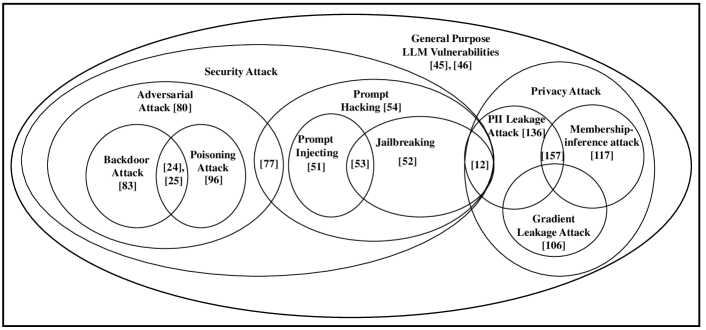
- The paper provides a comprehensive taxonomy of security and privacy attacks on LLMs, including prompt hacking, jailbreaking, backdoors, data poisoning, gradient leakage, membership inference, and PII leakage.
- It discusses a range of defense mechanisms and mitigation strategies for different attack classes.
- The survey compares recent works and identifies research gaps and limitations in current defenses and evaluation protocols.
- It emphasizes the growing need for secure and privacy-preserving human–LLM interactions as LLMs scale and proliferate across domains.
- The paper highlights application-specific risks and the importance of domain-aware security/privacy architectures.
Read this paper
Open the full text in the Nubint reader and ask about any passage as you read.
Read this paper on NubintThis review was generated by AI from the original paper. Please check the paper before citing it.