
[Paper Review] Security Enhancement for Coupled Phase-Shift STAR-RIS Networks
This paper proposes a penalty-based secrecy beamforming (PSB) algorithm for coupled phase-shift STAR-RIS networks to maximize the minimum secrecy capacity among indoor and outdoor users, ensuring fairness and security. The method jointly optimizes transmit beamforming and phase-shift coefficients under phase coupling constraints, achieving near-continuous phase-shift performance with only 4-bit quantization.
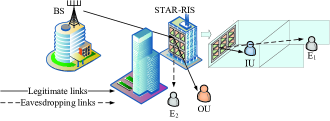
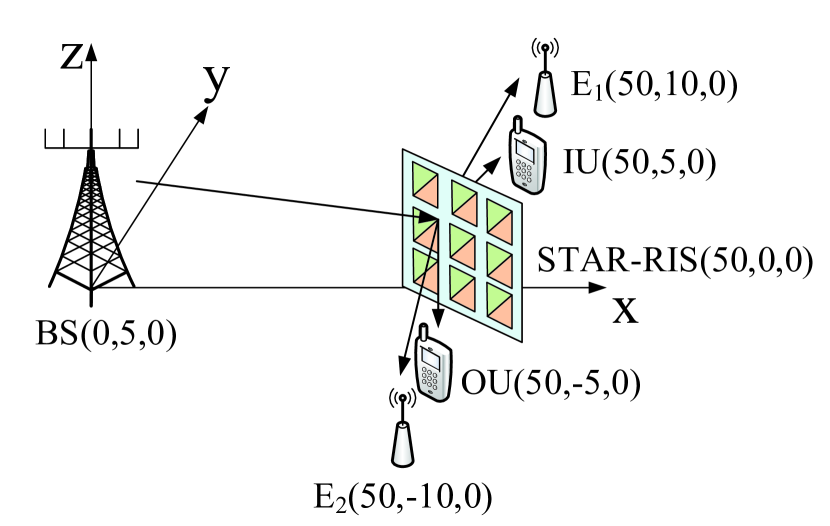
The secure transmission of the simultaneously transmitting and reflecting reconfigurable intelligent surface (STAR-RIS) aided communication system is investigated. Considering the coupled phase shifts of STAR-RISs and the fair secrecy requirement of users, a novel secure beamforming design is proposed for addressing the unique full-space mutual eavesdropping of STAR-RIS aided communication. In particular, a penalty based secrecy beamforming algorithm is developed to solve the resulting non-convex optimization problem, where the closed-form solutions of the coupled transmission/reflection coefficients are obtained in each iteration. Numerical results demonstrate that 1) the proposed scheme achieves higher secrecy capacity than conventional RIS; 2) 4-bit discrete phase shifters are sufficient for secrecy guarantee.
Motivation & Objective
- To address the security challenge in STAR-RIS networks where full-space eavesdropping increases due to simultaneous transmission and reflection.
- To design a secure beamforming scheme that ensures fairness in secrecy capacity between indoor and outdoor users under coupled phase-shift constraints.
- To develop an optimization framework that jointly designs transmit beamforming and STAR-RIS reflection/transmission coefficients under practical phase coupling and quantization.
- To evaluate the secrecy performance gain of STAR-RIS over conventional RIS and determine the minimum phase quantization bits required for near-optimal performance.
Proposed method
- A penalty-based secrecy beamforming (PSB) algorithm is proposed to solve the non-convex optimization problem with coupled phase-shift constraints.
- The algorithm uses an augmented Lagrangian (AL) relaxation in the outer loop to handle the coupled phase-shift constraints.
- In the inner loop, semidefinite relaxation (SDR) is applied to obtain rank-one transmit beamforming vectors.
- First-order optimality conditions are used to derive closed-form solutions for the coupled transmission and reflection coefficients.
- The method ensures convergence and maintains fairness by maximizing the minimum secrecy capacity across both users.
- The system model assumes Rician fading channels and employs a joint optimization of beamforming and STAR-RIS phase shifts under power and phase coupling constraints.
Experimental results
Research questions
- RQ1How can physical layer security be enhanced in STAR-RIS networks with coupled phase shifts, where transmission and reflection coefficients are inherently linked?
- RQ2What is the optimal beamforming strategy that maximizes the minimum secrecy capacity between indoor and outdoor users under fairness constraints?
- RQ3How does phase quantization affect secrecy performance in coupled phase-shift STAR-RIS systems?
- RQ4What is the performance gap between continuous phase shifts and discrete phase shifts in terms of secrecy capacity?
Key findings
- The proposed PSB algorithm achieves higher secrecy capacity than conventional RIS, demonstrating the superiority of STAR-RIS in secure communication.
- The scheme ensures fairness by maximizing the minimum secrecy capacity between the indoor and outdoor users.
- With only 4-bit phase quantization, the discrete STAR-RIS achieves secrecy performance comparable to continuous phase shifts.
- The coupled phase-shift STAR-RIS outperforms conventional RIS and random phase-shift schemes, though it slightly lags behind independent phase-shift STAR-RIS due to phase coupling.
- Time-switching (TS) schemes outperform energy-splitting (ES) schemes in low transmit power regions due to interference-free decoding, while ES performs better at high power due to better time utilization.
- Deploying STAR-RIS at the user end yields higher secrecy performance due to reduced path loss in the cascaded links.
Better researchstarts right now
From reading papers to final review, dramatically reduce your research time.
No credit card · Free plan available
This review was created by AI and reviewed by human editors.