
[Paper Review] SEED-Bench-2: Benchmarking Multimodal Large Language Models
SEED-Bench-2 introduces a comprehensive, hierarchical benchmark for evaluating multimodal large language models (MLLMs) across five capability levels (L₀ to L₄), with a focus on assessing understanding and generation of interleaved image-text inputs up to L₃. It comprises 24,371 human-annotated multiple-choice questions across 27 dimensions, enabling objective, GPT-free evaluation of both text and image generation, revealing critical limitations in current MLLMs and guiding future AGI research.
Multimodal large language models (MLLMs), building upon the foundation of powerful large language models (LLMs), have recently demonstrated exceptional capabilities in generating not only texts but also images given interleaved multimodal inputs (acting like a combination of GPT-4V and DALL-E 3). However, existing MLLM benchmarks remain limited to assessing only models' comprehension ability of single image-text inputs, failing to keep up with the strides made in MLLMs. A comprehensive benchmark is imperative for investigating the progress and uncovering the limitations of current MLLMs. In this work, we categorize the capabilities of MLLMs into hierarchical levels from $L_0$ to $L_4$ based on the modalities they can accept and generate, and propose SEED-Bench-2, a comprehensive benchmark that evaluates the extbf{hierarchical} capabilities of MLLMs. Specifically, SEED-Bench-2 comprises 24K multiple-choice questions with accurate human annotations, which spans 27 dimensions, including the evaluation of both text and image generation. Multiple-choice questions with groundtruth options derived from human annotation enables an objective and efficient assessment of model performance, eliminating the need for human or GPT intervention during evaluation. We further evaluate the performance of 23 prominent open-source MLLMs and summarize valuable observations. By revealing the limitations of existing MLLMs through extensive evaluations, we aim for SEED-Bench-2 to provide insights that will motivate future research towards the goal of General Artificial Intelligence. Dataset and evaluation code are available at \href{https://github.com/AILab-CVC/SEED-Bench}
Motivation & Objective
- To address the gap in existing benchmarks that only evaluate single-image text comprehension, failing to keep pace with the evolving capabilities of multimodal LLMs.
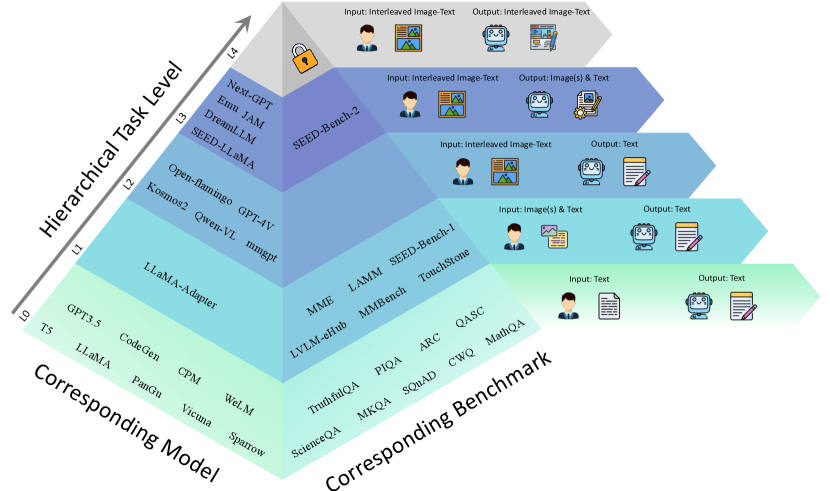
- To propose a hierarchical framework (L₀ to L₄) that systematically categorizes MLLM capabilities based on input and output modalities.
- To develop a scalable, objective evaluation benchmark that eliminates reliance on GPT or human judgment during inference by using human-verified ground-truth answers.
- To comprehensively evaluate 23 open-source MLLMs across diverse multimodal reasoning and generation tasks, uncovering key limitations in current models.
Proposed method
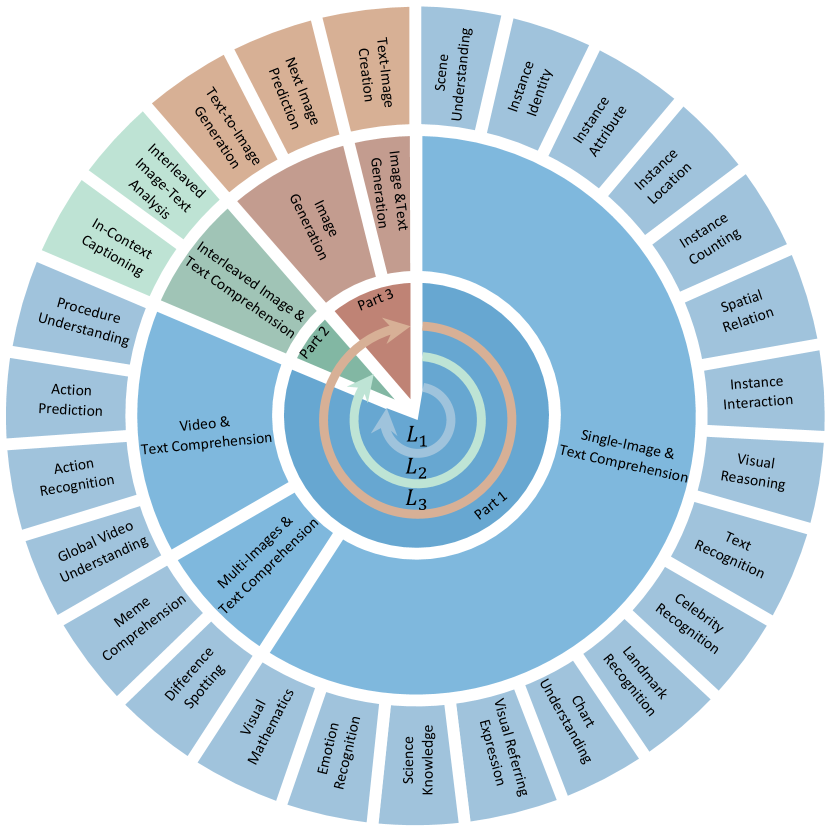
- The benchmark is structured into three parts: Part-1 evaluates L₁ (image and text comprehension), Part-1&2 evaluate L₂ (interleaved image-text comprehension), and Part-1&2&3 evaluate L₃ (image and text generation).
- Multiple-choice questions are automatically generated using GPT-4 and ChatGPT, guided by visual information extracted via BLIP2, Tag2Text, SAM, and PaddleOCR for image captions, instance descriptions, and textual elements.
- A three-stage filtering pipeline ensures visual grounding: LLMs (Vicuna-7B, Flan-T5-XXL, LLaMA-7B) are used to filter out questions answerable without images, reducing non-visual questions by 5.52%.
- Human annotators verify all question-answer pairs, selecting correct options and assigning dimensions, discarding ambiguous, incorrect, or multiple-correct questions.
- The final benchmark includes 24,371 questions with human-verified answers, ensuring objectivity and eliminating the need for GPT-based or human evaluation during model inference.
- Evaluation is conducted on 23 open-source MLLMs, with performance reported across 27 dimensions and hierarchical levels (L₁ to L₃).
Experimental results
Research questions
- RQ1How do current MLLMs perform across a hierarchical spectrum of multimodal capabilities, from basic comprehension to complex image and text generation?
- RQ2To what extent can existing MLLMs generate accurate images and coherent text from interleaved multimodal inputs, especially in reasoning and visual understanding tasks?
- RQ3How do different MLLMs compare in generating grounded, multimodal outputs when evaluated on a large-scale, human-annotated benchmark without GPT or human intervention?
- RQ4What are the key limitations of current MLLMs in generating multimodal content, particularly in complex reasoning and visual grounding tasks?
Key findings
- SEED-Bench-2 evaluates 23 open-source MLLMs across 27 dimensions and three hierarchical levels (L₁ to L₃), with the largest benchmark to date at 24,371 human-annotated multiple-choice questions.
- The best-performing model, SEED-LLaMA (13B), achieved a score of 65.8 on the L₃ part, indicating progress in multimodal generation, but still far from human-level performance.
- Only 36.7% of models scored above 40% on the L₃ generation tasks, revealing significant limitations in current MLLMs' ability to generate accurate, coherent images and text from interleaved inputs.
- The automatic filtering pipeline successfully removed 5.52% of questions that could be answered without visual input, ensuring that only visually grounded questions remain in the benchmark.
- SEED-Bench-2 outperforms prior benchmarks in scale and scope, with 8× more questions than MMBench and 10× more than MME, enabling more robust and reliable model evaluation.
- The benchmark reveals that current MLLMs struggle most with complex reasoning and visual grounding in generation tasks, highlighting a key research gap toward AGI.
Read this paper
Open the full text in the Nubint reader and ask about any passage as you read.
Read this paper on NubintThis review was generated by AI from the original paper. Please check the paper before citing it.