
[Paper Review] SEEDS: Emulation of Weather Forecast Ensembles with Diffusion Models
SEEDS uses diffusion models to generate large, weather-like forecast ensembles conditioned on a few operational forecasts, achieving comparable or better predictive skill with vastly reduced compute.
Uncertainty quantification is crucial to decision-making. A prominent example is probabilistic forecasting in numerical weather prediction. The dominant approach to representing uncertainty in weather forecasting is to generate an ensemble of forecasts. This is done by running many physics-based simulations under different conditions, which is a computationally costly process. We propose to amortize the computational cost by emulating these forecasts with deep generative diffusion models learned from historical data. The learned models are highly scalable with respect to high-performance computing accelerators and can sample hundreds to tens of thousands of realistic weather forecasts at low cost. When designed to emulate operational ensemble forecasts, the generated ones are similar to physics-based ensembles in important statistical properties and predictive skill. When designed to correct biases present in the operational forecasting system, the generated ensembles show improved probabilistic forecast metrics. They are more reliable and forecast probabilities of extreme weather events more accurately. While this work demonstrates the utility of the methodology by focusing on weather forecasting, the generative artificial intelligence methodology can be extended for uncertainty quantification in climate modeling, where we believe the generation of very large ensembles of climate projections will play an increasingly important role in climate risk assessment.
Motivation & Objective
- Quantify forecast uncertainty in numerical weather prediction via large ensembles.
- Develop a scalable generative method that emulates physics-based ensemble distributions from limited seeds.
- Enable post-processing to debias ensembles by mixing with alternative data sources.
- Demonstrate that generated ensembles match or exceed physics-based ensembles in key skill metrics.
- Assess reliability and extreme-event representation in the generated ensembles.
Proposed method
- Train diffusion-based generative models conditioned on K seed forecasts to produce N>K weather-state samples.
- Represent atmospheric data as standardized anomalies on a cubed-sphere grid and use a ViT-inspired score network with axial attention.
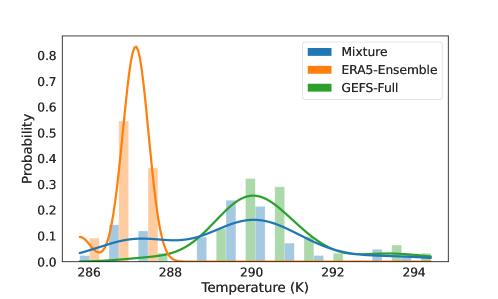
- Two learning tasks: generative ensemble emulation (emulate p(v) from seeds) and generative post-processing (approximate α p(v) + (1−α) p′(v)).
- Use 20 years of GEFS reforecasts and ERA5 reanalysis data for training and evaluation.
- Evaluate using rank histograms, RMSE, ACC, CRPS, and extreme-event (±2σ) skill against ERA5-HRES ground truth.
Experimental results
Research questions
- RQ1Can a diffusion-based emulator generate large ensembles that reproduce the statistical properties of physics-based GEFS ensembles from a small set of seed forecasts?
- RQ2Does generative post-processing (mixture with ERA5 data) improve reliability and extreme-event forecasting compared to the physics-based ensemble alone?
- RQ3How do generated ensembles compare to ground truth in terms of spatial coherence, multivariate correlations, and spectral characteristics?
- RQ4What is the computational efficiency gain when generating hundreds to thousands of ensemble members using SEEDS?
Key findings
- Generated ensembles (seeds-gee and seeds-gpp) achieve weather-like samples with covariance structures and energy spectra similar to GEFS-full and ERA5, including realistic spatial patterns.
- Seeds-gee attains comparable skill to gefs-full across RMSE, ACC, and CRPS, while seeds-gpp often surpasses gefs-full in near-surface temperature and extreme-event coverage.
- Generative post-processing (seeds-gpp) provides highest reliability (lower rank-histogram unreliability δ) and better extreme-event classification (Brier scores) than the full physics-based ensemble.
- The models can generate 512 members with negligible additional compute (3 minutes per batch on TPUv3) using only 2 seed forecasts, enabling very large ensembles.
- Generated ensembles capture tail events better, expanding envelopes beyond the seeds and facilitating uncertainty quantification for rare events.
- Across lead times up to 16 days, generative ensembles show strong correlation with the full GEFS ensemble, indicating they learn dynamics beyond simple climatology.

Read this paper
Open the full text in the Nubint reader and ask about any passage as you read.
Read this paper on NubintThis review was generated by AI from the original paper. Please check the paper before citing it.