
[Paper Review] Seeing the Intangible: Survey of Image Classification into High-Level and Abstract Categories
This survey systematically reviews computer vision research on detecting abstract social concepts (ASCs) from still images, such as emotions, values, and ideologies, by analyzing their semantic, cognitive, and visual representation. It identifies key tasks and clusters—like visual sentiment analysis, social signal processing, and visual rhetoric—demonstrating that while explicit ASC detection is rare, many existing CV tasks implicitly address high-level visual understanding, revealing a significant gap in dedicated research on abstract concept recognition.
The field of Computer Vision (CV) is increasingly shifting towards ``high-level'' visual sensemaking tasks, yet the exact nature of these tasks remains unclear and tacit. This survey paper addresses this ambiguity by systematically reviewing research on high-level visual understanding, focusing particularly on Abstract Concepts (ACs) in automatic image classification. Our survey contributes in three main ways: Firstly, it clarifies the tacit understanding of high-level semantics in CV through a multidisciplinary analysis, and categorization into distinct clusters, including commonsense, emotional, aesthetic, and inductive interpretative semantics. Secondly, it identifies and categorizes computer vision tasks associated with high-level visual sensemaking, offering insights into the diverse research areas within this domain. Lastly, it examines how abstract concepts such as values and ideologies are handled in CV, revealing challenges and opportunities in AC-based image classification. Notably, our survey of AC image classification tasks highlights persistent challenges, such as the limited efficacy of massive datasets and the importance of integrating supplementary information and mid-level features. We emphasize the growing relevance of hybrid AI systems in addressing the multifaceted nature of AC image classification tasks. Overall, this survey enhances our understanding of high-level visual reasoning in CV and lays the groundwork for future research endeavors.
Motivation & Objective
- To address the scarcity of explicit research on automatic detection of abstract social concepts (ASCs) in computer vision.
- To identify and cluster high-level visual understanding tasks that implicitly deal with ASCs, such as emotions, values, and ideologies.
- To provide a multidisciplinary framework integrating computer science, visual studies, and cognitive science for understanding abstract concepts in images.
- To map existing CV work on ASCs across semantic categories, tasks, datasets, and neural network approaches.
- To highlight the potential of ASC detection for applications in cultural heritage, multimedia retrieval, and interactive systems.
Proposed method
- Conduct a systematic literature review of CV works that implicitly or explicitly address abstract social concepts in still images.
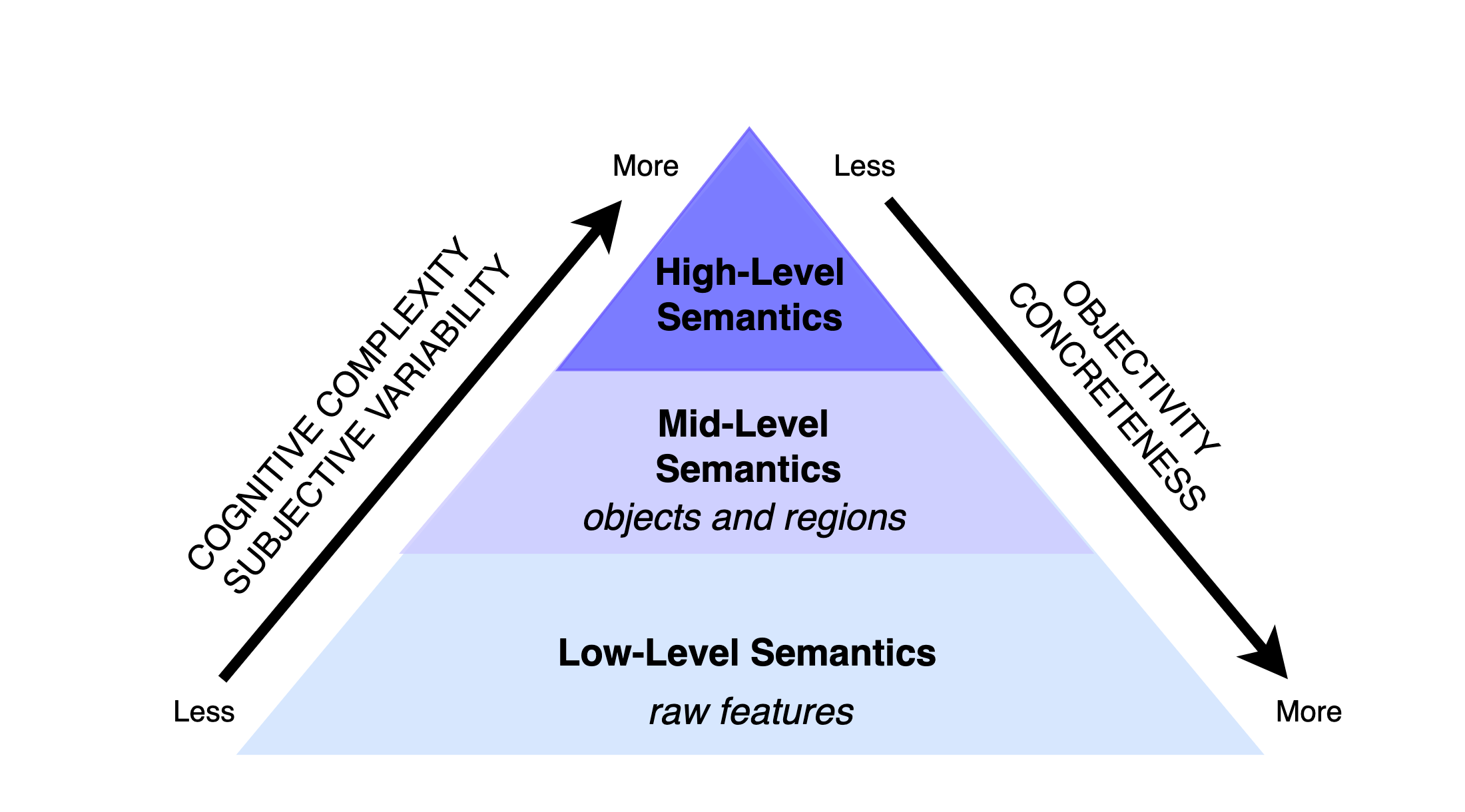
- Categorize high-level visual semantics into five clusters: event understanding, visual sentiment analysis, aesthetic analysis, social signal processing, and visual rhetorical analysis.
- Analyze the semantic elements and tasks within each cluster using a multidisciplinary lens combining computer vision, cognitive science, and visual studies.
- Map existing datasets and deep learning models used in ASC-related tasks, identifying gaps in data and methodology.
- Use cognitive theory (e.g., Words As Tools) to ground the conceptual framework of abstract concepts in human perception and social cognition.
- Cluster and compare works based on their focus on perceptual features, social context, and cultural coding, especially in relation to connotation (Barthes).
Experimental results
Research questions
- RQ1What are the key semantic elements of high-level visual understanding that correspond to abstract social concepts in still images?
- RQ2Which computer vision tasks implicitly or explicitly address the detection of abstract social concepts, and how are they structured?
- RQ3How do existing datasets and neural network architectures support or limit the recognition of abstract concepts in images?
- RQ4What are the main challenges in detecting abstract concepts due to their lack of unique perceptual referents and cultural variability?
- RQ5How can multidisciplinary perspectives from cognitive science and visual studies improve the design of ASC detection systems?
Key findings
- The field of computer vision lacks dedicated research on explicit abstract concept detection, despite its centrality to full image understanding.
- Many existing CV tasks—such as visual sentiment analysis, social signal processing, and visual rhetoric—implicitly deal with abstract social concepts, especially emotions and social values.
- Abstract concepts like freedom, consumerism, or racism are not perceptually bounded and rely on culturally coded features, making them difficult to detect with standard CV methods.
- The semantic gap is exacerbated for abstract concepts due to their reliance on low-level, ambiguous features and variable interpretation across individuals and cultures.
- Social signal processing tasks, such as detecting leadership or social cohesion in group images, represent a growing area of implicit ASC detection with practical applications.
- Despite progress in image classification and generation, automatic recognition of abstract concepts remains underdeveloped, indicating a critical research gap in high-level visual understanding.

Read this paper
Open the full text in the Nubint reader and ask about any passage as you read.
Read this paper on NubintThis review was generated by AI from the original paper. Please check the paper before citing it.