
[Paper Review] SEGA: Instructing Text-to-Image Models using Semantic Guidance
SEGA introduces semantic guidance for diffusion-based text-to-image models, enabling zero-shot, architecture-agnostic, and multi-concept edits by manipulating sparse dimensions of the noise-estimate space without retraining.
Text-to-image diffusion models have recently received a lot of interest for their astonishing ability to produce high-fidelity images from text only. However, achieving one-shot generation that aligns with the user's intent is nearly impossible, yet small changes to the input prompt often result in very different images. This leaves the user with little semantic control. To put the user in control, we show how to interact with the diffusion process to flexibly steer it along semantic directions. This semantic guidance (SEGA) generalizes to any generative architecture using classifier-free guidance. More importantly, it allows for subtle and extensive edits, changes in composition and style, as well as optimizing the overall artistic conception. We demonstrate SEGA's effectiveness on both latent and pixel-based diffusion models such as Stable Diffusion, Paella, and DeepFloyd-IF using a variety of tasks, thus providing strong evidence for its versatility, flexibility, and improvements over existing methods.
Motivation & Objective
- Provide a formal definition and intuition for Semantic Guidance (SEGA) in diffusion models.
- Show that semantic directions are robust, monotonic, and largely isolated within the noise-estimate space.
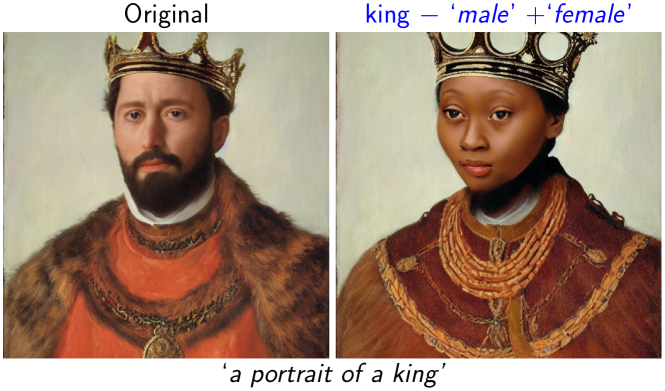
- Demonstrate SEGA's ability to perform subtle edits, composition/style changes, and artistically guided concept manipulation without architecture changes or training.
- Evaluate SEGA against related methods and demonstrate practical utility across multiple generative models.
Proposed method
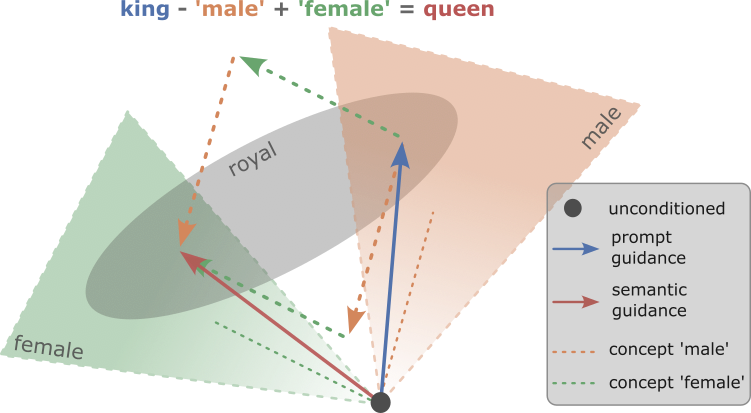
- Extend classifier-free guidance with semantic guidance computations derived from concept-conditioned and unconditioned noise estimates.
- Identify semantic directions by analyzing the difference between epsilon estimates conditioned on concept prompts and the unconditioned estimates.
- Define a sparse, tail-based selection (lambda percentile) of epsilon-dimensions to form concept vectors that are largely isolated.
- Incorporate a warm-up period delta and a momentum term to control when and how guidance is applied and to accelerate consistent edits.
- Allow combining multiple concepts via a weighted sum of individual gamma_t guidance terms (gamma_i) with per-concept hyperparameters.
- Provide an implementation-agnostic formulation applicable to latent and pixel-based diffusion models, with a public code implementation.
Experimental results
Research questions
- RQ1Can semantic directions be extracted from the diffusion model's noise-estimate space without training or architectural changes?
- RQ2Do semantic guidance vectors exhibit robustness, uniqueness, monotonicity, and isolation across prompts and domains?
- RQ3Is SEGA capable of performing multiple, non-interfering edits simultaneously and with controllable strength?
- RQ4How does SEGA compare to existing diffusion-editing methods in terms of edit success and faithfulness to the original composition?
- RQ5Can SEGA mitigate unwanted content or guide generations away from inappropriate concepts across architectures?
Key findings
- Semantic guidance vectors are extractable from the noise estimates and can be applied with a single forward pass.
- Guidance vectors are robust across domains, largely unique per concept, and their effects scale monotonically with guidance strength.
- Different concept vectors largely isolate, allowing simultaneous edits without interference and enabling multi-concept manipulation.
- SEGA outperforms comparable methods on multiple editing tasks and improves fidelity to the original composition while enabling style transfers and object removals.
- In experiments on faces and I2P benchmarks, SEGA achieves high success rates for edits and strong mitigation of inappropriate content across architectures.
- Qualitative and user-study evidence shows SEGA's edits are perceived as faithful, with preferable results over several baselines.
Read this paper
Open the full text in the Nubint reader and ask about any passage as you read.
Read this paper on NubintThis review was generated by AI from the original paper. Please check the paper before citing it.