
[Paper Review] Segment Anything Meets Semantic Communication
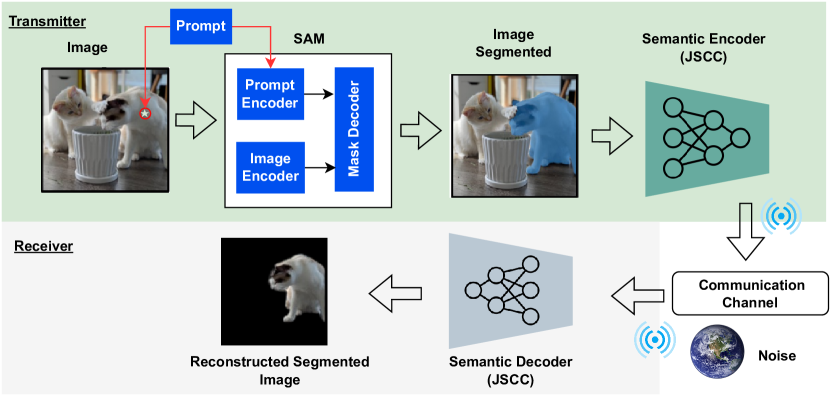
This paper proposes a semantic communication framework for image transmission that leverages the Segment Anything Model (SAM) for zero-shot image segmentation, enabling efficient, task-relevant feature extraction without domain-specific training. By segmenting images into regions of interest (ROI) before lightweight neural encoding, the method achieves higher PSNR in image reconstruction under AWGN and Rayleigh fading noise, reducing communication overhead while preserving semantic fidelity.
In light of the diminishing returns of traditional methods for enhancing transmission rates, the domain of semantic communication presents promising new frontiers. Focusing on image transmission, this paper explores the application of foundation models, particularly the Segment Anything Model (SAM) developed by Meta AI Research, to improve semantic communication. SAM is a promptable image segmentation model that has gained attention for its ability to perform zero-shot segmentation tasks without explicit training or domain-specific knowledge. By employing SAM's segmentation capability and lightweight neural network architecture for semantic coding, we propose a practical approach to semantic communication. We demonstrate that this approach retains critical semantic features, achieving higher image reconstruction quality and reducing communication overhead. This practical solution eliminates the resource-intensive stage of training a segmentation model and can be applied to any semantic coding architecture, paving the way for real-world applications.
Motivation & Objective
- To address the limitations of traditional image transmission methods approaching Shannon's capacity limits.
- To improve communication efficiency in semantic communication by focusing on task-relevant semantic features rather than full-image reconstruction.
- To eliminate the need for resource-intensive training of segmentation models by leveraging the zero-shot generalization of SAM.
- To enable plug-and-play integration of SAM into any semantic coding architecture for real-world deployment.
- To evaluate the impact of segmentation on image reconstruction quality under noisy channel conditions.
Proposed method
- Employing the Segment Anything Model (SAM) for zero-shot, prompt-based image segmentation to extract regions of interest (ROI) without fine-tuning or labeled data.
- Applying a lightweight neural network for joint source and channel encoding of segmented image features to reduce communication overhead.
- Using additive white Gaussian noise (AWGN) and Rayleigh fading (RF) channels to simulate real-world wireless conditions.
- Training the semantic encoder and decoder on segmented features using mean squared error (MSE) loss with Adam optimizer and a fixed learning rate of 0.001.
- Reconstructing the original image via a CNN decoder from the noisy received signal, formalized as $ x_{in}^\prime = F_{dec}(y) $.
- Evaluating performance using PSNR across different SNR levels (1–20 dB) under both AWGN and RF noise.

Experimental results
Research questions
- RQ1Can zero-shot segmentation using SAM improve image reconstruction quality in semantic communication under noisy channels?
- RQ2How does segmenting images into ROIs before encoding affect communication efficiency and reconstruction fidelity?
- RQ3To what extent does SAM-based segmentation reduce the need for domain-specific training in semantic coding systems?
- RQ4How does the proposed method compare to non-segmentation-based semantic communication in terms of PSNR under AWGN and Rayleigh fading?
- RQ5Can the integration of SAM enhance task achievability, such as object detection or classification, by focusing on relevant image regions?
Key findings
- The proposed SAM-based semantic communication system achieves higher PSNR in image reconstruction compared to non-segmentation approaches under both AWGN and Rayleigh fading noise.
- Image reconstruction quality improves significantly when using SAM-generated masks, particularly in low-SNR conditions, due to focused feature extraction.
- The compression ratio of the semantic features is $ \frac{1}{6} $, indicating a substantial reduction in data volume without significant quality loss.
- The method achieves robust performance across different SNR levels (1–20 dB), demonstrating resilience to channel noise.
- The zero-shot capability of SAM eliminates the need for training a segmentation model, enabling immediate deployment on diverse, personalized datasets.
- Visual comparisons in Figure 6 confirm that reconstructed images using SAM masks (e and f) are closer to the original (a) than those without segmentation (b and c), especially under noisy conditions.
Read this paper
Open the full text in the Nubint reader and ask about any passage as you read.
Read this paper on NubintThis review was generated by AI from the original paper. Please check the paper before citing it.