
[Paper Review] Segment Anything Model for Medical Image Analysis: an Experimental Study
The paper evaluates Segment Anything Model (SAM) on 19 medical imaging datasets across modalities to assess zero-shot segmentation performance and interaction modes, comparing to other interactive methods and detailing prompting strategies.
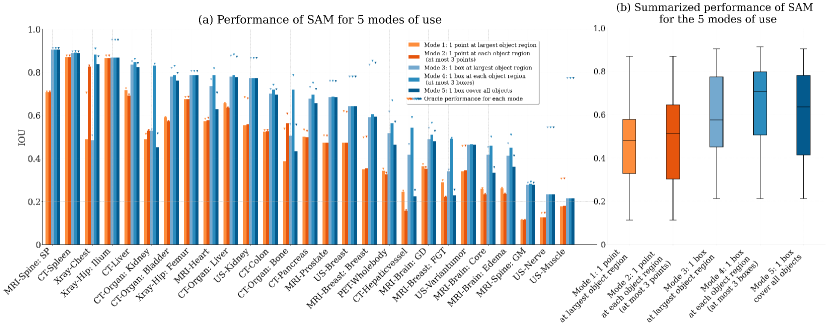
Training segmentation models for medical images continues to be challenging due to the limited availability of data annotations. Segment Anything Model (SAM) is a foundation model that is intended to segment user-defined objects of interest in an interactive manner. While the performance on natural images is impressive, medical image domains pose their own set of challenges. Here, we perform an extensive evaluation of SAM's ability to segment medical images on a collection of 19 medical imaging datasets from various modalities and anatomies. We report the following findings: (1) SAM's performance based on single prompts highly varies depending on the dataset and the task, from IoU=0.1135 for spine MRI to IoU=0.8650 for hip X-ray. (2) Segmentation performance appears to be better for well-circumscribed objects with prompts with less ambiguity and poorer in various other scenarios such as the segmentation of brain tumors. (3) SAM performs notably better with box prompts than with point prompts. (4) SAM outperforms similar methods RITM, SimpleClick, and FocalClick in almost all single-point prompt settings. (5) When multiple-point prompts are provided iteratively, SAM's performance generally improves only slightly while other methods' performance improves to the level that surpasses SAM's point-based performance. We also provide several illustrations for SAM's performance on all tested datasets, iterative segmentation, and SAM's behavior given prompt ambiguity. We conclude that SAM shows impressive zero-shot segmentation performance for certain medical imaging datasets, but moderate to poor performance for others. SAM has the potential to make a significant impact in automated medical image segmentation in medical imaging, but appropriate care needs to be applied when using it.
Motivation & Objective
- Assess SAM's zero-shot segmentation performance on a wide range of medical imaging datasets.
- Characterize how prompting strategy (points vs boxes) and prompt iteration affect SAM performance.
- Compare SAM to other interactive segmentation methods (RITM, SimpleClick, FocalClick) across tasks.
- Identify prompt-ambiguity effects and practical usage modes for medical imaging applications.
Proposed method
- Evaluate SAM on 19 publicly available medical imaging datasets spanning MRI, CT, X-ray, ultrasound, and PET.
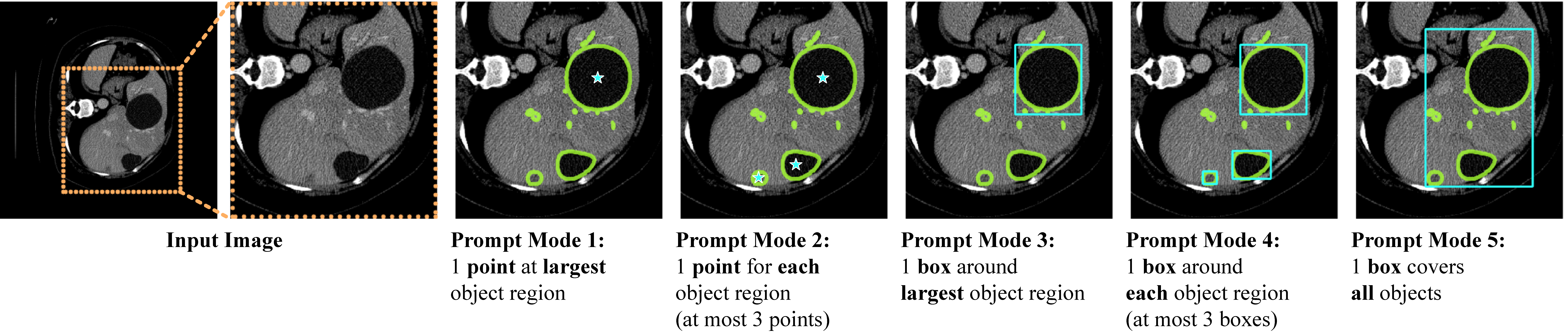
- Define five non-iterative prompting modes (points or boxes) and an iterative prompting scheme to simulate user interaction.
- Use IoU as the primary accuracy metric, with oracle performance as an upper-bound proxy.
- Compare SAM against RITM, SimpleClick, and FocalClick under non-iterative prompts and under iterative prompts.
- Analyze segment-everything mode and object size influence on performance.
- Provide qualitative visualizations and discuss prompt ambiguity effects.
Experimental results
Research questions
- RQ1How does SAM perform on medical images with zero-shot segmentation across diverse modalities and anatomies?
- RQ2Which prompting strategies (points vs boxes) and modes yield the best SAM performance for medical objects, including multi-part structures?
- RQ3How does SAM compare to other interactive segmentation methods under single and multiple prompts?
- RQ4Does iterative prompting significantly improve SAM performance, especially for objects with multiple parts or ambiguous prompts?
- RQ5What practical usage modes emerge for integrating SAM into medical image annotation and model training?
Key findings
- SAM performance across 28 tasks varies widely, from IoU 0.1135 (spine MRI) to 0.8650 (hip X-ray).
- Box prompts outperform point prompts, with Mode 4 (one box per object part) achieving the best average IoU of 0.6542 across tasks.
- SAM generally outperforms RITM, SimpleClick, and FocalClick in single-point prompt settings; in oracle mode SAM leads in 26 of 28 tasks.
- Iterative prompts provide limited benefit to SAM, while SimpleClick and RITM improve more with additional points and can surpass SAM in some cases.
- SAM shows zero-shot potential for some datasets but moderate to poor performance for others, indicating careful use and prompting strategy are needed.
- Ambiguity in prompts can yield multiple outputs; SAM’s higher-confidence maps tend to resemble region-growing segmented regions; lower-confidence outputs vary more.
Read this paper
Open the full text in the Nubint reader and ask about any passage as you read.
Read this paper on NubintThis review was generated by AI from the original paper. Please check the paper before citing it.