
[Paper Review] Self-Discover: Large Language Models Self-Compose Reasoning Structures
Self-Discover lets LLMs self-discover task-intrinsic reasoning structures by composing atomic reasoning modules, improving challenging reasoning benchmarks with fewer inferences.
We introduce SELF-DISCOVER, a general framework for LLMs to self-discover the task-intrinsic reasoning structures to tackle complex reasoning problems that are challenging for typical prompting methods. Core to the framework is a self-discovery process where LLMs select multiple atomic reasoning modules such as critical thinking and step-by-step thinking, and compose them into an explicit reasoning structure for LLMs to follow during decoding. SELF-DISCOVER substantially improves GPT-4 and PaLM 2's performance on challenging reasoning benchmarks such as BigBench-Hard, grounded agent reasoning, and MATH, by as much as 32% compared to Chain of Thought (CoT). Furthermore, SELF-DISCOVER outperforms inference-intensive methods such as CoT-Self-Consistency by more than 20%, while requiring 10-40x fewer inference compute. Finally, we show that the self-discovered reasoning structures are universally applicable across model families: from PaLM 2-L to GPT-4, and from GPT-4 to Llama2, and share commonalities with human reasoning patterns.
Motivation & Objective
- Motivate a framework where tasks have intrinsic reasoning structures rather than relying on a fixed prompting module.
- Develop a two-stage process where LLMs first discover task-specific reasoning structures and then follow them to solve instances.
- Show that self-discovered structures are more efficient and interpretable than traditional prompting methods.
- Demonstrate transferability of discovered structures across model families and their alignment with human reasoning patterns.
Proposed method
- Define a seed set of atomic reasoning modules described in natural language (e.g., critical thinking, step-by-step thinking).
- Stage 1: self-discovery with three actions—SELECT useful modules, ADAPT them to the task, and IMPLEMENT an actionable JSON-like structure.
- Stage 2: solve task instances by following the self-discovered structure during decoding.
- Represent the discovered structure in a key-value (JSON) format to guide decoding and enable interpretability.
- Compare Self-Discover to zero-shot Direct Prompting, Chain-of-Thought (CoT), Plan-and-Solve (PS), and inference-heavy baselines like CoT-Self-Consistency.
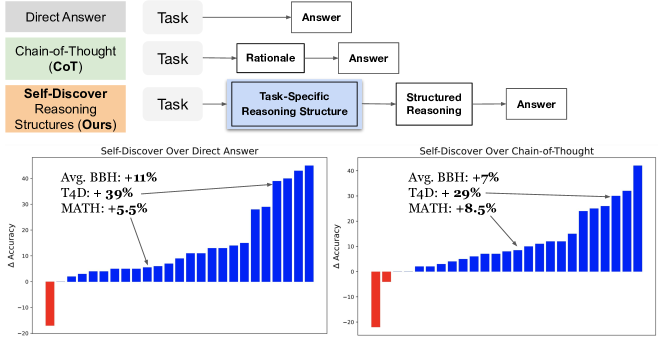
Experimental results
Research questions
- RQ1Can self-discovered reasoning structures improve LLM reasoning across diverse benchmarks (BBH, T4D, MATH)?
- RQ2Which task categories benefit most from self-discovered structures, and how do they compare in efficiency to alternative prompting methods?
- RQ3Are the self-discovered structures transferable across model families and across different LLMs?
Key findings
- Self-Discover improves reasoning performance for PaLM 2-L and GPT-4 across BBH, T4D, and MATH, with gains up to 32% over CoT in some settings.
- On 23 BBH tasks, Self-Discover yields absolute improvements of 7% over CoT and 6% over PS for PaLM 2-L, and similar gains for GPT-4.
- On the T4D task, Self-Discover achieves ≥27% absolute improvement over baselines for PaLM 2-L and 32% for GPT-4, with accuracies of 69% (PaLM 2-L) and 85% (GPT-4).
- On MATH, Self-Discover shows modest gains (1–7% for PaLM 2-L; 2–3% for GPT-4) with an error pattern indicating most failures arise from computation rather than structure.
- Self-Discover achieves 10–40x fewer inference calls than inference-heavy alternatives like CoT-Self-Consistency or majority voting while maintaining or improving performance.
- The self-discovered structures transfer across model families (PaLM 2-L → GPT-4; GPT-4 → Llama-2-70B) and show commonalities with human reasoning patterns.

Read this paper
Open the full text in the Nubint reader and ask about any passage as you read.
Read this paper on NubintThis review was generated by AI from the original paper. Please check the paper before citing it.