
[Paper Review] Self-Distillation from the Last Mini-Batch for Consistency Regularization
This paper proposes DLB (Self-Distillation from the Last Mini-Batch), a computationally efficient and memory-light self-distillation method that uses soft labels from the previous mini-batch to regularize training, improving model consistency and robustness to label noise. It achieves state-of-the-art performance across multiple architectures without architectural changes or pre-trained teachers.
Knowledge distillation (KD) shows a bright promise as a powerful regularization strategy to boost generalization ability by leveraging learned sample-level soft targets. Yet, employing a complex pre-trained teacher network or an ensemble of peer students in existing KD is both time-consuming and computationally costly. Various self KD methods have been proposed to achieve higher distillation efficiency. However, they either require extra network architecture modification or are difficult to parallelize. To cope with these challenges, we propose an efficient and reliable self-distillation framework, named Self-Distillation from Last Mini-Batch (DLB). Specifically, we rearrange the sequential sampling by constraining half of each mini-batch coinciding with the previous iteration. Meanwhile, the rest half will coincide with the upcoming iteration. Afterwards, the former half mini-batch distills on-the-fly soft targets generated in the previous iteration. Our proposed mechanism guides the training stability and consistency, resulting in robustness to label noise. Moreover, our method is easy to implement, without taking up extra run-time memory or requiring model structure modification. Experimental results on three classification benchmarks illustrate that our approach can consistently outperform state-of-the-art self-distillation approaches with different network architectures. Additionally, our method shows strong compatibility with augmentation strategies by gaining additional performance improvement. The code is available at https://github.com/Meta-knowledge-Lab/DLB.
Motivation & Objective
- To address the high computational and memory costs of traditional knowledge distillation, especially those relying on pre-trained teachers or ensemble models.
- To overcome limitations in existing self-distillation methods, such as architectural modifications, memory overhead from model snapshots, and computational redundancy.
- To develop a simple, efficient, and parallelizable self-distillation framework that enhances training stability and consistency.
- To improve model robustness to label noise and compatibility with data augmentation strategies.
- To provide a plug-and-play regularization method that works across diverse network architectures without architectural changes.
Proposed method
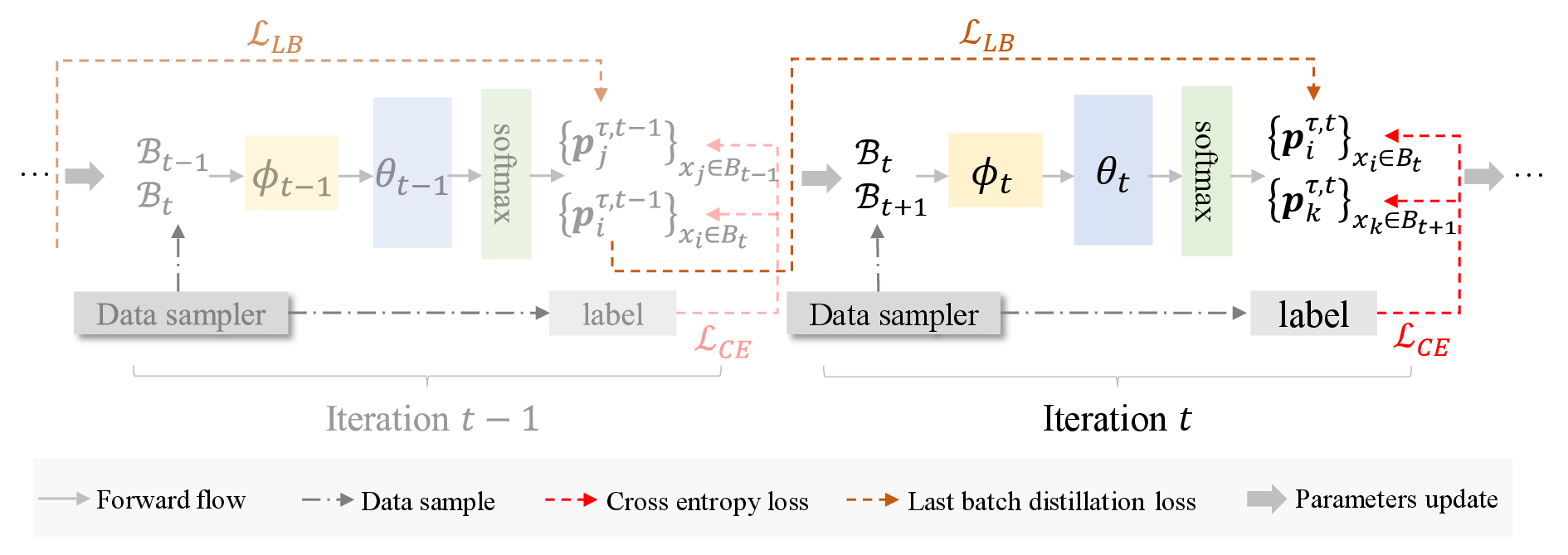
- Rearranging mini-batch sampling so that half of each batch overlaps with the previous iteration and the other half with the next, enabling temporal consistency.
- Using on-the-fly generated soft labels from the previous mini-batch as distillation targets for the current batch.
- Applying a consistency loss that distills the model's own predictions from the prior mini-batch, using temperature scaling for soft label smoothing.
- Integrating the distillation loss with cross-entropy loss via a balancing coefficient α, enabling end-to-end training with one forward and one backward pass per batch.
- Avoiding extra memory by storing only the last mini-batch’s soft targets, not model snapshots or full history.
- Enabling seamless integration with data augmentation by leveraging consistent predictions across augmented views.
Experimental results
Research questions
- RQ1Can a self-distillation method be designed that avoids pre-trained teachers and architectural modifications while maintaining high efficiency and performance?
- RQ2How does using only the last mini-batch’s soft labels improve training stability and consistency compared to other self-distillation baselines?
- RQ3To what extent does the proposed method enhance robustness to label noise in training data?
- RQ4Does the method remain effective when combined with data augmentation techniques?
- RQ5How sensitive is the method to hyperparameters such as temperature and loss weighting?
Key findings
- DLB outperforms state-of-the-art self-distillation methods on CIFAR-10, CIFAR-100, and Tiny ImageNet, achieving a 26.00% top-1 error rate on ResNet-32 for CIFAR-100.
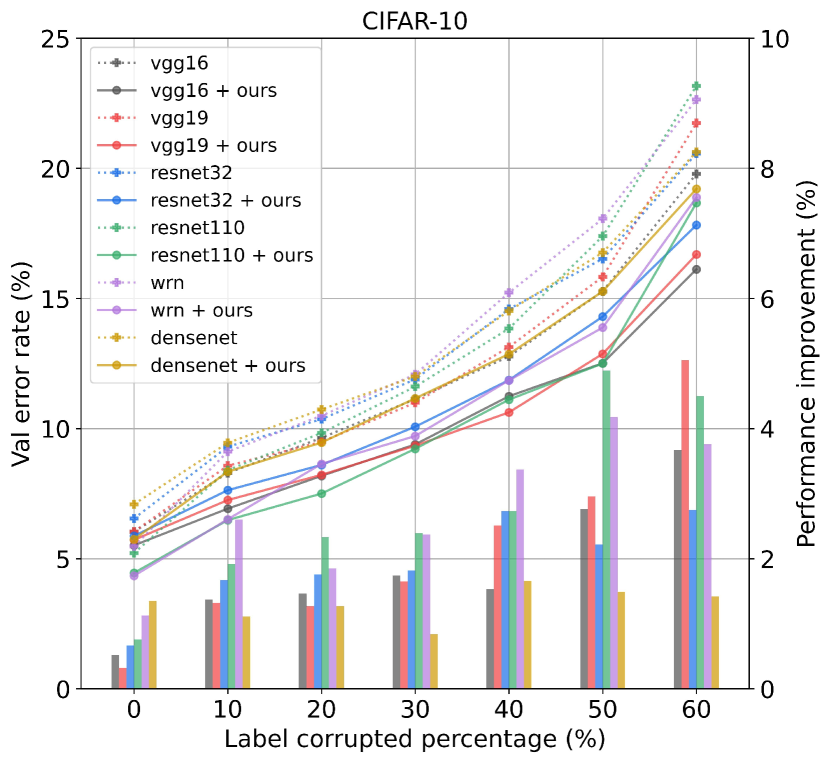
- On CIFAR-100 with 60% label noise, DLB improved accuracy by 4.44% over the baseline, demonstrating strong robustness to noisy labels.
- The method achieved a 2.38% accuracy gain at 10% label noise and showed increasing performance gains with higher noise rates.
- Combining DLB with data augmentation techniques led to additional performance improvements, indicating orthogonal and complementary benefits.
- Abllation studies confirmed that removing the distillation loss degraded performance significantly, with ResNet-32's error rising from 26.00% to 28.01%.
- Hyperparameter analysis showed optimal performance at τ=3 and α∈[0.5,2.0], indicating robustness to hyperparameter choice.
Read this paper
Open the full text in the Nubint reader and ask about any passage as you read.
Read this paper on NubintThis review was generated by AI from the original paper. Please check the paper before citing it.