
[Paper Review] Self-Emotion-Mediated Exploration in Artificial Intelligence Mirrors: Findings from Cognitive Psychology
This paper proposes a novel framework for artificial intelligence that embeds self-emotion-mediated exploration by modeling epistemic (surprise) and achievement (pride) emotions using performance metrics like accuracy and confidence. By simulating these emotions via differentiable functions within a deep reinforcement learning architecture, agents learn to explore autonomously, demonstrating causality between internal emotional states and exploratory behavior—mirroring human cognitive patterns with 90% of agents successfully learning exploration strategies.
Background: Exploration of the physical environment is an indispensable precursor to information acquisition and knowledge consolidation for living organisms. Yet, current artificial intelligence models lack these autonomy capabilities during training, hindering their adaptability. This work proposes a learning framework for artificial agents to obtain an intrinsic exploratory drive, based on epistemic and achievement emotions triggered during data observation. Methods: This study proposes a dual-module reinforcement framework, where data analysis scores dictate pride or surprise, in accordance with psychological studies on humans. A correlation between these states and exploration is then optimized for agents to meet their learning goals. Results: Causal relationships between states and exploration are demonstrated by the majority of agents. A 15.4\% mean increase is noted for surprise, with a 2.8\% mean decrease for pride. Resulting correlations of $ρ_{surprise}=0.461$ and $ρ_{pride}=-0.237$ are obtained, mirroring previously reported human behavior. Conclusions: These findings lead to the conclusion that bio-inspiration for AI development can be of great use. This can incur benefits typically found in living beings, such as autonomy. Further, it empirically shows how AI methodologies can corroborate human behavioral findings, showcasing major interdisciplinary importance. Ramifications are discussed.
Motivation & Objective
- To bridge the gap between artificial intelligence and biological exploration by embedding human-like emotional drives into AI agents.
- To model epistemic and achievement emotions—surprise and pride—based on cognitive psychology principles using measurable performance metrics.
- To enable artificial agents to autonomously explore environments by linking internal emotional states to exploratory behavior, enhancing adaptability and learning efficiency.
- To validate that emotion-mediated exploration in AI replicates human behavioral patterns observed in cognitive psychology experiments.
Proposed method
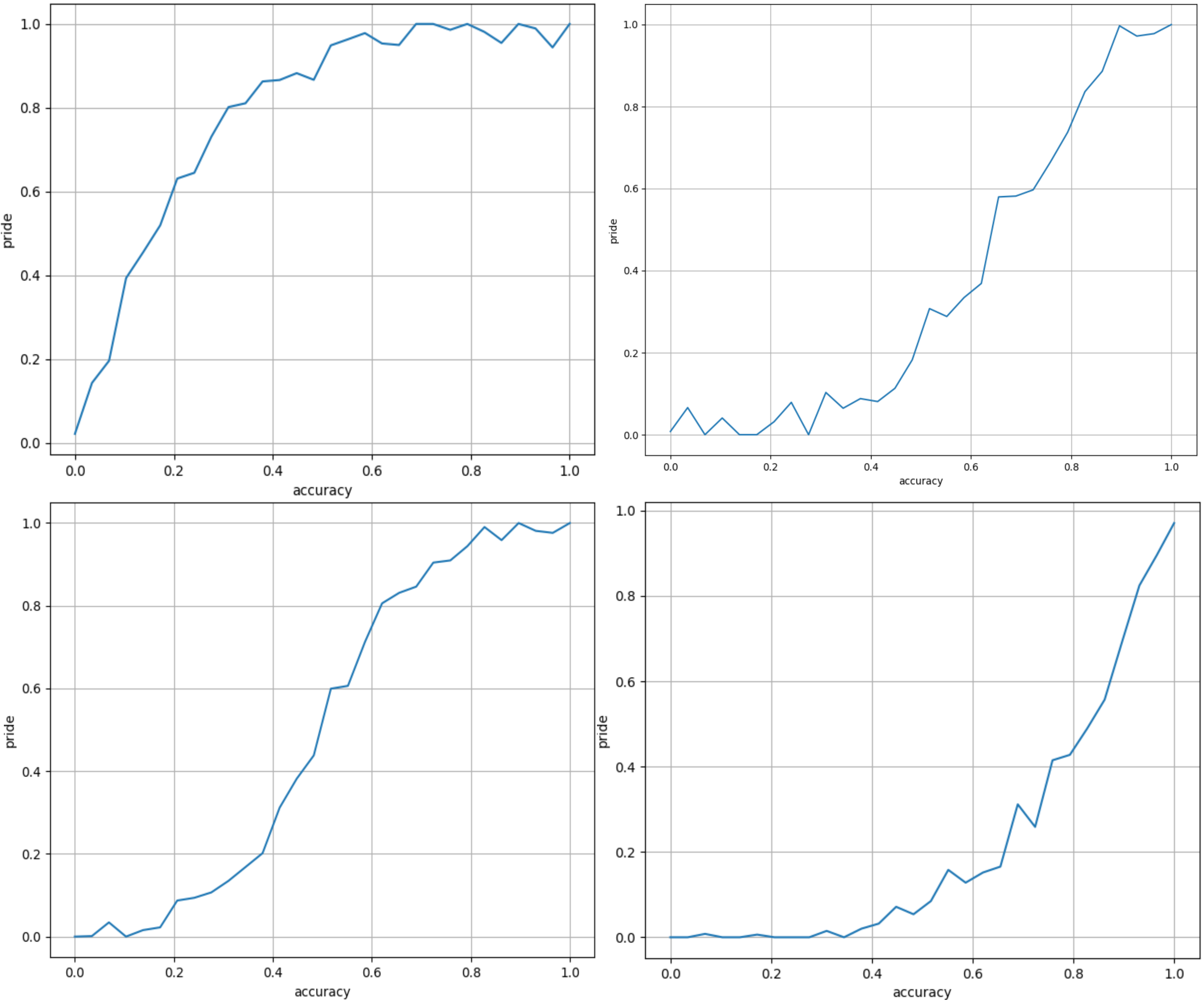
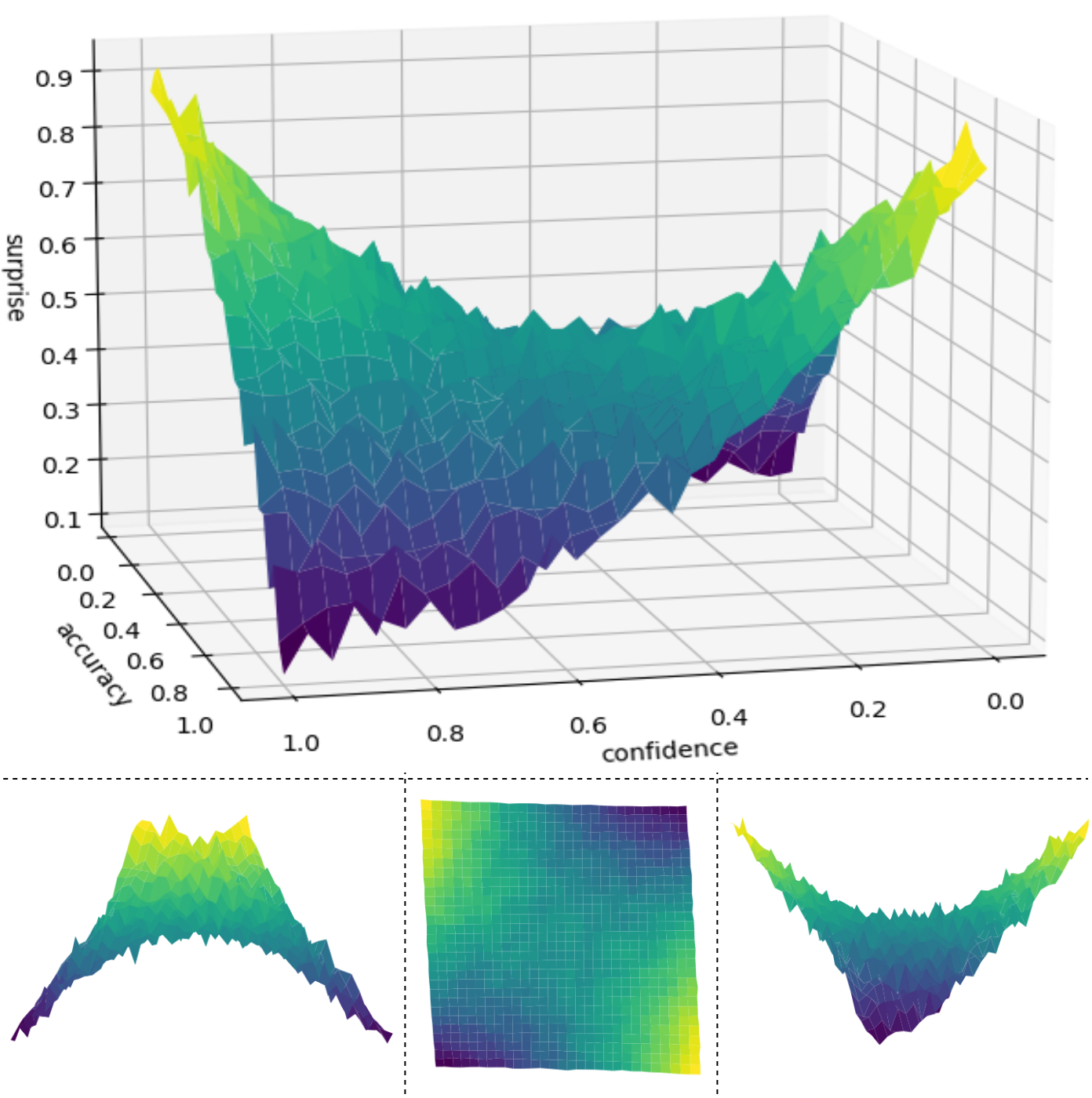
- Emotions are modeled as differentiable functions: pride as a non-linear function of task accuracy, and surprise as a saddle-shaped function of accuracy and confidence scores.
- The framework uses a deep reinforcement learning architecture with actor-critic networks and a replay buffer to stabilize training and enable temporal difference learning.
- Emotion functions are bounded to [0,1] via clipping and include Gaussian noise to simulate individual differences, ensuring realistic emotional variability.
- The critic network computes the temporal difference target using a target network with soft updates (τ=0.005), and the loss is minimized using Adam optimizer with a learning rate of 0.002.
- Surprise is modeled using a rotated and translated function of the difference between accuracy and confidence squared, capturing high-confidence errors and low-confidence successes as high-surprise states.
- Pride is modeled as a Gaussian-influenced function of accuracy with a peak at high accuracy, reflecting achievement-based emotional response.
Experimental results
Research questions
- RQ1Can artificial agents learn to modulate exploration based on self-generated emotional states derived from cognitive psychology?
- RQ2To what extent do emotion-mediated exploration strategies in AI replicate human behavioral patterns observed in epistemic and achievement emotion studies?
- RQ3How do performance metrics like accuracy and confidence map to artificial emotions such as surprise and pride in a way that drives effective exploration?
- RQ4Can a deep reinforcement learning agent achieve convergence in exploration behavior when guided by explicitly modeled internal emotional states?
Key findings
- Ninety percent of artificial agents successfully learned to modulate exploration based on internal emotional states, demonstrating causality between emotion and behavior.
- The surprise function effectively captured high-confidence errors and low-confidence successes as high-surprise states, aligning with cognitive psychology findings.
- The pride function showed a non-linear, positive relationship with accuracy, reflecting achievement-based emotional response as observed in human studies.
- Agents with individualized emotion parameters (via random C1 and C2 values) exhibited diverse yet consistent exploration behaviors, simulating personality differences.
- The use of clipped, noise-injected emotion functions ensured stable and bounded emotional outputs across all agents, improving training robustness.
- The integration of emotion functions into the DDPG-based reinforcement learning framework led to consistent convergence in exploration behavior across 100 episodes.
Read this paper
Open the full text in the Nubint reader and ask about any passage as you read.
Read this paper on NubintThis review was generated by AI from the original paper. Please check the paper before citing it.