
[Paper Review] Self-Evaluation Guided Beam Search for Reasoning
The authors introduce a stepwise self-evaluation guided stochastic beam search to calibrate and guide multi-step reasoning in LLMs, improving accuracy on arithmetic, symbolic, and commonsense tasks over strong baselines at comparable cost.
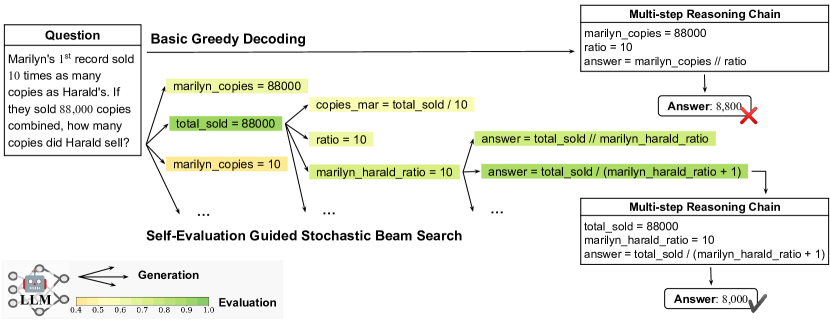
Breaking down a problem into intermediate steps has demonstrated impressive performance in Large Language Model (LLM) reasoning. However, the growth of the reasoning chain introduces uncertainty and error accumulation, making it challenging to elicit accurate final results. To tackle this challenge of uncertainty in multi-step reasoning, we introduce a stepwise self-evaluation mechanism to guide and calibrate the reasoning process of LLMs. We propose a decoding algorithm integrating the self-evaluation guidance via stochastic beam search. The self-evaluation guidance serves as a better-calibrated automatic criterion, facilitating an efficient search in the reasoning space and resulting in superior prediction quality. Stochastic beam search balances exploitation and exploration of the search space with temperature-controlled randomness. Our approach surpasses the corresponding Codex-backboned baselines in few-shot accuracy by $6.34\%$, $9.56\%$, and $5.46\%$ on the GSM8K, AQuA, and StrategyQA benchmarks, respectively. Experiment results with Llama-2 on arithmetic reasoning demonstrate the efficiency of our method in outperforming the baseline methods with comparable computational budgets. Further analysis in multi-step reasoning finds our self-evaluation guidance pinpoints logic failures and leads to higher consistency and robustness. Our code is publicly available at https://guideddecoding.github.io/.
Motivation & Objective
- Mitigate error accumulation in multi-step LLM reasoning by introducing a stepwise self-evaluation mechanism.
- Develop a constrained stochastic beam search that balances exploration and exploitation for reasoning chains.
- Calibrate decoding through a self-evaluation score that combines generation confidence and correctness confidence.
- Demonstrate performance gains across arithmetic, symbolic and commonsense reasoning benchmarks.
- Analyze cost and robustness of the approach under different backbones and prompting paradigms.
Proposed method
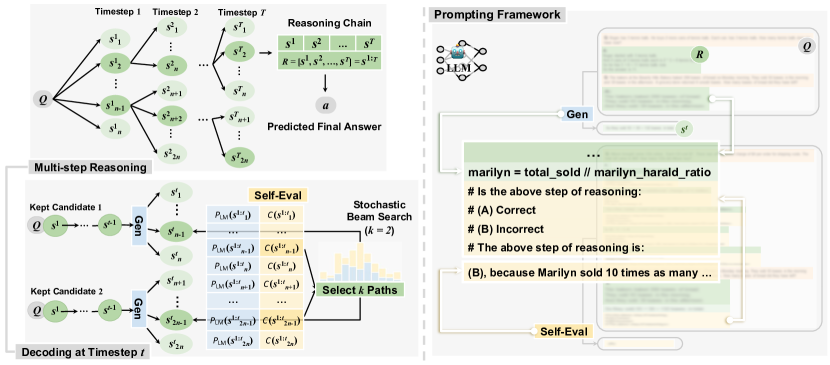
- Formulate reasoning chain generation as a multi-step decoding problem where each step s^t is a semantically integrated sequence of tokens.
- Introduce a constraint function C(s^t) that encodes LLM-based correctness confidence for each step, used to balance with LM probabilities in an objective E(s^{1:T}).
- Define E(s^{1:T}) = prod_t P_{LM_G}^λ(s^t | x, s^{1:t-1}) * C^{1-λ}(s^t) to guide decoding.
- Apply a stochastic beam search with beam size k, sampling n candidates per beam to form S, then prune by sampling proportionally to exp(E(s^{1:t})/τ) to encourage diversity.
- Incorporate a temperature decay α to progressively reduce randomness across steps, stabilizing long chains.
- Use a self-evaluation LLM (same backbone, different prompt) to produce a multiple-choice correctness score C(s^t) via P(A | prompt_C, Q, s^{1:t}).
- Experiment with closed- and open-source LLMs (Codex and Llama-2) on arithmetic, symbolic, and commonsense benchmarks, comparing to CoT, PAL/PoT baselines and self-consistency.
Experimental results
Research questions
- RQ1Can stepwise self-evaluation calibrate and steer the decoding of multi-step reasoning chains to reduce error accumulation?
- RQ2Does stochastic beam search with controllable randomness improve reasoning quality under fixed computational budgets?
- RQ3How does the proposed method perform across arithmetic, symbolic, and commonsense benchmarks compared to strong baselines?
- RQ4What is the cost-performance trade-off relative to self-consistency and other prompting strategies?
- RQ5How do generation confidence and correctness confidence contribute to the self-evaluation score across tasks?
Key findings
- The method yields accuracy gains on GSM8K, AQuA, and StrategyQA benchmarks over Codex-backed baselines in both single and multiple chain settings.
- On arithmetic reasoning with Codex, Ours-PAL achieves 85.5% on GSM8K and 64.2% on AQuA, outperforming baselines 80.4% and 58.6% respectively.
- On commonsense reasoning with Codex, Ours-CoT achieves 77.2% on StrategyQA and 78.6% on CommonsenseQA, surpassing baselines 73.2% and 74.4% respectively.
- Cost analysis shows the method incurs higher token usage than self-consistency but can outperform it at comparable budgets, especially for longer reasoning chains.
- Generation and correctness confidence analyses indicate correctness confidence is more discriminative for catching logical errors, and balancing both confidences via λ improves results (λ=0.5 used in experiments).
- The approach benefits longer reasoning chains, with larger gains on StrategyQA as chain length grows, and gains persist under diversity-enabled sampling and temperature decay.
Read this paper
Open the full text in the Nubint reader and ask about any passage as you read.
Read this paper on NubintThis review was generated by AI from the original paper. Please check the paper before citing it.