
[Paper Review] Self-Interference Channel Characterization in Underwater Acoustic In-Band Full-Duplex Communications Using OFDM
This paper characterizes the self-interference channel impulse response (SCIR) in underwater acoustic in-band full-duplex (UWA-IBFD) systems using OFDM in a lake experiment. It reveals that the direct path is strong and stable, while the surface-bounce path—contributing 16% of SI power—has a short coherence time (~70 ms), making it highly time-varying and challenging to cancel, despite being the dominant reflection path.
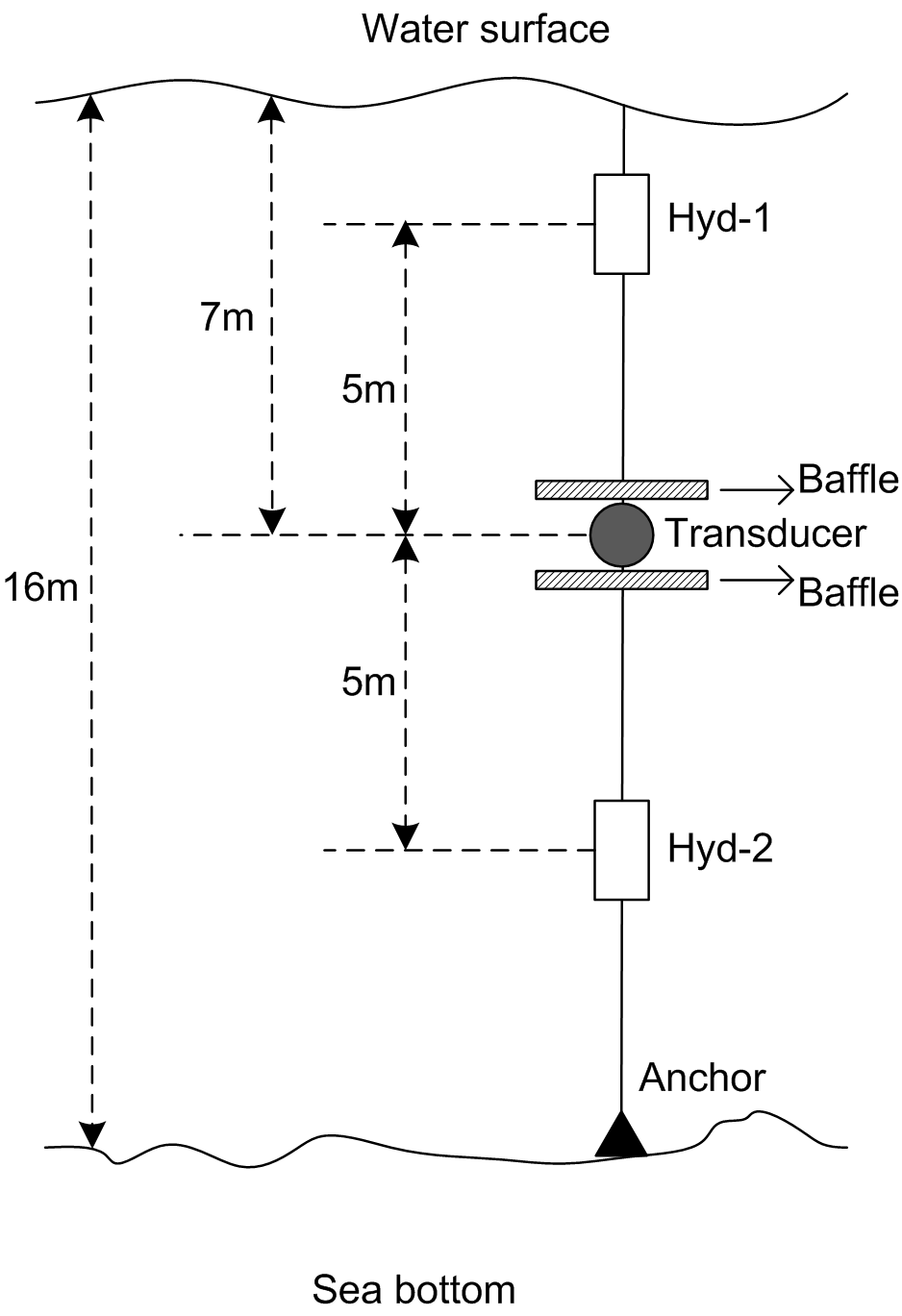
Due to the limited available bandwidth and dynamic channel, data rates are extremely limited in underwater acoustic (UWA) communications. Addressing this concern, in-band fullduplex (IBFD) has the potential to double the efficiency in a given bandwidth. In an IBFD scheme, transmission and reception are performed simultaneously in the same frequency band. However, in UWA-IBFD, because of reflections from the surface and bottom and the inhomogeneity of the water, a significant part of the transmitted signal returns back to the IBFD receiver. This signal contaminates the desired signal from the remote end and is known as the self-interference (SI). With an estimate of the self-interference channel impulse response (SCIR), a receiver can estimate and eliminate the SI. A better understanding of the statistical characteristics of the SCIR is necessary for an accurate SI cancellation. In this article, we use an orthogonal frequency division multiplexing (OFDM) signal to characterize the SCIR in a lake water experiment. To verify the results, SCIR estimation is performed using estimators in both the frequency and time domains. We show that, in our experiment, regardless of the depth of the hydrophone, the direct path of SCIR is strong, stable and easily tracked; however, the reflection paths are weaker and rapidly time-varying making SI cancellation challenging. Among the reflections, the first bounce from the water surface is the prevalent path with a short coherence time around 70 ms.
Motivation & Objective
- To understand the statistical characteristics of the self-interference channel impulse response (SCIR) in underwater acoustic in-band full-duplex (UWA-IBFD) systems.
- To evaluate the feasibility of SI cancellation by analyzing power delay profile (PDP), autocorrelation function (ACF), and coherence time (COT).
- To compare frequency-domain and time-domain SCIR estimation methods for robustness in dynamic underwater environments.
- To determine which multipath components dominate SI power and how their time-varying behavior affects cancellation performance.
- To assess whether conventional OFDM channel estimation assumptions (constant over block) hold for UWA-IBFD SCIR.
Proposed method
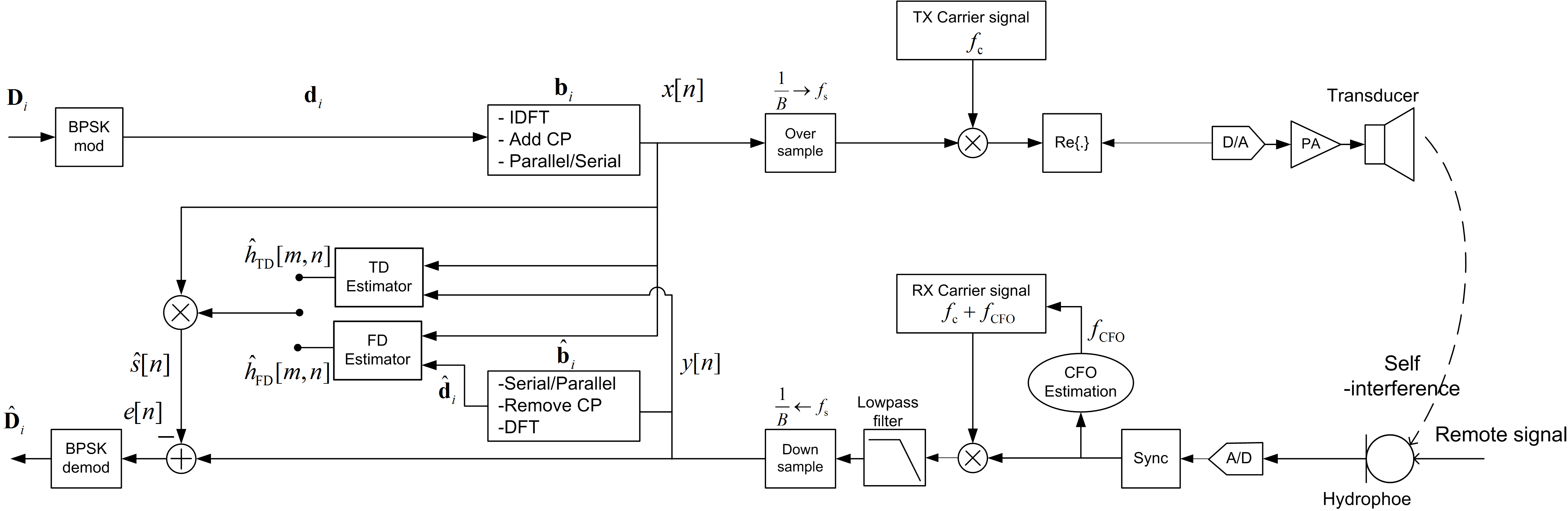
- An OFDM signal is transmitted in a lake environment to estimate the SCIR using both frequency-domain (FD) and time-domain (TD) methods.
- The power delay profile (PDP) is estimated from the magnitude of the SCIR to identify dominant multipath components.
- The autocorrelation function (ACF) of the SCIR is computed to analyze temporal correlation and derive the coherence time (COT).
- Coherence time is estimated as the lag at which ACF drops to half its maximum value, indicating the timescale over which the channel remains approximately constant.
- A windowed time-domain approach with reduced window size (36 ms) is used to validate that short-term channel stability is achievable for accurate COT estimation.
- Theoretical analysis uses the relation $ P_s = \frac{1}{M} \sum_{m=0}^{M-1} p[m] $ to compute total SI power from the PDP, and $ p_{\text{acc}}[j] = \frac{1}{M} \sum_{m=0}^{j-1} p[m] $ to assess cumulative power contribution of early paths.
Experimental results
Research questions
- RQ1What are the dominant multipath components in the self-interference channel impulse response (SCIR) of UWA-IBFD systems?
- RQ2How does the coherence time of the SCIR vary across different paths, particularly the direct and surface-bounce paths?
- RQ3To what extent do the time-varying characteristics of the SCIR, especially the surface-bounce path, violate the assumption of constant channel over an OFDM block?
- RQ4Can frequency-domain and time-domain SCIR estimation methods yield consistent statistical characterization of the SCIR in real underwater environments?
- RQ5What fraction of the total self-interference power is contributed by the direct path and the surface-bounce path, respectively?
Key findings
- The direct path of the SCIR is strong, stable, and contributes approximately 72% of the total self-interference power, making it relatively easy to cancel.
- The surface-bounce path is the dominant reflection path, contributing about 16% of the total SI power and exhibiting rapid time variations.
- The coherence time of the surface-bounce path is approximately 70 ms, which is shorter than typical OFDM block lengths, invalidating the assumption of channel slowness over a block.
- The time-domain estimation with a 36-ms window confirms the coherence time estimate, validating that the surface-bounce path remains approximately constant over short intervals.
- Together, the direct and surface-bounce paths account for about 88% of the total self-interference power, meaning accurate tracking of these two paths could cancel the vast majority of SI.
- Standard OFDM channel estimation methods assuming constant channel over one block are inadequate for UWA-IBFD due to the severe time-varying nature of the SCIR, especially the surface-bounce path.
Read this paper
Open the full text in the Nubint reader and ask about any passage as you read.
Read this paper on NubintThis review was generated by AI from the original paper. Please check the paper before citing it.