
[Paper Review] Self-Sovereign Identity for Trust and Interoperability in the Metaverse
This paper proposes a Self-Sovereign Identity (SSI) framework integrated with blockchain to enable decentralized, trustworthy, and interoperable identity management in the Metaverse. By allowing users to own and control their digital identities and cryptographic keys, the system supports end-to-end encrypted communication across virtual worlds without reliance on centralized authorities, achieving seamless identity and data interoperability across decentralized environments.
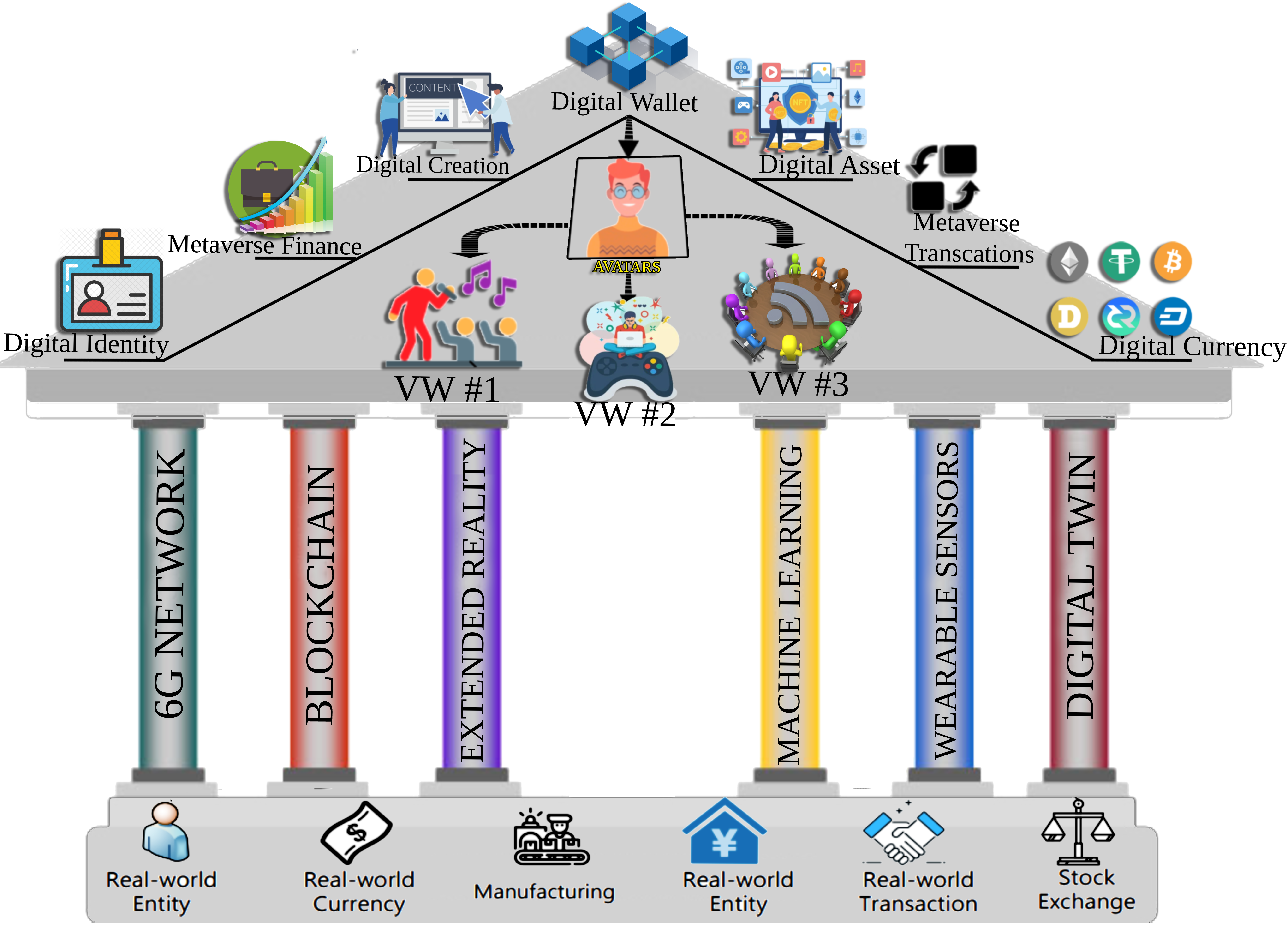
With the advancement in computing power and speed, the Internet is being transformed from screen-based information to immersive and extremely low latency communication environments in web 3.0 and the Metaverse. With the emergence of the Metaverse technology, more stringent demands are required in terms of connectivity such as secure access and data privacy. Future technologies such as 6G, Blockchain, and Artificial Intelligence (AI) can mitigate some of these challenges. The Metaverse is now on the verge where security and privacy concerns are crucial for the successful adaptation of such disruptive technology. The Metaverse and web 3.0 are to be decentralized, anonymous, and interoperable. Metaverse is the virtual world of Digital Twins and non-fungible tokens (NFTs). The control and possession of users' data on centralized servers are the cause of numerous security and privacy concerns. This paper proposes a solution for the security and interoperability challenges using Self-Sovereign Identity (SSI) integrated with blockchain. The philosophy of Self-Sovereign Identity, where the users are the only holders and owners of their identity, comes in handy to solve the questions of decentralization, trust, and interoperability in the Metaverse. This work also discusses the vision of a single, open standard, trustworthy, and interoperable Metaverse with initial design and implementation of SSI concepts.
Motivation & Objective
- To address critical challenges in trust and interoperability among virtual worlds in the Metaverse.
- To enable users to own, control, and manage their digital identities without reliance on centralized authorities.
- To design and implement a secure, decentralized communication protocol using SSI and blockchain for end-to-end encryption in immersive virtual environments.
- To establish a vision for a single, open-standard, interoperable, and trustworthy Metaverse in the 6G era.
- To explore the integration of enabling technologies such as 6G, blockchain, AI, and Digital Twins to support a user-centric Metaverse.
Proposed method
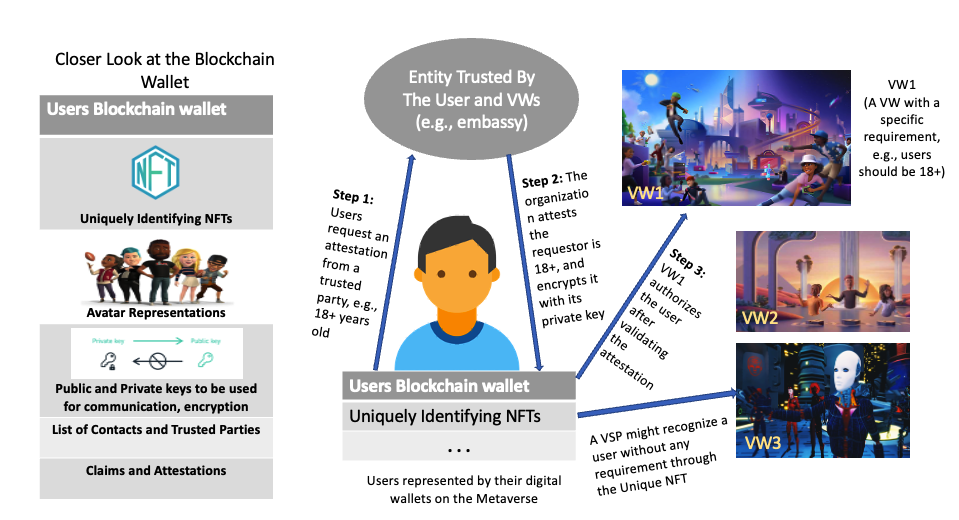
- The proposed system uses Self-Sovereign Identity (SSI) principles, where users are the sole owners of their digital identities and cryptographic keys.
- Identity data and public key bundles are stored on a public SSI blockchain, enabling verifiable and cryptographically secure identity assertions.
- A Trusted Party (TP) issues attestation certificates for public keys, which are validated using the TP’s public key to ensure authenticity.
- End-to-end encryption is implemented using the X3DH key exchange protocol, with public keys self-attested by users and verified via the TP’s certificate.
- The system enables secure communication between users across virtual worlds by allowing direct key exchange without centralized mediation.
- Algorithms 1 and 2 define the request and reply processes for establishing secure communication channels using SSI-verified keys and X3DH.
Experimental results
Research questions
- RQ1How can decentralized identity management be achieved in the Metaverse to ensure user control and data sovereignty?
- RQ2What mechanisms enable secure, end-to-end encrypted communication between users in a trustless, decentralized virtual environment?
- RQ3How can interoperability of identities, avatars, and data be achieved across multiple, independent virtual worlds?
- RQ4What role do blockchain and trusted attestation play in establishing verifiable and tamper-proof digital identities in the Metaverse?
- RQ5How can emerging technologies like 6G, AI, and Digital Twins be integrated to support a scalable and immersive Metaverse with strong privacy and trust guarantees?
Key findings
- The proposed SSI-based system enables users to fully own and control their digital identities and cryptographic keys, eliminating reliance on centralized identity providers.
- End-to-end encryption is successfully implemented using the X3DH protocol with SSI-verified public keys, ensuring secure communication without centralized intermediaries.
- The system supports interoperability of identities and data across different virtual worlds by leveraging a shared, public SSI blockchain for identity and key storage.
- Trusted Party (TP)-issued attestation certificates are used to validate public key bundles, ensuring authenticity and preventing impersonation attacks.
- The architecture supports seamless, secure communication between users even when one party is offline, provided key derivation and storage mechanisms are extended.
- The paper identifies blockchain storage limitations for large-scale identity data and proposes future work on scalable off-chain storage solutions for SSI-managed data.
Read this paper
Open the full text in the Nubint reader and ask about any passage as you read.
Read this paper on NubintThis review was generated by AI from the original paper. Please check the paper before citing it.