
[Paper Review] Self-supervised Group Meiosis Contrastive Learning for EEG-Based Emotion Recognition
This paper proposes a self-supervised Group Meiosis Contrastive Learning (SGMC) framework for EEG-based emotion recognition that leverages stimuli consistency across group EEG samples. By introducing a novel meiosis-inspired data augmentation method and a group projector for learning shared representations, SGMC achieves state-of-the-art accuracy of 94.72% and 95.68% on the DEAP dataset for valence and arousal, respectively, even with limited labeled data.
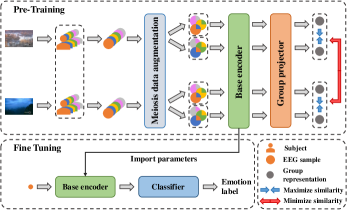
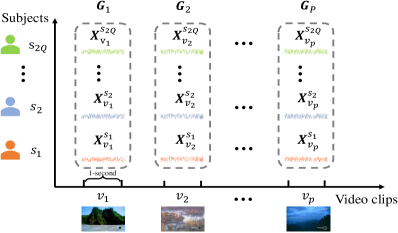
The progress of EEG-based emotion recognition has received widespread attention from the fields of human-machine interactions and cognitive science in recent years. However, how to recognize emotions with limited labels has become a new research and application bottleneck. To address the issue, this paper proposes a Self-supervised Group Meiosis Contrastive learning framework (SGMC) based on the stimuli consistent EEG signals in human being. In the SGMC, a novel genetics-inspired data augmentation method, named Meiosis, is developed. It takes advantage of the alignment of stimuli among the EEG samples in a group for generating augmented groups by pairing, cross exchanging, and separating. And the model adopts a group projector to extract group-level feature representations from group EEG samples triggered by the same emotion video stimuli. Then contrastive learning is employed to maximize the similarity of group-level representations of augmented groups with the same stimuli. The SGMC achieves the state-of-the-art emotion recognition results on the publicly available DEAP dataset with an accuracy of 94.72% and 95.68% in valence and arousal dimensions, and also reaches competitive performance on the public SEED dataset with an accuracy of 94.04%. It is worthy of noting that the SGMC shows significant performance even when using limited labels. Moreover, the results of feature visualization suggest that the model might have learned video-level emotion-related feature representations to improve emotion recognition. And the effects of group size are further evaluated in the hyper parametric analysis. Finally, a control experiment and ablation study are carried out to examine the rationality of architecture. The code is provided publicly online.
Motivation & Objective
- To address the challenge of limited labeled EEG data in emotion recognition by leveraging self-supervised learning.
- To exploit stimuli consistency across group EEG samples to guide contrastive learning without relying on manual labels.
- To develop a novel data augmentation method inspired by biological meiosis that preserves stimuli-related features.
- To improve group-level representation learning through a dedicated group projector and contrastive loss.
- To validate the framework's robustness and generalization across public EEG emotion datasets like DEAP and SEED.
Proposed method
- Introduces Meiosis, a genetics-inspired data augmentation technique that pairs, cross-exchanges, and separates EEG samples from the same stimulus group to generate augmented groups.
- Employs a group projector to extract shared, high-level representations from multiple EEG samples triggered by the same emotional video.
- Uses contrastive learning to maximize similarity between group-level representations of augmented groups with identical stimuli.
- Designs positive-negative pairs based on stimulus consistency to guide the model toward learning emotion-relevant features.
- Applies a symmetric loss function to ensure stable training and invariant representation learning across augmented views.
- Trains a base encoder and group projector in a two-stage pipeline: pre-training via self-supervised contrastive learning, followed by fine-tuning with limited labels.
Experimental results
Research questions
- RQ1Can stimuli consistency across EEG samples from multiple subjects be effectively leveraged to improve self-supervised emotion recognition?
- RQ2How does the proposed Meiosis data augmentation method compare to standard augmentation techniques like Mixup in preserving emotion-relevant features?
- RQ3What is the contribution of group-level representation learning versus individual sample learning in contrastive EEG emotion recognition?
- RQ4How does the framework perform under low-label regimes, and does it outperform fully supervised baselines?
- RQ5To what extent does the model learn video-level emotion representations, as indicated by feature visualization?
Key findings
- SGMC achieves state-of-the-art performance on the DEAP dataset with 94.72% accuracy for valence and 95.68% for arousal, surpassing fully supervised baselines.
- On the SEED dataset, SGMC achieves 94.04% accuracy, demonstrating competitive performance even with limited labeled data.
- The ablation study shows that removing Meiosis augmentation reduces accuracy by over 3% on DEAP and 1.2% on SEED, confirming its critical role.
- The Non-group variant, which removes group-level learning, leads to a drop in performance of over 1.5% on both datasets, proving the importance of group representation.
- The Consistent-only variant, which retains only stimulus consistency without group samples or Meiosis, still outperforms the fully-supervised baseline by 1.7% on DEAP and 0.6% on SEED, indicating exploitable consistency.
- Feature visualization suggests the model learns video-level emotion-related representations, supporting its ability to generalize across subjects.
Read this paper
Open the full text in the Nubint reader and ask about any passage as you read.
Read this paper on NubintThis review was generated by AI from the original paper. Please check the paper before citing it.