
[Paper Review] Self-Supervised Guided Segmentation Framework for Unsupervised Anomaly Detection
This paper proposes a Self-Supervised Guided Segmentation Framework (SGSF) for unsupervised anomaly detection that generates realistic forged anomalous samples using a Saliency Augmentation Module (SAM) and leverages self-supervised guidance features to improve localization. The method achieves state-of-the-art performance on benchmark datasets by combining saliency-driven anomaly synthesis with noise-free, semantic-rich guidance features for precise anomaly segmentation.
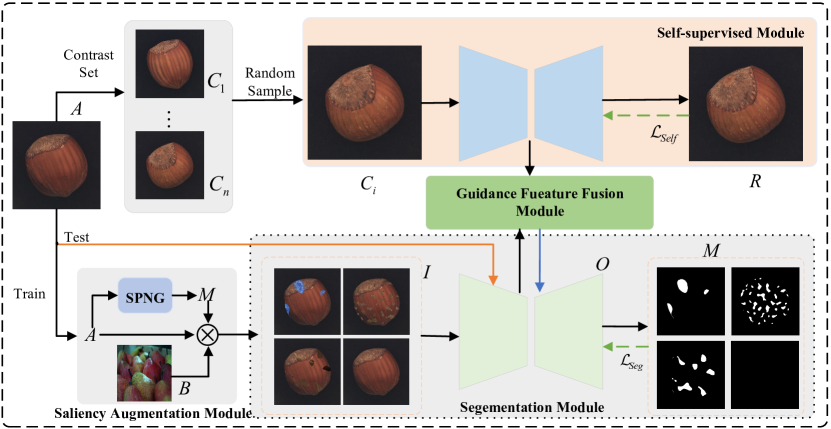
Unsupervised anomaly detection is a challenging task in industrial applications since it is impracticable to collect sufficient anomalous samples. In this paper, a novel Self-Supervised Guided Segmentation Framework (SGSF) is proposed by jointly exploring effective generation method of forged anomalous samples and the normal sample features as the guidance information of segmentation for anomaly detection. Specifically, to ensure that the generated forged anomaly samples are conducive to model training, the Saliency Augmentation Module (SAM) is proposed. SAM introduces a saliency map to generate saliency Perlin noise map, and develops an adaptive segmentation strategy to generate irregular masks in the saliency region. Then, the masks are utilized to generate forged anomalous samples as negative samples for training. Unfortunately, the distribution gap between forged and real anomaly samples makes it difficult for models trained based on forged samples to effectively locate real anomalies. Towards this end, the Self-supervised Guidance Network (SGN) is proposed. It leverages the self-supervised module to extract features that are noise-free and contain normal semantic information as the prior knowledge of the segmentation module. The segmentation module with the knowledge of normal patterns segments out the abnormal regions that are different from the guidance features. To evaluate the effectiveness of SGSF for anomaly detection, extensive experiments are conducted on three anomaly detection datasets. The experimental results show that SGSF achieves state-of-the-art anomaly detection results.
Motivation & Objective
- To address the challenge of unsupervised anomaly detection with limited or no real anomalous samples.
- To reduce the distribution gap between forged and real anomalies by generating more realistic, saliency-based anomalous regions.
- To improve anomaly localization by leveraging self-supervised, noise-free features as prior knowledge for segmentation.
- To develop a robust framework that generalizes well to tiny and irregular anomalies.
Proposed method
- The Saliency Augmentation Module (SAM) uses saliency maps to generate Perlin noise maps focused on salient regions, creating irregular, realistic-looking anomalous masks.
- An adaptive segmentation strategy applies these masks to normal images, generating forged anomalous samples that are more representative of real anomalies.
- The Self-Supervised Guidance Network (SGN) extracts clean, semantic-rich features from a contrast set of augmented views, serving as prior knowledge for segmentation.
- A guidance fusion module combines the self-supervised features with features from the forged anomalous image in the segmentation decoder.
- The model is trained using a combination of self-supervised reconstruction loss and segmentation loss to optimize both feature quality and anomaly localization.
- During inference, the SAM is discarded, and the input image is directly fed into the segmentation network for anomaly detection.

Experimental results
Research questions
- RQ1Can saliency-driven forged anomalies improve the realism and effectiveness of training data in unsupervised anomaly detection?
- RQ2How does self-supervised feature learning enhance the robustness and accuracy of anomaly segmentation?
- RQ3What impact does the inclusion of the original image in the contrast set have on guidance feature quality and model performance?
- RQ4How does adaptive thresholding in mask generation affect localization precision for small or irregular anomalies?
- RQ5What is the optimal balance between self-supervised and segmentation losses for model convergence and performance?
Key findings
- SGSF achieves state-of-the-art performance on three benchmark datasets for both anomaly classification and localization.
- The ablation study confirms that excluding the original image from the contrast set improves performance, as it prevents overfitting to low-level features.
- Setting the contrast set size to n=4 without the original image yields the best localization results, balancing feature diversity and guidance quality.
- The adaptive threshold segmentation strategy (a=0.4, b=0.2) outperforms fixed thresholds, especially in detecting small and scattered anomalies.
- The optimal hyperparameter λ=1 in the loss function balances self-supervised and segmentation objectives, with performance degrading at both lower and higher values.
Read this paper
Open the full text in the Nubint reader and ask about any passage as you read.
Read this paper on NubintThis review was generated by AI from the original paper. Please check the paper before citing it.