
[Paper Review] Self-Supervised Learning for Recommender Systems: A Survey
This survey defines self-supervised recommendation (SSR), proposes a four-category taxonomy (contrastive, generative, predictive, hybrid), introduces SELFRec, and analyzes SSR methods and future directions for recommender systems.
In recent years, neural architecture-based recommender systems have achieved tremendous success, but they still fall short of expectation when dealing with highly sparse data. Self-supervised learning (SSL), as an emerging technique for learning from unlabeled data, has attracted considerable attention as a potential solution to this issue. This survey paper presents a systematic and timely review of research efforts on self-supervised recommendation (SSR). Specifically, we propose an exclusive definition of SSR, on top of which we develop a comprehensive taxonomy to divide existing SSR methods into four categories: contrastive, generative, predictive, and hybrid. For each category, we elucidate its concept and formulation, the involved methods, as well as its pros and cons. Furthermore, to facilitate empirical comparison, we release an open-source library SELFRec (https://github.com/Coder-Yu/SELFRec), which incorporates a wide range of SSR models and benchmark datasets. Through rigorous experiments using this library, we derive and report some significant findings regarding the selection of self-supervised signals for enhancing recommendation. Finally, we shed light on the limitations in the current research and outline the future research directions.
Motivation & Objective
- Define SSR and distinguish it from related paradigms such as pre-training and standard contrastive learning.
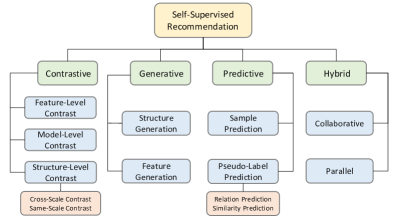
- Develop a taxonomy of SSR methods into four categories: contrastive, generative, predictive, and hybrid.
- Summarize data augmentation techniques and training schemes used in SSR.
- Provide an open-source framework (SELFRec) and empirical findings to guide SSR design.
- Discuss limitations and future directions in SSR for recommender systems.
Proposed method
- Propose a formal definition of SSR based on semi-automatic supervision from augmented data and a self-supervised task that enhances recommendation.
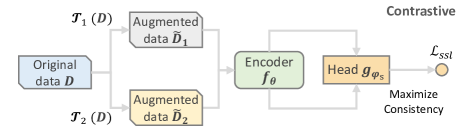
- Introduce a unified encoder+projection-head architecture capable of handling graphs, sequences, and categorical features.
- Categorize SSR methods into four categories (contrastive, generative, predictive, hybrid) with their objectives and losses (L_rec, L_ssl).
- Outline three training schemes (Joint Learning, Pre-training and Fine-tuning, Integrated Learning) for combining self-supervised tasks with recommendations.
- Present and summarize commonly used data augmentation techniques for sequences, graphs, and features.
- Provide an open-source library SELFRec with benchmarks and over 20 SSR methods.
Experimental results
Research questions
- RQ1What formal definition best captures SSR and its distinction from related paradigms?
- RQ2How can SSR methods be systematically categorized for recommender systems?
- RQ3What are effective data augmentation strategies and training schemes in SSR?
- RQ4What insights emerge from empirical comparisons using SELFRec about self-supervised signals for enhancement of recommendations?
- RQ5What are the current limitations and promising directions for SSR research?
Key findings
- SSR benefits from diverse self-supervision signals across four categories, with distinct trade-offs for each category.
- Data augmentation plays a crucial role in learning transferable representations for SSR.
- Joint Learning is the most common training scheme, while Pre-training and Fine-tuning is prevalent for BERT-like generative SSR models.
- An open-source SELFRec library enables reproducible evaluation of SSR methods and benchmarks.
- Empirical results in SELFRec highlight effective choices of self-supervised signals and the importance of task alignment with recommendation objectives.
- The survey identifies limitations and outlines future directions to advance SSR in recommendation.
Read this paper
Open the full text in the Nubint reader and ask about any passage as you read.
Read this paper on NubintThis review was generated by AI from the original paper. Please check the paper before citing it.