
[Paper Review] Self-Supervised Learning of Object Parts for Semantic Segmentation
This paper proposes Leopart, a self-supervised method that learns object parts via dense clustering of Vision Transformer (ViT) spatial tokens to improve semantic segmentation. By leveraging ViT attention mechanisms and a novel pretext task, Leopart achieves state-of-the-art performance on Pascal VOC, COCO-Thing, and COCO-Stuff benchmarks, surpassing prior self-supervised and supervised methods in both transferable representation learning and fully unsupervised segmentation.
Progress in self-supervised learning has brought strong general image representation learning methods. Yet so far, it has mostly focused on image-level learning. In turn, tasks such as unsupervised image segmentation have not benefited from this trend as they require spatially-diverse representations. However, learning dense representations is challenging, as in the unsupervised context it is not clear how to guide the model to learn representations that correspond to various potential object categories. In this paper, we argue that self-supervised learning of object parts is a solution to this issue. Object parts are generalizable: they are a priori independent of an object definition, but can be grouped to form objects a posteriori. To this end, we leverage the recently proposed Vision Transformer's capability of attending to objects and combine it with a spatially dense clustering task for fine-tuning the spatial tokens. Our method surpasses the state-of-the-art on three semantic segmentation benchmarks by 17%-3%, showing that our representations are versatile under various object definitions. Finally, we extend this to fully unsupervised segmentation - which refrains completely from using label information even at test-time - and demonstrate that a simple method for automatically merging discovered object parts based on community detection yields substantial gains.
Motivation & Objective
- To address the lack of effective self-supervised dense representation learning for semantic segmentation, especially in unsupervised or weakly supervised settings.
- To overcome the brittleness of predefined object definitions by learning generalizable object parts that can be composed into objects a-posteriori.
- To improve ViT-based self-supervised models by learning semantically structured, spatially discriminative token embeddings without relying on human-annotated labels.
- To enable fully unsupervised semantic segmentation by automatically merging learned object parts using community detection on cluster co-occurrence networks.
Proposed method
- Leverages a Vision Transformer (ViT) with DINO pretraining to extract spatial tokens from image patches.
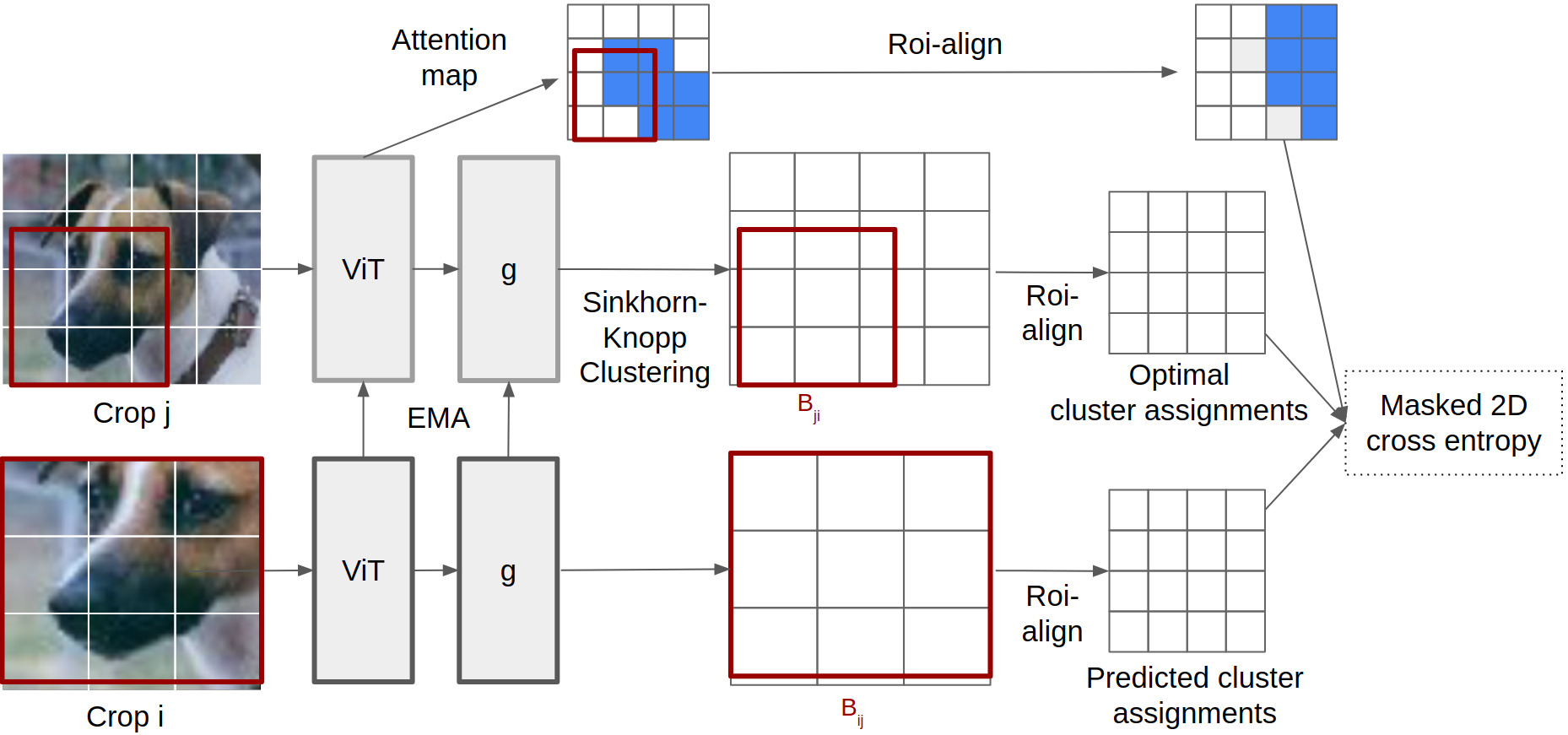
- Introduces a dense clustering pretext task that groups spatial tokens based on feature similarity, encouraging the model to learn semantically meaningful object parts.
- Uses contrastive clustering with a momentum encoder to stabilize training and improve feature discrimination across patches.
- Applies community detection on a co-occurrence network of clusters to automatically merge object parts into coherent object segments in fully unsupervised settings.
- Employs a two-stage inference pipeline: first, cluster-based foreground extraction (CBFE) using attention maps and cluster masks; second, overclustering with K-Means on foreground tokens.
- Constructs a cluster co-occurrence network where nodes represent learned clusters and edges represent spatial co-occurrence, enabling community detection to form higher-level object-like segments.
Experimental results
Research questions
- RQ1Can self-supervised learning of object parts via dense clustering improve the quality of ViT-based dense representations for semantic segmentation?
- RQ2Does learning object parts as a generalizable intermediate representation outperform direct self-supervised pretraining in downstream semantic segmentation tasks?
- RQ3Can a fully unsupervised segmentation pipeline be built using only learned object parts and community detection, without any human-annotated labels at test time?
- RQ4How does the proposed method compare to supervised and semi-supervised baselines in terms of transferability and performance across diverse object definitions and datasets?
Key findings
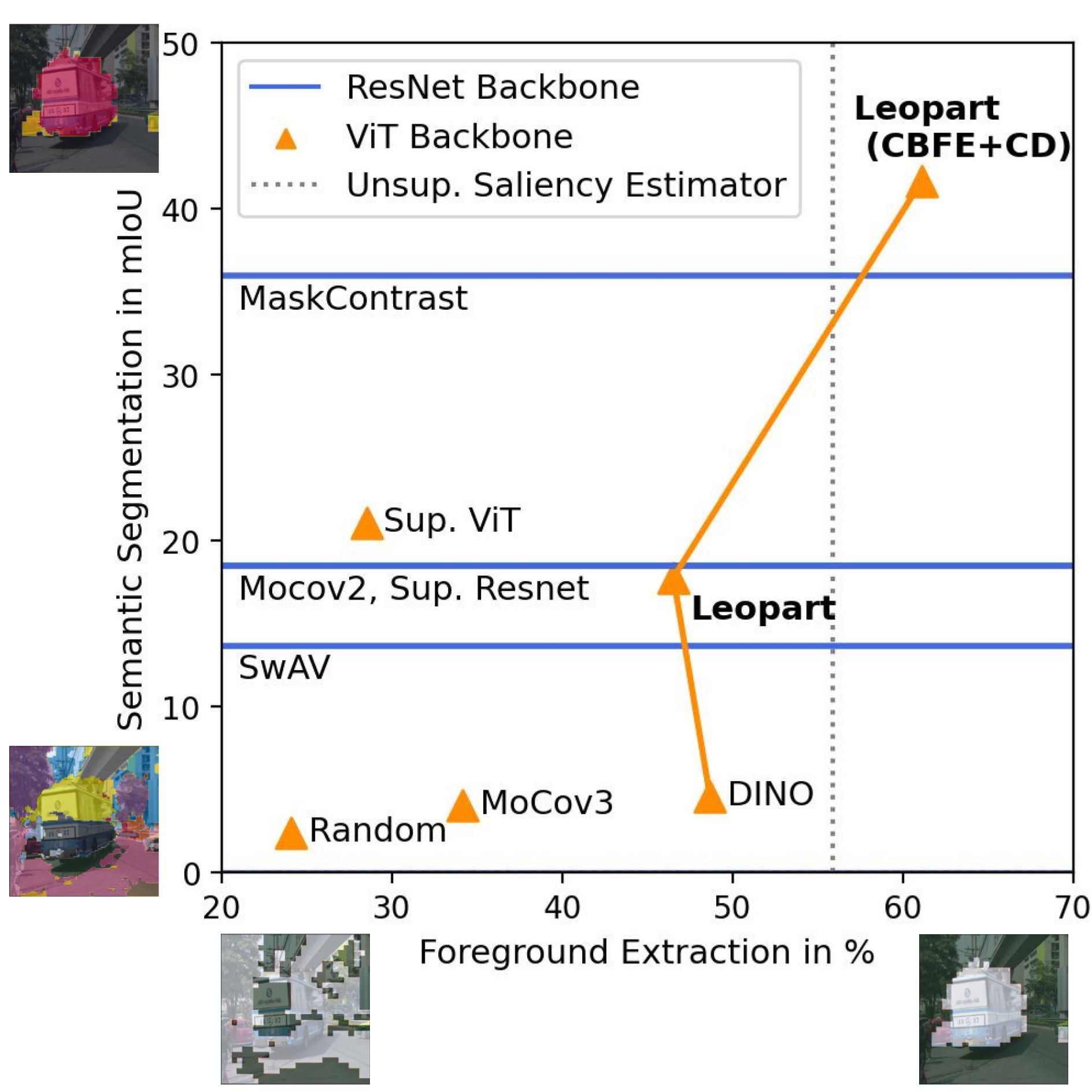
- Leopart improves over DINO’s self-supervised ViT by 9% in Jaccard distance and 9% in Boundary F1 score for foreground extraction, outperforming dedicated unsupervised saliency estimators.
- On Pascal VOC, COCO-Thing, and COCO-Stuff benchmarks, Leopart achieves state-of-the-art performance, surpassing prior self-supervised and supervised methods by 3% to 17% in mIoU.
- The combination of CBFE (cluster-based foreground extraction) and community detection (CD) improves fully unsupervised segmentation performance by over 6% compared to prior unsupervised methods.
- Community detection successfully identifies semantically coherent object parts, such as separate clusters for bicycle wheels and car wheels, and groups semantically similar parts like human faces and hair into the same communities.
- The method demonstrates that object parts learned through self-supervision can be dynamically recombined into objects under different definitions, proving their versatility across benchmarks with varying granularity.
- Even though ViTs are strong at object localization, they fail to learn discriminative spatial embeddings for segmentation unless fine-tuned with the proposed dense clustering loss.
Read this paper
Open the full text in the Nubint reader and ask about any passage as you read.
Read this paper on NubintThis review was generated by AI from the original paper. Please check the paper before citing it.