
[Paper Review] Self-Supervised Monocular Depth Estimation with Self-Reference Distillation and Disparity Offset Refinement
This paper proposes a self-supervised monocular depth estimation method using self-reference distillation and disparity offset refinement. By continuously updating a student-teacher model pair and filtering outliers via multiview consistency, the approach improves depth accuracy and mitigates misalignment from upsampling, achieving state-of-the-art performance on KITTI and Make3D benchmarks.
Monocular depth estimation plays a fundamental role in computer vision. Due to the costly acquisition of depth ground truth, self-supervised methods that leverage adjacent frames to establish a supervisory signal have emerged as the most promising paradigms. In this work, we propose two novel ideas to improve self-supervised monocular depth estimation: 1) self-reference distillation and 2) disparity offset refinement. Specifically, we use a parameter-optimized model as the teacher updated as the training epochs to provide additional supervision during the training process. The teacher model has the same structure as the student model, with weights inherited from the historical student model. In addition, a multiview check is introduced to filter out the outliers produced by the teacher model. Furthermore, we leverage the contextual consistency between high-scale and low-scale features to obtain multiscale disparity offsets, which are used to refine the disparity output incrementally by aligning disparity information at different scales. The experimental results on the KITTI and Make3D datasets show that our method outperforms previous state-of-the-art competitors.
Motivation & Objective
- Address the challenge of limited availability of real-world depth annotations by advancing self-supervised monocular depth estimation.
- Improve training stability and depth estimation accuracy in dynamic or low-texture regions where standard self-supervised methods fail.
- Overcome disparity misalignment caused by upsampling in multiscale feature prediction by introducing contextual consistency-based refinement.
- Develop a single-stage, efficient distillation framework that avoids the two-stage training overhead of prior distillation methods.
Proposed method
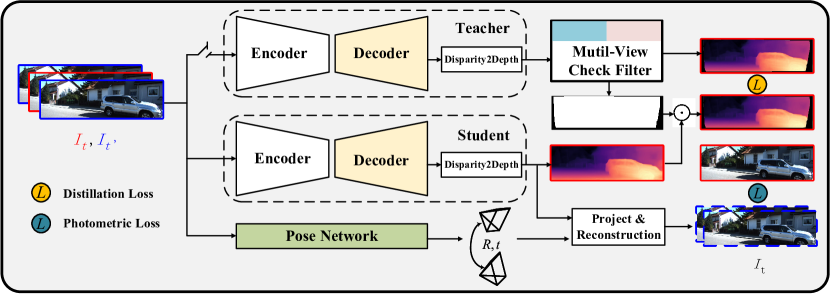
- Introduce self-reference distillation, where a teacher model with the same architecture as the student is updated via student weights at each training epoch to provide evolving supervision.
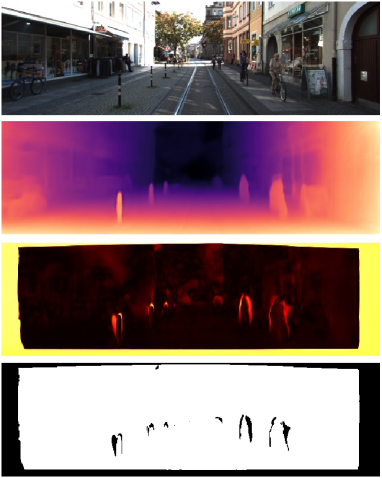
- Apply a multiview check filter to detect and suppress unreliable depth predictions—especially in motion or edge regions—by validating consistency between forward and backward image warping.
- Leverage contextual consistency between high-level and low-level features to predict multiscale disparity offsets that refine disparity maps incrementally.
- Use the disparity offset fields to correct misalignment introduced during upsampling, improving alignment across feature scales.
- Train the student model end-to-end with a combined loss: photometric reconstruction loss and distillation loss from the filtered teacher output.
- Employ a binarized hard mask derived from the multiview check to selectively suppress high-error regions during distillation, improving robustness.
Experimental results
Research questions
- RQ1Can a continuously updated teacher model improve self-supervised depth estimation without requiring separate pre-training?
- RQ2How effective is a multiview consistency check in filtering out unreliable depth predictions from a teacher model during distillation?
- RQ3Can disparity offset refinement based on feature-level context reduce misalignment in multiscale disparity prediction?
- RQ4Does the proposed method achieve better performance and efficiency than existing two-stage distillation approaches?
Key findings
- The proposed method achieves state-of-the-art performance on the KITTI and Make3D datasets, outperforming previous self-supervised methods.
- The self-reference distillation module significantly improves the Sq Rel metric, demonstrating its effectiveness in reducing depth estimation error.
- The hard mask generated by the multiview check filter outperforms soft mask, discovered mask, and auto mask in all evaluation metrics, especially in handling outliers.
- Using MPViT-S as the backbone yields the best performance, indicating strong feature representation learning with the proposed modules.
- The method achieves superior results with minimal computational overhead, outperforming two-stage distillation methods in both training time and FLOPs.
- Ablation studies confirm that all components—self-reference distillation, multiview check, and disparity alignment—contribute independently and significantly to performance gains.
Read this paper
Open the full text in the Nubint reader and ask about any passage as you read.
Read this paper on NubintThis review was generated by AI from the original paper. Please check the paper before citing it.