
[Paper Review] Self-Supervised Multimodal Learning: A Survey
This survey provides a comprehensive overview of self-supervised multimodal learning (SSML), addressing core challenges in representation learning without labels, multimodal fusion, and unaligned data. It reviews self-supervision objectives, architectures, alignment strategies, and real-world applications, highlighting unification trends, emergent abilities, and evolving definitions of self-supervision in multimodal AI.
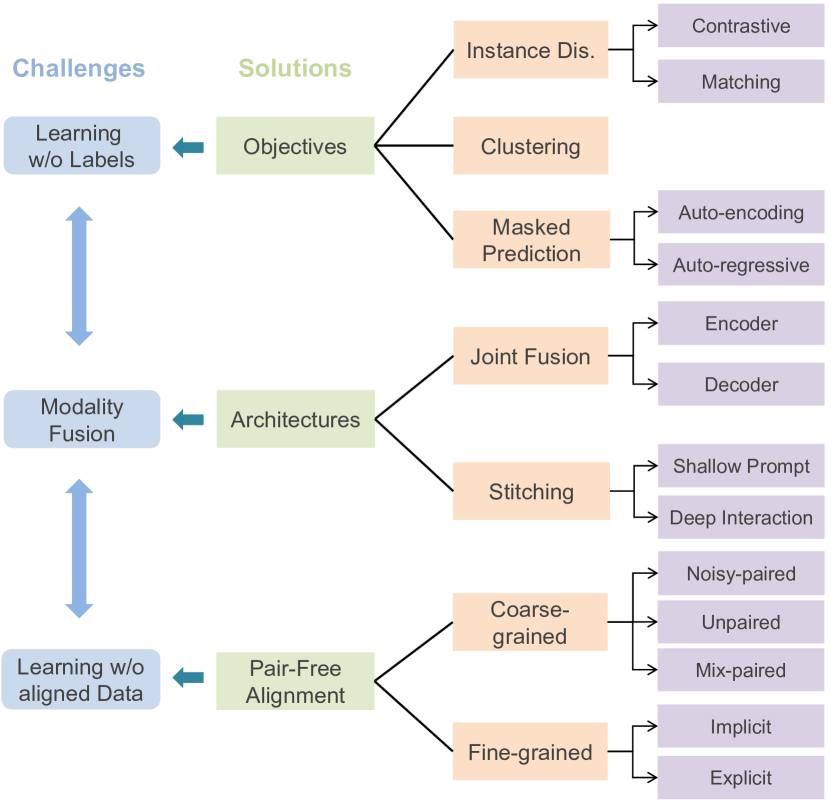
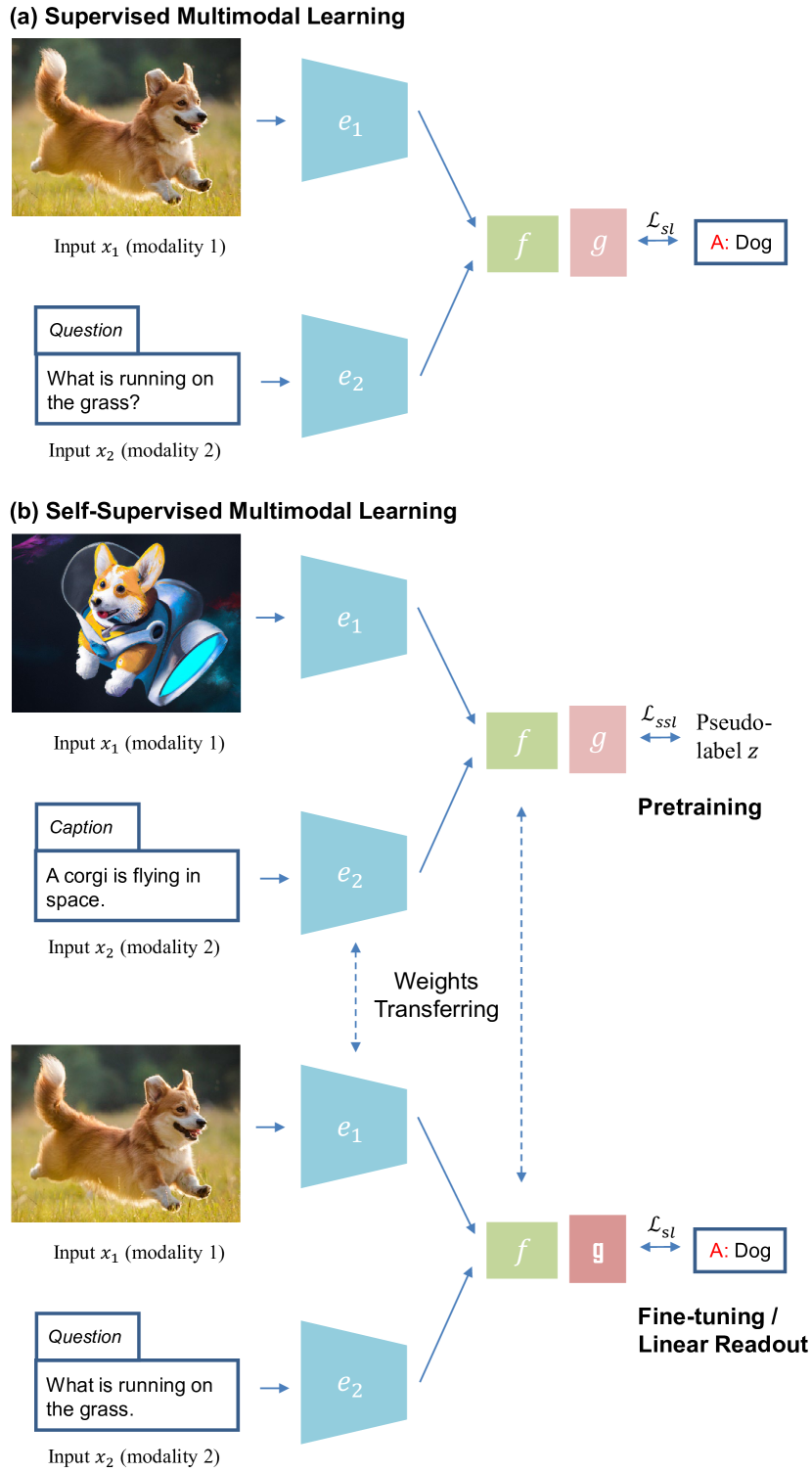
Multimodal learning, which aims to understand and analyze information from multiple modalities, has achieved substantial progress in the supervised regime in recent years. However, the heavy dependence on data paired with expensive human annotations impedes scaling up models. Meanwhile, given the availability of large-scale unannotated data in the wild, self-supervised learning has become an attractive strategy to alleviate the annotation bottleneck. Building on these two directions, self-supervised multimodal learning (SSML) provides ways to learn from raw multimodal data. In this survey, we provide a comprehensive review of the state-of-the-art in SSML, in which we elucidate three major challenges intrinsic to self-supervised learning with multimodal data: (1) learning representations from multimodal data without labels, (2) fusion of different modalities, and (3) learning with unaligned data. We then detail existing solutions to these challenges. Specifically, we consider (1) objectives for learning from multimodal unlabeled data via self-supervision, (2) model architectures from the perspective of different multimodal fusion strategies, and (3) pair-free learning strategies for coarse-grained and fine-grained alignment. We also review real-world applications of SSML algorithms in diverse fields such as healthcare, remote sensing, and machine translation. Finally, we discuss challenges and future directions for SSML. A collection of related resources can be found at: https://github.com/ys-zong/awesome-self-supervised-multimodal-learning.
Motivation & Objective
- To address the annotation bottleneck in multimodal learning by leveraging self-supervised learning (SSL) with unpaired, unlabeled data.
- To identify and analyze three core challenges in SSML: representation learning without labels, effective multimodal fusion, and learning from unaligned data.
- To review state-of-the-art methods for self-supervised objectives, fusion architectures, and pair-free alignment strategies across coarse- and fine-grained levels.
- To examine real-world applications of SSML in healthcare, remote sensing, and machine translation, and discuss ethical and societal implications.
- To explore emerging trends such as architectural unification, emergent abilities in large-scale models, and evolving definitions of self-supervision in multimodal contexts.
Proposed method
- Categorizes self-supervised objectives into instance discrimination, clustering, and masked prediction, with hybrid approaches.
- Classifies multimodal fusion strategies into early fusion (joint encoders), late fusion (separate encoders with late interaction), and model stitching (pretrained unimodal models linked via SSL).
- Reviews pair-free learning techniques for coarse-grained alignment using noisy-paired, mixed-paired, and completely unpaired data scenarios.
- Examines fine-grained alignment methods that derive implicit or explicit alignment without explicit bounding box or word-level supervision.
- Analyzes decoder designs and their impact on representation quality and downstream task performance.
- Proposes a taxonomy of SSML challenges and solutions, integrating insights from vision-language pretraining, biomedicine, and autonomous systems.
Experimental results
Research questions
- RQ1How can multimodal representations be effectively learned from raw, unannotated data using self-supervision?
- RQ2What are the most effective architectures and fusion strategies for self-supervised multimodal learning?
- RQ3How can models learn robust representations when modalities are unaligned at coarse- or fine-grained levels?
- RQ4What are the key self-supervision objectives that enable strong performance without human-annotated pairs?
- RQ5How do emergent abilities and architectural unification shape the future of self-supervised multimodal models?
Key findings
- Self-supervised multimodal learning significantly reduces reliance on expensive human annotations by leveraging freely available co-occurring data like video-audio pairs or image-caption pairs.
- Architectural unification—using shared encoders or unified objectives—enables more scalable and generalizable multimodal models across diverse data types.
- Emergent abilities in large-scale SSML models, such as zero-shot recognition or reasoning, appear only at specific model sizes, suggesting a threshold effect in multimodal representation learning.
- Pair-free learning strategies for unaligned data, including contrastive learning with noise-robust objectives, enable effective alignment without explicit pairing.
- Bias in SSML models can emerge from data, architecture, or objectives, highlighting the need for systematic bias detection and mitigation in multimodal systems.
- The definition of self-supervision is evolving, especially with LLM-generated outputs, raising questions about whether such signals qualify as truly self-supervised.
Read this paper
Open the full text in the Nubint reader and ask about any passage as you read.
Read this paper on NubintThis review was generated by AI from the original paper. Please check the paper before citing it.