
[Paper Review] Self-Supervised Time Series Representation Learning via Cross Reconstruction Transformer
This paper proposes Cross Reconstruction Transformer (CRT), a self-supervised time series representation learning method that leverages cross-domain reconstruction between time and frequency domains using a Transformer encoder. By applying masked reconstruction with curriculum learning and instance discrimination, CRT achieves state-of-the-art performance, outperforming existing methods by 2%–9% on multiple real-world datasets through enhanced modeling of temporal-spectral correlations.
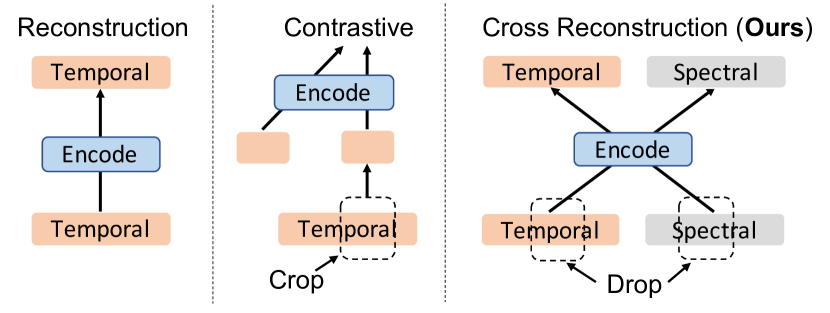
Unsupervised/self-supervised representation learning in time series is critical since labeled samples are usually scarce in real-world scenarios. Existing approaches mainly leverage the contrastive learning framework, which automatically learns to understand the similar and dissimilar data pairs. Nevertheless, they are restricted to the prior knowledge of constructing pairs, cumbersome sampling policy, and unstable performances when encountering sampling bias. Also, few works have focused on effectively modeling across temporal-spectral relations to extend the capacity of representations. In this paper, we aim at learning representations for time series from a new perspective and propose Cross Reconstruction Transformer (CRT) to solve the aforementioned problems in a unified way. CRT achieves time series representation learning through a cross-domain dropping-reconstruction task. Specifically, we transform time series into the frequency domain and randomly drop certain parts in both time and frequency domains. Dropping can maximally preserve the global context compared to cropping and masking. Then a transformer architecture is utilized to adequately capture the cross-domain correlations between temporal and spectral information through reconstructing data in both domains, which is called Dropped Temporal-Spectral Modeling. To discriminate the representations in global latent space, we propose Instance Discrimination Constraint to reduce the mutual information between different time series and sharpen the decision boundaries. Additionally, we propose a specified curriculum learning strategy to optimize the CRT, which progressively increases the dropping ratio in the training process.
Motivation & Objective
- To address the limitations of existing self-supervised time series methods that neglect spectral information and suffer from distribution shifts due to masking.
- To improve representation learning by explicitly modeling temporal-spectral correlations through cross-domain reconstruction.
- To eliminate dependency on complex sampling policies in contrastive learning and avoid distribution shift in reconstruction-based methods.
- To develop a robust, end-to-end framework that enhances downstream performance through curriculum learning and instance discrimination.
Proposed method
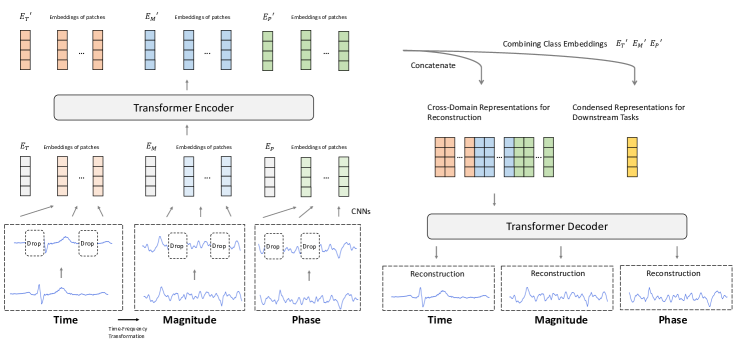
- The method applies Fast Fourier Transform to obtain frequency-domain representations, including both magnitude and phase, to preserve spectral information.
- It introduces a cross-domain dropping-reconstruction task by randomly masking patches in both time and frequency domains to induce distribution shift while preserving global context.
- A shared Transformer encoder processes representations from both domains, learning cross-domain dependencies through joint modeling of temporal and spectral features.
- The model reconstructs the original time and frequency data from the masked representations, enabling self-supervised pre-training.
- A curriculum learning strategy progressively increases the dropping ratio during pre-training to improve robustness and generalization.
- An Instance Discrimination Constraint (IDC) is applied to minimize mutual information between different samples, sharpening decision boundaries in the latent space.
Experimental results
Research questions
- RQ1Can cross-domain reconstruction between time and frequency domains improve self-supervised time series representation learning?
- RQ2How does modeling temporal-spectral correlations enhance feature discriminability and downstream performance?
- RQ3Does curriculum learning with progressive masking improve robustness and generalization in pre-training?
- RQ4How does the proposed instance discrimination constraint compare to contrastive learning in terms of stability and performance?
- RQ5To what extent does preserving phase information in the frequency domain improve reconstruction and representation quality?
Key findings
- CRT achieves state-of-the-art performance across three benchmark datasets, outperforming existing methods by 2% to 9% in classification accuracy.
- On the PTB-XL dataset, CRT achieves an AUC of 98.94% ± 0.22 on the 'MI' class, significantly outperforming F2T (87.30%) and T2F (94.24%) methods.
- The ablation study confirms that both curriculum learning and instance discrimination constraints significantly improve model performance, with IDC reducing mutual information between samples.
- The cross-domain reconstruction framework (CRT) consistently outperforms unidirectional methods (T2F and F2T), especially on complex patterns like ECG signals with periodic structures.
- The model demonstrates strong generalization, maintaining high reconstruction quality even at a 70% dropping ratio, indicating robust learning of global patterns.
- The inclusion of phase information in the frequency domain leads to more accurate and informative representations compared to magnitude-only approaches.
Read this paper
Open the full text in the Nubint reader and ask about any passage as you read.
Read this paper on NubintThis review was generated by AI from the original paper. Please check the paper before citing it.