
[Paper Review] Self-supervised Trajectory Representation Learning with Temporal Regularities and Travel Semantics
This paper proposes START, a self-supervised trajectory representation learning framework that integrates temporal regularities (periodic traffic patterns and irregular time intervals) and travel semantics (road visit frequencies and types) into trajectory embeddings. By combining a Trajectory Pattern-Enhanced Graph Attention Network and a Time-Aware Trajectory Encoder with span-masked recovery and contrastive learning, START achieves state-of-the-art performance across multiple downstream tasks on real-world datasets, with strong transferability across cities.
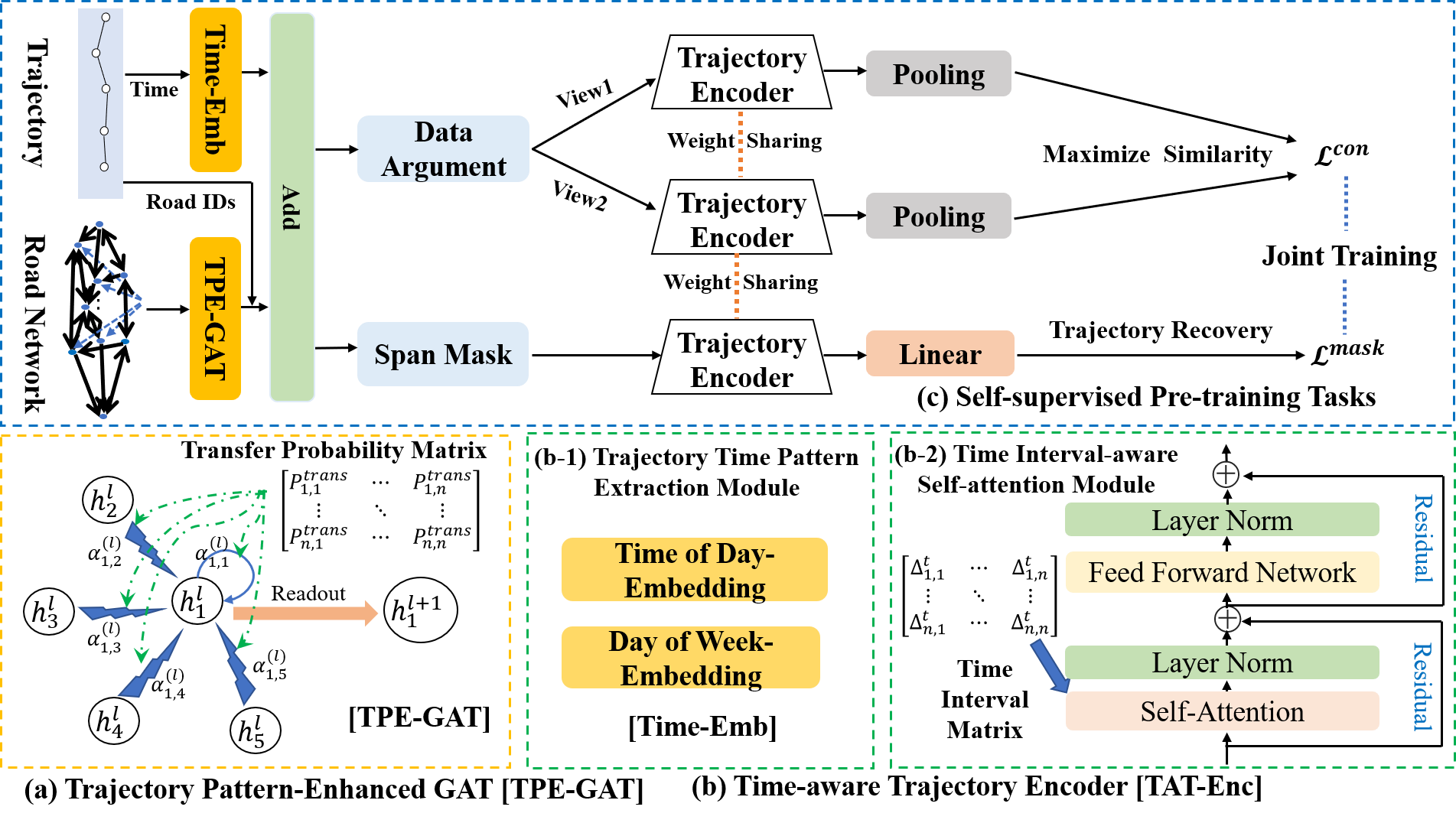
Trajectory Representation Learning (TRL) is a powerful tool for spatial-temporal data analysis and management. TRL aims to convert complicated raw trajectories into low-dimensional representation vectors, which can be applied to various downstream tasks, such as trajectory classification, clustering, and similarity computation. Existing TRL works usually treat trajectories as ordinary sequence data, while some important spatial-temporal characteristics, such as temporal regularities and travel semantics, are not fully exploited. To fill this gap, we propose a novel Self-supervised trajectory representation learning framework with TemporAl Regularities and Travel semantics, namely START. The proposed method consists of two stages. The first stage is a Trajectory Pattern-Enhanced Graph Attention Network (TPE-GAT), which converts the road network features and travel semantics into representation vectors of road segments. The second stage is a Time-Aware Trajectory Encoder (TAT-Enc), which encodes representation vectors of road segments in the same trajectory as a trajectory representation vector, meanwhile incorporating temporal regularities with the trajectory representation. Moreover, we also design two self-supervised tasks, i.e., span-masked trajectory recovery and trajectory contrastive learning, to introduce spatial-temporal characteristics of trajectories into the training process of our START framework. The effectiveness of the proposed method is verified by extensive experiments on two large-scale real-world datasets for three downstream tasks. The experiments also demonstrate that our method can be transferred across different cities to adapt heterogeneous trajectory datasets.
Motivation & Objective
- Address the limitation of existing trajectory representation learning (TRL) methods that treat trajectories as ordinary sequences, ignoring critical spatial-temporal characteristics.
- Incorporate travel semantics—such as road visit frequencies and types—into trajectory representations to improve downstream task performance.
- Model temporal regularities, including periodic urban traffic patterns and irregular time intervals between trajectory samples, to enhance representation quality.
- Design a two-stage framework that learns generic, transferable trajectory representations applicable across diverse cities and datasets.
- Develop self-supervised pre-training tasks that explicitly leverage spatial-temporal regularities to improve representation learning without labeled data.
Proposed method
- Employ a Trajectory Pattern-Enhanced Graph Attention Network (TPE-GAT) to encode road network features and travel semantics into road segment representation vectors.
- Use a Time-Aware Trajectory Encoder (TAT-Enc) to aggregate road segment representations into a unified trajectory representation vector while modeling temporal regularities.
- Introduce a span-masked trajectory recovery task to predict masked road segments based on context and temporal patterns, enhancing sequence modeling.
- Design a trajectory contrastive learning task using temporal and spatial augmentations to maximize similarity between positive trajectory views and minimize it for negative pairs.
- Leverage both predictive (span-masked recovery) and contrastive self-supervised learning objectives to jointly train the framework.
- Apply normalized temperature-scaled cross-entropy (NT-Xent) loss for contrastive learning and standard reconstruction loss for span-masking.

Experimental results
Research questions
- RQ1Can integrating temporal regularities such as periodic traffic patterns and irregular time intervals improve trajectory representation learning?
- RQ2To what extent do travel semantics like road visit frequency and type contribute to more informative trajectory embeddings?
- RQ3Can a two-stage self-supervised framework effectively learn generic trajectory representations transferable across heterogeneous urban datasets?
- RQ4How does the proposed framework compare to state-of-the-art methods in downstream tasks such as trajectory classification, clustering, and similarity computation?
- RQ5Can the combination of span-masked recovery and contrastive learning better capture spatial-temporal regularities than existing self-supervised methods?
Key findings
- START outperforms state-of-the-art baselines on three downstream tasks—trajectory classification, clustering, and similarity computation—across two large-scale real-world datasets.
- The model achieves significant performance gains, particularly in trajectory clustering and similarity computation, due to the explicit modeling of temporal regularities and travel semantics.
- The framework demonstrates strong zero-shot transferability, generalizing well to different cities without retraining, even when trajectory distributions vary.
- Ablation studies confirm that both self-supervised tasks—span-masked recovery and contrastive learning—contribute meaningfully to representation quality.
- Compared to Trembr, which also considers timestamps, START performs better by explicitly modeling periodic patterns and irregular time intervals.
- The integration of travel semantics (e.g., road visit frequency) into the graph encoder leads to more discriminative road segment representations, improving overall performance.
Better researchstarts right now
From reading papers to final review, dramatically reduce your research time.
No credit card · Free plan available
This review was created by AI and reviewed by human editors.