
[Paper Review] Self-Taught Evaluators
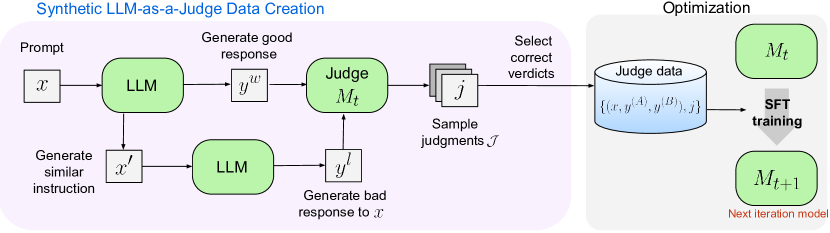
This paper proposes Self-Taught Evaluators, a method to train LLM-as-a-Judge models without human preference annotations by using iterative synthetic data generation. Starting from a seed LLM, the approach generates contrasting response pairs, uses the model to produce reasoning traces and judgments, retrains the model, and repeats—achieving 88.7% accuracy on RewardBench, matching or exceeding human-annotated reward models.
Model-based evaluation is at the heart of successful model development -- as a reward model for training, and as a replacement for human evaluation. To train such evaluators, the standard approach is to collect a large amount of human preference judgments over model responses, which is costly and the data becomes stale as models improve. In this work, we present an approach that aims to im-prove evaluators without human annotations, using synthetic training data only. Starting from unlabeled instructions, our iterative self-improvement scheme generates contrasting model outputs and trains an LLM-as-a-Judge to produce reasoning traces and final judgments, repeating this training at each new iteration using the improved predictions. Without any labeled preference data, our Self-Taught Evaluator can improve a strong LLM (Llama3-70B-Instruct) from 75.4 to 88.3 (88.7 with majority vote) on RewardBench. This outperforms commonly used LLM judges such as GPT-4 and matches the performance of the top-performing reward models trained with labeled examples.
Motivation & Objective
- To develop a scalable, low-cost method for training strong LLM-based evaluators without relying on expensive human-annotated preference data.
- To address the issue of stale human preference data as models improve over time.
- To enable self-improvement of evaluators through iterative synthetic data generation and retraining.
- To match or exceed the performance of human-annotated reward models using only synthetic data and self-supervision.
Proposed method
- The method begins with a seed LLM to generate contrasting response pairs (one high-quality, one low-quality) for a given instruction.
- The same LLM acts as an LLM-as-a-Judge, generating reasoning traces and final pairwise judgments for each synthetic pair.
- These synthetic judgments are treated as supervised labels, and the model is fine-tuned on this synthetic data to improve its evaluation capability.
- The process is repeated iteratively, using the improved model to generate better synthetic data in each subsequent round.
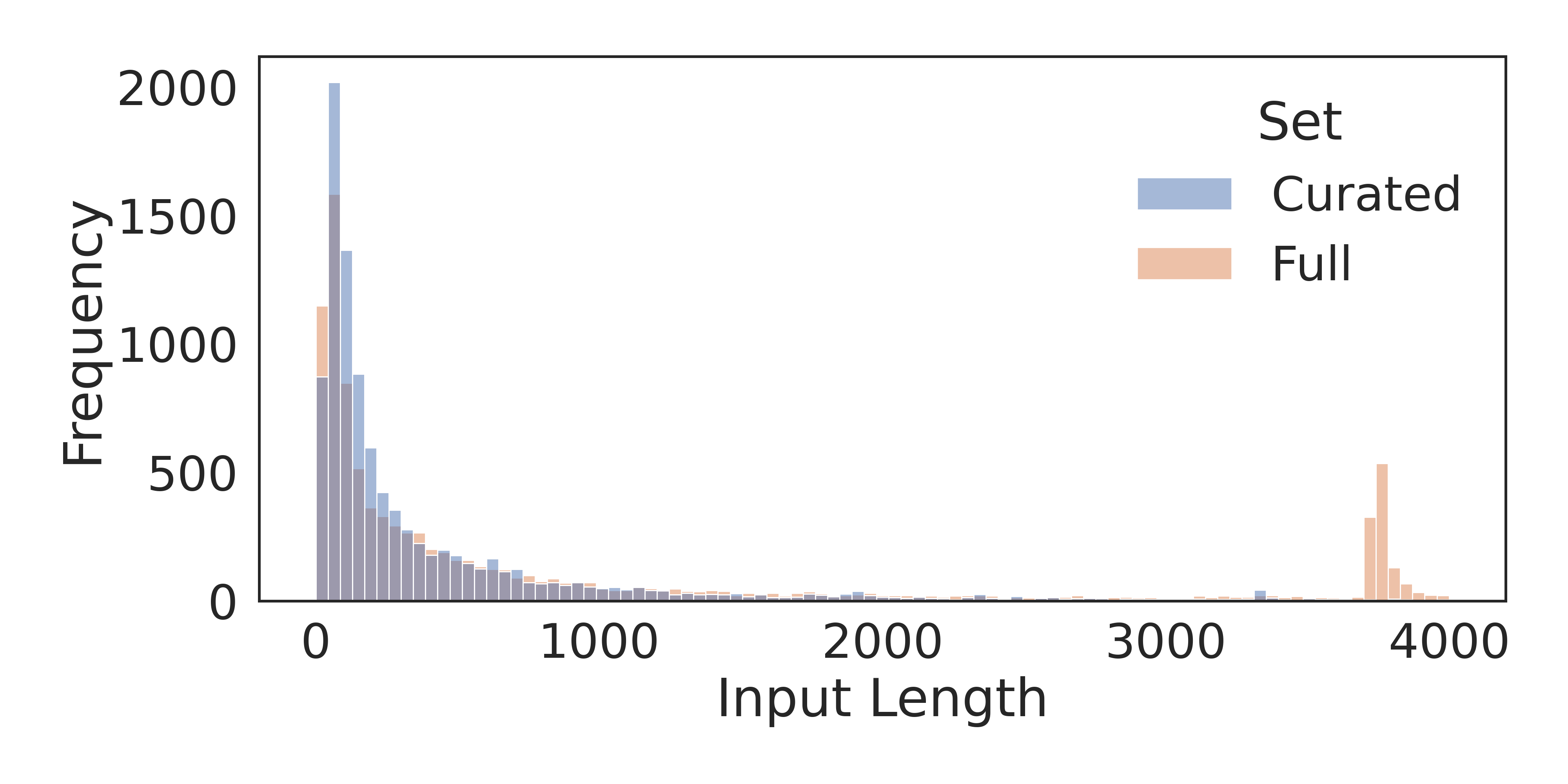
- The training data is curated to include diverse instruction types, with complexity and output length estimated via prompting.
- The approach uses a self-supervised loop where model-generated judgments are used to refine the model’s own evaluation behavior.
Experimental results
Research questions
- RQ1Can an LLM-as-a-Judge be effectively trained without any human-annotated preference data?
- RQ2How effective is iterative synthetic data generation in improving evaluator performance over time?
- RQ3Can self-improving evaluators match or surpass the performance of human-annotated reward models?
- RQ4How does combining synthetic and human-annotated data affect evaluator accuracy?
- RQ5What impact does instruction complexity have on the performance of self-trained evaluators?
Key findings
- The Self-Taught Evaluator improves Llama3-70B-Instruct’s performance on RewardBench from 75.4% to 88.7% using only synthetic data and iterative training.
- The method achieves state-of-the-art performance among LLM-as-a-Judge approaches, matching or exceeding models trained with human-annotated data such as those fine-tuned on the HelpSteer2 dataset.
- Even when initialized with a model fine-tuned on 10k human annotations (HelpSteer2), the iterative synthetic training does not clearly outperform training from unlabeled data alone.
- Combining synthetic preferences with human-annotated data (e.g., HelpSteer2) leads to slight performance improvements across different data mixing weights.
- The curated training set contains more complex, reasoning-intensive instructions (e.g., logic, science), while the full dataset includes more long-form, repetitive, or entertainment-focused inputs.
- The method demonstrates strong generalization, maintaining high performance across in-distribution and out-of-distribution evaluation sets, including safety and code tasks.
Read this paper
Open the full text in the Nubint reader and ask about any passage as you read.
Read this paper on NubintThis review was generated by AI from the original paper. Please check the paper before citing it.