
[Paper Review] Self-Verification Improves Few-Shot Clinical Information Extraction
The paper introduces a self-verification (SV) framework that uses multiple calls to the same LLM with different prompts to extract clinical information, ground outputs in evidence, and prune inaccuracies, improving few-shot performance and yielding interpretable span-based grounding.
Extracting patient information from unstructured text is a critical task in health decision-support and clinical research. Large language models (LLMs) have shown the potential to accelerate clinical curation via few-shot in-context learning, in contrast to supervised learning which requires much more costly human annotations. However, despite drastic advances in modern LLMs such as GPT-4, they still struggle with issues regarding accuracy and interpretability, especially in mission-critical domains such as health. Here, we explore a general mitigation framework using self-verification, which leverages the LLM to provide provenance for its own extraction and check its own outputs. This is made possible by the asymmetry between verification and generation, where the latter is often much easier than the former. Experimental results show that our method consistently improves accuracy for various LLMs in standard clinical information extraction tasks. Additionally, self-verification yields interpretations in the form of a short text span corresponding to each output, which makes it very efficient for human experts to audit the results, paving the way towards trustworthy extraction of clinical information in resource-constrained scenarios. To facilitate future research in this direction, we release our code and prompts.
Motivation & Objective
- Address the limited accuracy and interpretability of few-shot clinical information extraction with LLMs in healthcare domains.
- Propose a self-verification pipeline that sequentially refines, grounds, and prunes LLM outputs.
- Demonstrate that SV improves extraction accuracy across multiple tasks and models while providing interpretable evidence grounding.
- Release code and prompts to facilitate future research.
Proposed method
- Four-step SV pipeline using the same LLM with different prompts: Original extraction, Omission to find missing elements, Evidence grounding to source spans, and Prune to remove inaccuracies.
- For long inputs, repeat the Omission step up to five iterations until no new omissions are found.
- Grounding spans provide text evidence for each extracted item to enable human auditing.
- Compared SV to a single large-prompt baseline and evaluated macro F1, recall, and precision across multiple tasks and models.
- Prompts and exact prompts are provided in the GitHub repository.

Experimental results
Research questions
- RQ1Does self-verification improve extraction accuracy in few-shot clinical information extraction tasks across diverse models?
- RQ2Can SV provide interpretable grounding that aids human auditing without sacrificing performance?
- RQ3How do the individual SV components (Omission, Evidence, Prune) contribute to overall performance across tasks?
- RQ4Are there model- or task-dependent patterns in SV effectiveness and grounding quality?
Key findings
- SV consistently improves extraction accuracy across tasks and models (average F1 improvement around 0.056).
- GPT-4 shows substantial gains (e.g., >0.1 F1 increase for clinical trial arms, >0.3 for medication status).
- Ablation results show Omission raises recall, Prune raises precision, and Full SV balances both to improve F1.
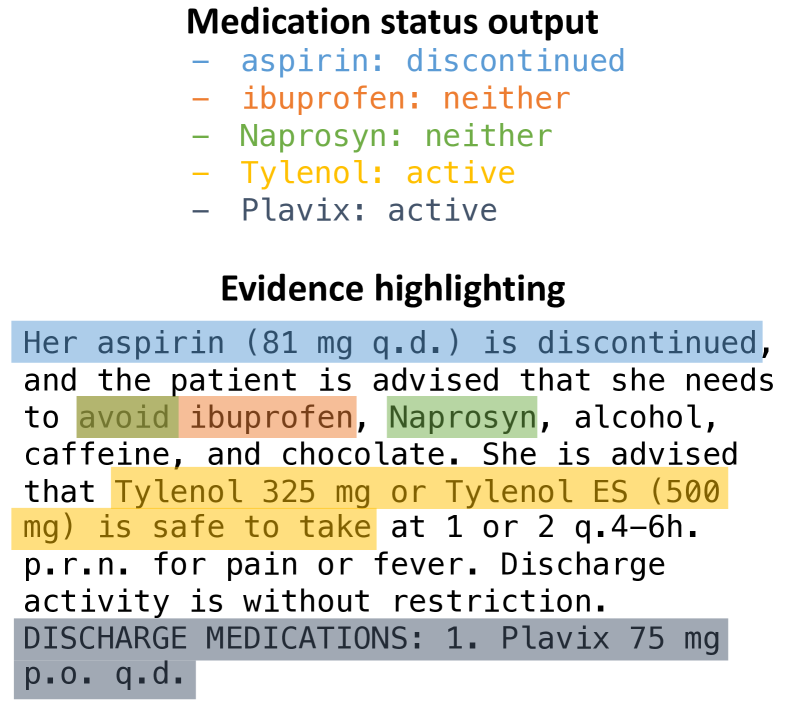
- SV yields interpretable grounding spans that align well with human judgments (e.g., 93% span overlap with human-annotated interventions for GPT-4).
- For long inputs, Omission tends to contribute more to F1 gains, while Prune maintains precision improvements; Full SV offers a balanced enhancement.
Read this paper
Open the full text in the Nubint reader and ask about any passage as you read.
Read this paper on NubintThis review was generated by AI from the original paper. Please check the paper before citing it.