
[Paper Review] SelfCheck: Using LLMs to Zero-Shot Check Their Own Step-by-Step Reasoning
SelfCheck uses a zero-shot, multi-stage check to verify each step of an LLM’s reasoning, then applies weighted voting over multiple solutions to improve final accuracy on GSM8K, MathQA, and MATH without external data or fine-tuning.
The recent progress in large language models (LLMs), especially the invention of chain-of-thought prompting, has made it possible to automatically answer questions by stepwise reasoning. However, when faced with more complicated problems that require non-linear thinking, even the strongest LLMs make mistakes. To address this, we explore whether LLMs are able to recognize errors in their own step-by-step reasoning, without resorting to external resources. To this end, we propose SelfCheck, a general-purpose zero-shot verification schema for recognizing such errors. We then use the results of these checks to improve question-answering performance by conducting weighted voting on multiple solutions to the question. We test SelfCheck on three datasets (GSM8K, MathQA, and MATH) and find that it successfully recognizes errors and, in turn, increases final answer accuracies.
Motivation & Objective
- Motivate the need for reliable multi-step reasoning beyond standard chain-of-thought prompting.
- Propose a zero-shot self-checking schema that identifies errors in individual steps without external resources.
- Show how per-step checks can be integrated into a confidence score to improve overall answers via weighted voting.
- Demonstrate effectiveness across multiple math datasets and analyze ablations to justify design choices.
Proposed method
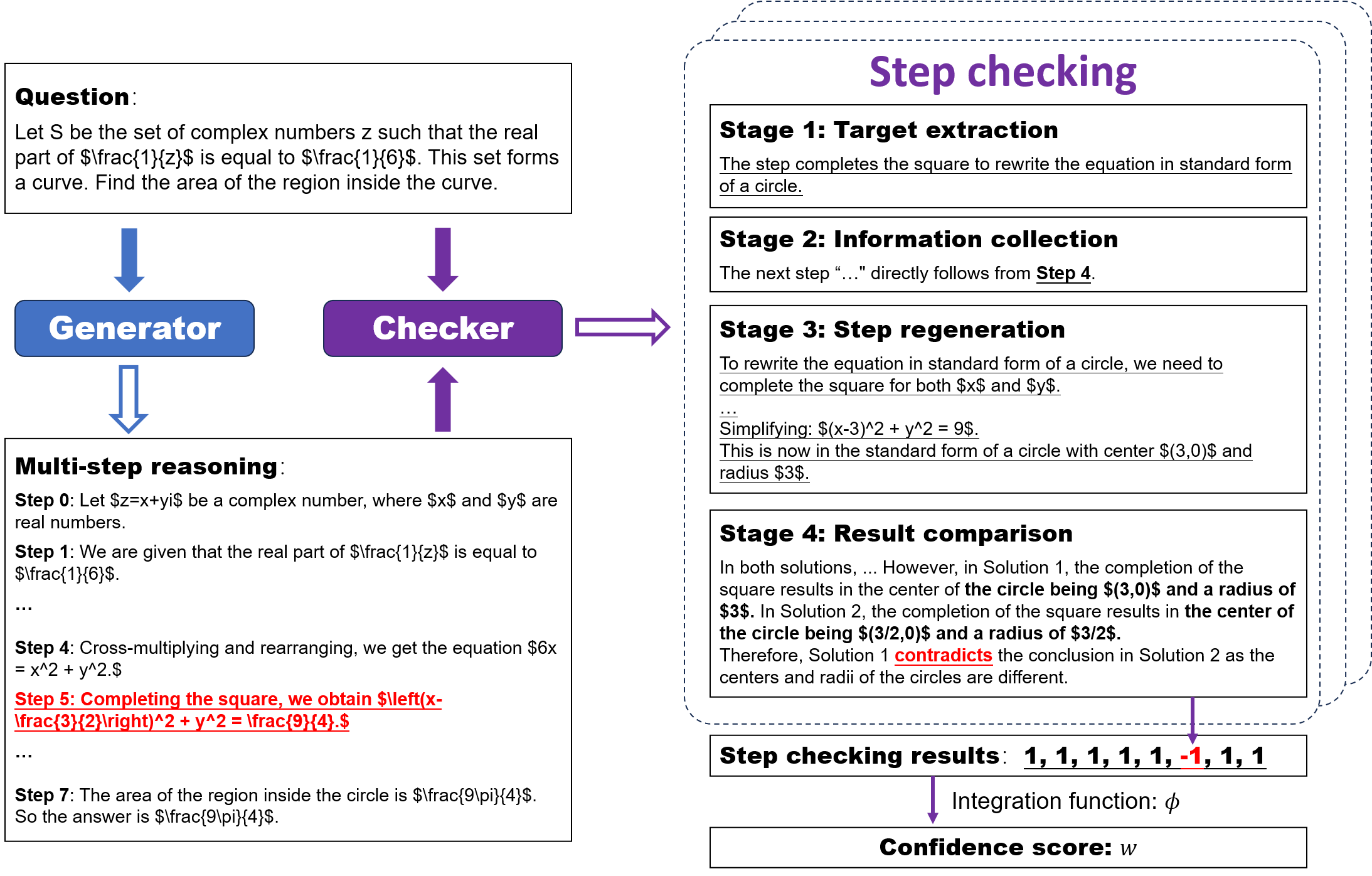
- Introduce SelfCheck as a zero-shot checker that evaluates each step conditioned on preceding steps.
- Decompose step checking into four stages: target extraction, information collection, step regeneration, and result comparison.
- Regenerate an independent alternative step using collected information and compare it to the original step to assess correctness.
- Compute an overall confidence score w from per-step checks to enable weighted voting across multiple solutions.
Experimental results
Research questions
- RQ1Can a zero-shot LLM-based checker identify errors in its own step-by-step reasoning without external data?
- RQ2Does regenerating a step and comparing it to the original step improve reliability over direct checking?
- RQ3Can per-solution confidence scores improve final answer accuracy via weighted voting across multiple solutions?
Key findings
- SelfCheck increases final answer accuracies compared with simple majority voting across datasets and settings.
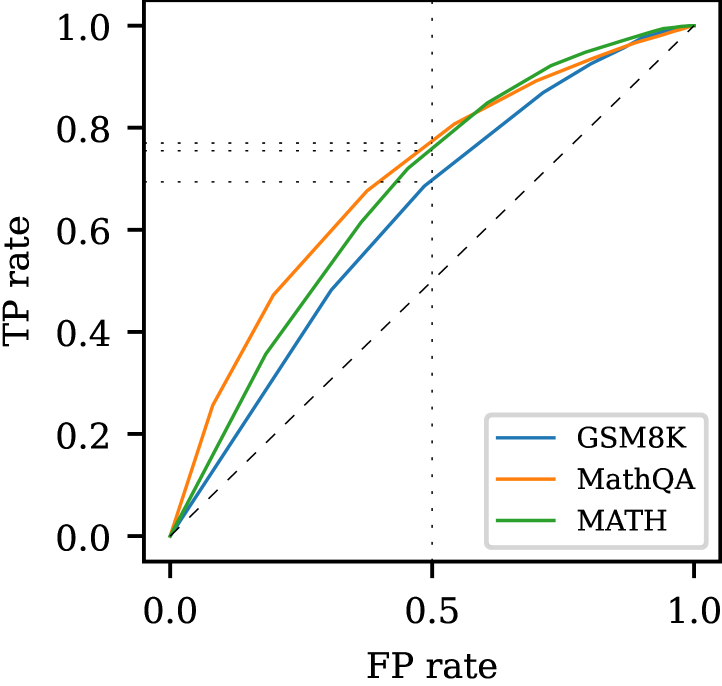
- The approach yields meaningful confidence estimates that reduce incorrect solutions by 9%, 22.8%, and 16.2% on GSM8K, MathQA, and MATH*, respectively when filtering by confidence.
- Using regenerating-and-comparing for step checks outperforms global or single-stage checks in ablations.
- Different generator/checker pairings (including cheaper LLMs) can still yield improvements, illustrating decorrelation benefits between generation and checking.
- Ensembling more solutions shows SelfCheck continues to outperform majority voting, with gains sustained as ensemble size grows.
Read this paper
Open the full text in the Nubint reader and ask about any passage as you read.
Read this paper on NubintThis review was generated by AI from the original paper. Please check the paper before citing it.