
[Paper Review] SelfCheckGPT: Zero-Resource Black-Box Hallucination Detection for Generative Large Language Models
SelfCheckGPT is a zero-resource, black-box hallucination detection approach for generative LLMs that uses multiple stochastic samples to assess informational consistency and flag non-factual content without external databases.
Generative Large Language Models (LLMs) such as GPT-3 are capable of generating highly fluent responses to a wide variety of user prompts. However, LLMs are known to hallucinate facts and make non-factual statements which can undermine trust in their output. Existing fact-checking approaches either require access to the output probability distribution (which may not be available for systems such as ChatGPT) or external databases that are interfaced via separate, often complex, modules. In this work, we propose "SelfCheckGPT", a simple sampling-based approach that can be used to fact-check the responses of black-box models in a zero-resource fashion, i.e. without an external database. SelfCheckGPT leverages the simple idea that if an LLM has knowledge of a given concept, sampled responses are likely to be similar and contain consistent facts. However, for hallucinated facts, stochastically sampled responses are likely to diverge and contradict one another. We investigate this approach by using GPT-3 to generate passages about individuals from the WikiBio dataset, and manually annotate the factuality of the generated passages. We demonstrate that SelfCheckGPT can: i) detect non-factual and factual sentences; and ii) rank passages in terms of factuality. We compare our approach to several baselines and show that our approach has considerably higher AUC-PR scores in sentence-level hallucination detection and higher correlation scores in passage-level factuality assessment compared to grey-box methods.
Motivation & Objective
- Motivate and address the challenge of factual hallucinations in black-box LLMs without external knowledge bases.
- Propose a sampling-based framework (SelfCheckGPT) to measure consistency across multiple LLM samples.
- Evaluate the approach against grey-box and black-box baselines on a WikiBio-derived GPT-3 dataset with sentence- and passage-level factuality labels.
Proposed method
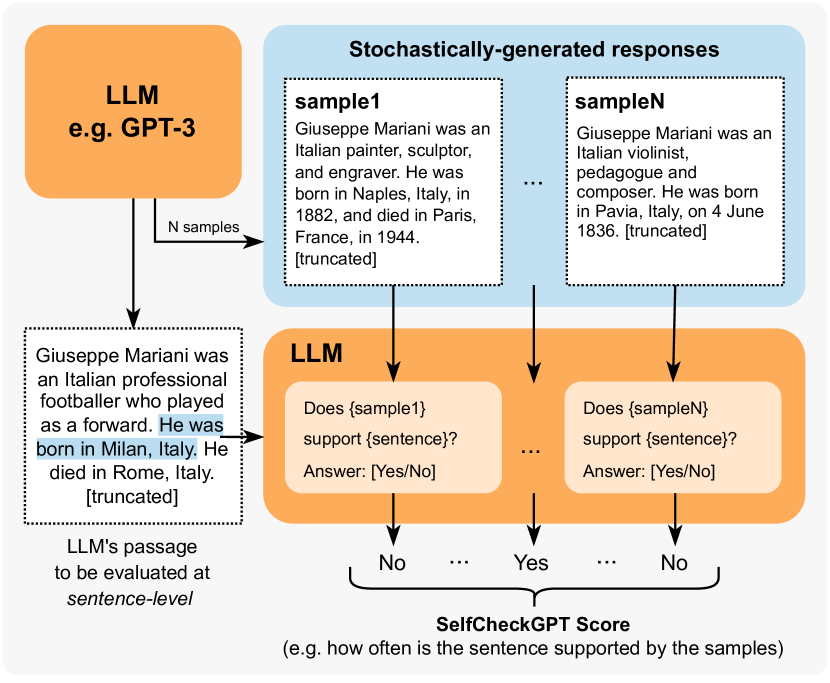
- Draw N stochastic samples from the same LLM for a given prompt.
- Compute sentence-level factuality scores using variants: BERTScore, QA-based consistency, unigram max n-gram, NLI, and Prompt-based prompting.
- For n-gram, train a simple n-gram model on the samples and main response to estimate token probabilities.
- Use NLI (DeBERTa-v3-large fined-tuned on MNLI) to compute contradiction probabilities for sentence evaluation.
- Use a prompt-based evaluator (SelfCheckGPT-Prompt) to query an LLM about whether a sentence is supported by sampled context.
- Report sentence-level scores and aggregate to passage-level scores via averaging.
Experimental results
Research questions
- RQ1Can zero-resource, black-box sampling detect factual vs. non-factual sentences without external databases?
- RQ2Which SelfCheckGPT variants best correlate with human judgments of factuality at sentence and passage levels?
- RQ3How does SelfCheckGPT compare to grey-box and other black-box methods in detection performance and correlation with human ratings?
Key findings
- SelfCheckGPT variants achieve higher sentence-level AUC-PR for non-factual and factual sentences than several baselines.
- NLI-based SelfCheckGPT achieves strong performance, approaching Prompt-based evaluation for sentence-level detection.
- Prompt-based SelfCheckGPT yields the best passage-level correlation with human judgments (Pearson 78.32, Spearman 78.30).
- NLI-based SelfCheckGPT offers a practical trade-off between performance and computation.
- Unigram max n-gram SelfCheckGPT provides competitive sentence-level results with relatively low computational cost.
- Compared to proxy LLMs (e.g., LLaMA), self-sampling based methods show superior correlation with human judgments.
Read this paper
Open the full text in the Nubint reader and ask about any passage as you read.
Read this paper on NubintThis review was generated by AI from the original paper. Please check the paper before citing it.