
[Paper Review] SELFormer: Molecular Representation Learning via SELFIES Language Models
SELFormer is a transformer-based chemical language model that uses SELFIES input, pre-trained on 2 million ChEMBL molecules, and fine-tuned for molecular property prediction, outperforming SMILES- and graph-based methods on key tasks.
Automated computational analysis of the vast chemical space is critical for numerous fields of research such as drug discovery and material science. Representation learning techniques have recently been employed with the primary objective of generating compact and informative numerical expressions of complex data. One approach to efficiently learn molecular representations is processing string-based notations of chemicals via natural language processing (NLP) algorithms. Majority of the methods proposed so far utilize SMILES notations for this purpose; however, SMILES is associated with numerous problems related to validity and robustness, which may prevent the model from effectively uncovering the knowledge hidden in the data. In this study, we propose SELFormer, a transformer architecture-based chemical language model that utilizes a 100% valid, compact and expressive notation, SELFIES, as input, in order to learn flexible and high-quality molecular representations. SELFormer is pre-trained on two million drug-like compounds and fine-tuned for diverse molecular property prediction tasks. Our performance evaluation has revealed that, SELFormer outperforms all competing methods, including graph learning-based approaches and SMILES-based chemical language models, on predicting aqueous solubility of molecules and adverse drug reactions. We also visualized molecular representations learned by SELFormer via dimensionality reduction, which indicated that even the pre-trained model can discriminate molecules with differing structural properties. We shared SELFormer as a programmatic tool, together with its datasets and pre-trained models. Overall, our research demonstrates the benefit of using the SELFIES notations in the context of chemical language modeling and opens up new possibilities for the design and discovery of novel drug candidates with desired features.
Motivation & Objective
- Motivate improved molecular representations that are 100% valid and robust for learning
- Leverage SELFIES, a robust string-based molecular notation, with transformer language models
- Pre-train on a large drug-like molecule corpus and fine-tune for diverse property-prediction tasks
- Compare performance against SMILES-based and graph-based models across multiple benchmarks
- Provide open access to code, datasets, and pre-trained models to the research community
Proposed method
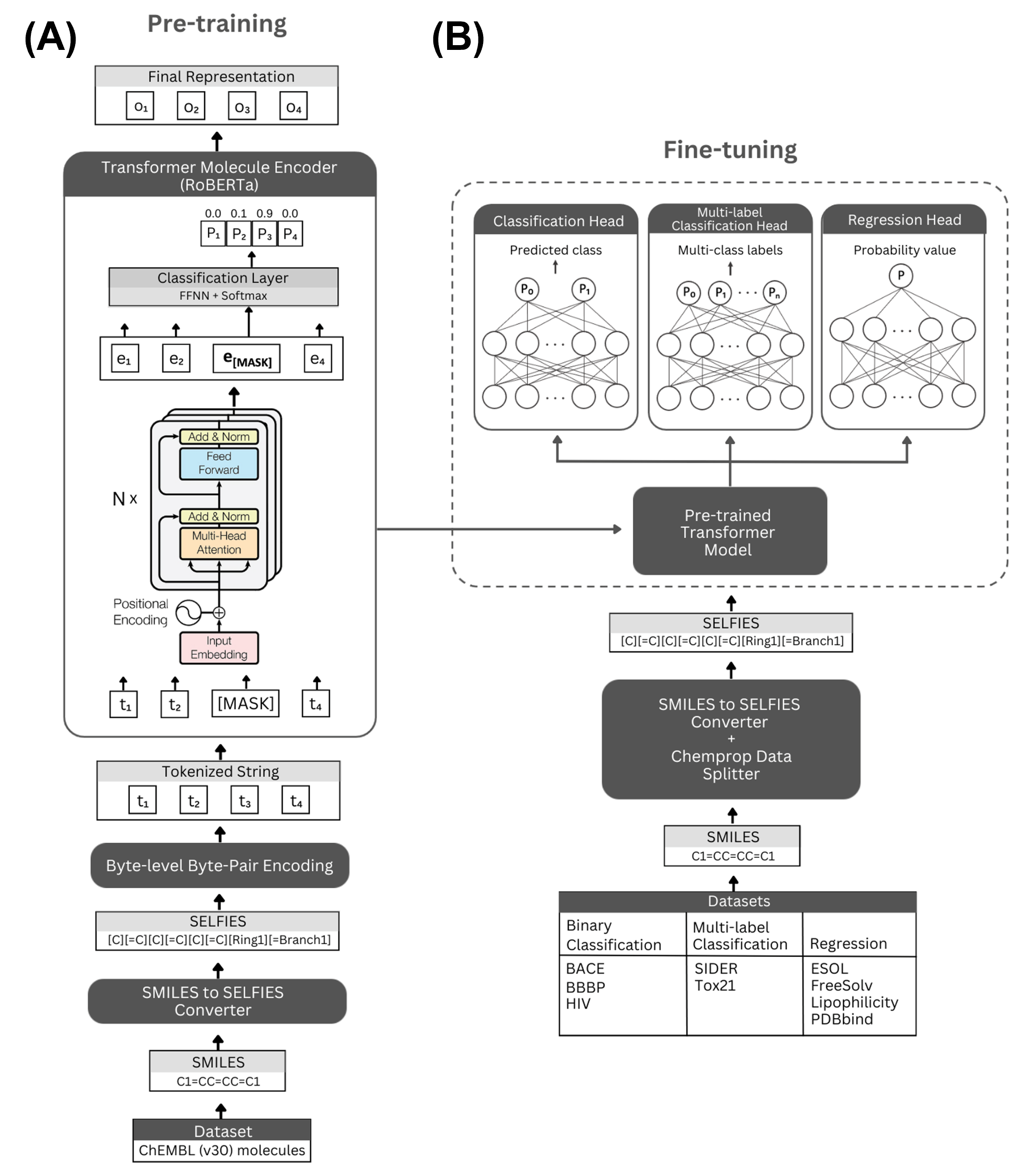
- Convert SMILES to SELFIES and tokenize using byte-level BPE akin to RoBERTa
- Pre-train a RoBERTa-like transformer encoder with masked language modeling on 2M ChEMBL molecules
- Conduct hyperparameter search (attention heads, layers, learning rate, batch size, epochs) to select SELFormer and SELFormer-Lite
- Fine-tune the pre-trained models on MoleculeNet classification and regression tasks with a two-layer linear head
- Evaluate using ROC-AUC and PRC for classification, RMSE for regression, with scaffold and random splits
- Make pre-trained models and representations publicly available
Experimental results
Research questions
- RQ1Can SELFIES-based transformers learn more robust molecular representations than SMILES-based models?
- RQ2How does pre-training on a large SELFIES corpus affect downstream molecular property prediction performance?
- RQ3What is the impact of fine-tuning vs. using pre-trained representations on standard MoleculeNet tasks?
- RQ4How do SELFIES-based models compare to graph-based and SMILES-based language models across classification and regression benchmarks?
Key findings
- SELFormer outperforms competing methods on predicting aqueous solubility and adverse drug reactions (SIDER, ESOL, etc.).
- The SELFIES-based model achieves comparable results to other methods on additional downstream tasks.
- Pre-trained representations (before heavy fine-tuning) already discriminate molecules with different structural properties, as seen in visualization analyses.
- An ablation study shows SELFormer consistently outperforms the lighter SELFormer-Lite across most tasks, with fine-tuning enhancing performance.
- Fine-tuning with optimized hyperparameters yields notable gains on several benchmarks, and SELFIES contributes to improved performance in tasks sensitive to stereochemistry.
Read this paper
Open the full text in the Nubint reader and ask about any passage as you read.
Read this paper on NubintThis review was generated by AI from the original paper. Please check the paper before citing it.