
[Paper Review] Semantic Communications with Variable-Length Coding for Extended Reality
This paper proposes a universal variable-length semantic-channel coding framework for wireless extended reality (XR) applications, enabling end-to-end trainable rate adaptation based on semantic content and noise resilience. By integrating a rate-allocation network with differentiable proxy functions, the system dynamically adjusts code lengths, significantly outperforming fixed-length and traditional methods in image and 3D mesh reconstruction tasks under low-SNR conditions.
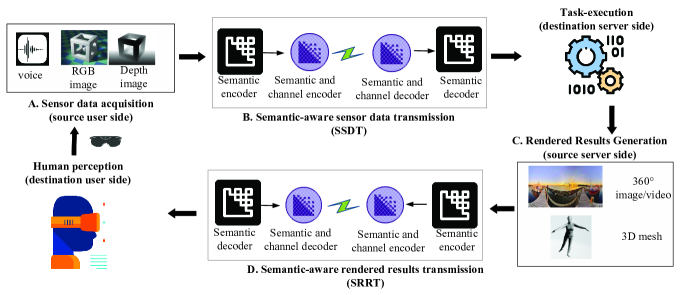
Wireless extended reality (XR) has attracted wide attentions as a promising technology to improve users' mobility and quality of experience. However, the ultra-high data rate requirement of wireless XR has hindered its development for many years. To overcome this challenge, we develop a semantic communication framework, where semantically-unimportant information is highly-compressed or discarded in semantic coders, significantly improving the transmission efficiency. Besides, considering the fact that some source content may have less amount of semantic information or have higher tolerance to channel noise, we propose a universal variable-length semantic-channel coding method. In particular, we first use a rate allocation network to estimate the best code length for semantic information and then adjust the coding process accordingly. By adopting some proxy functions, the whole framework is trained in an end-to-end manner. Numerical results show that our semantic system significantly outperforms traditional transmission methods and the proposed variable-length coding scheme is superior to the fixed-length coding methods.
Motivation & Objective
- To address the ultra-high data rate demands of wireless XR, which exceed current wireless capacity.
- To overcome limitations of fixed-length coding in semantic communication by enabling dynamic code length adaptation.
- To design a universal, end-to-end trainable framework that optimizes both semantic fidelity and transmission efficiency.
- To improve quality of experience (QoE) in latency-critical XR applications like remote rendering and real-time 3D reconstruction.
Proposed method
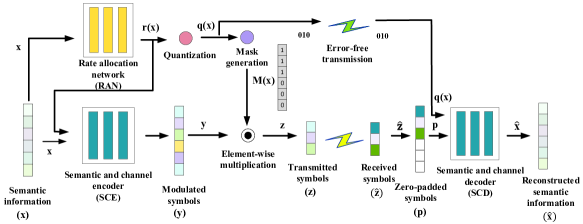
- Introduces a rate-allocation network that estimates semantic content quantity and noise resilience for each input, generating a dynamic code length map.
- Employs differentiable proxy functions to enable backpropagation through the variable-length coding process, allowing end-to-end training.
- Uses a semantic-channel coding (SCC) module with adaptive modulation and coding based on the rate-allocation output.
- Incorporates a learnable loss function combining PSNR, LPIPS, and semantic similarity to balance reconstruction quality and perceptual fidelity.
- Trains the entire system end-to-end using a joint optimization objective that trades off code length and performance.
- Applies the framework to multiple XR tasks: light estimation, 3D human mesh recovery, and wireless image transmission.
Experimental results
Research questions
- RQ1Can variable-length coding improve transmission efficiency in semantic communication for XR without sacrificing perceptual quality?
- RQ2How does dynamic code length allocation based on semantic content and noise tolerance affect system performance compared to fixed-length schemes?
- RQ3To what extent can end-to-end training with differentiable proxies enable optimal rate allocation in semantic communication?
- RQ4Does incorporating semantic loss improve perceptual quality even when pixel-level metrics (e.g., PSNR) are similar?
- RQ5Can the proposed framework generalize across diverse XR tasks such as image transmission and 3D mesh recovery?
Key findings
- The proposed variable-length semantic-channel coding (VL-SCC) method outperforms fixed-length coding (SCC) and traditional BPG+LDPC in both PSNR and LPIPS metrics across all tested SPP values.
- VL-SCC with semantic loss (λ=0.1) achieves significantly lower LPIPS values than methods without semantic loss, indicating superior perceptual quality.
- Even when PSNR is nearly identical, the absence of semantic loss leads to poor visual quality in human mesh recovery, proving the necessity of semantic-aware training.
- The rate-allocation network successfully learns to assign shorter codes to low-semantic-content inputs and longer codes to high-sensitivity or high-content inputs.
- The framework demonstrates strong generalization across diverse XR tasks, including image transmission, 3D mesh recovery, and light estimation.
- The end-to-end differentiable design enables effective optimization of code length and transmission performance without hand-crafted assumptions on rate allocation.
Read this paper
Open the full text in the Nubint reader and ask about any passage as you read.
Read this paper on NubintThis review was generated by AI from the original paper. Please check the paper before citing it.