
[Paper Review] Semantic Drift Compensation for Class-Incremental Learning
This paper proposes Semantic Drift Compensation (SDC) for class-incremental learning in embedding networks, which estimate and correct feature distribution shifts (semantic drift) in prototypes from previous tasks using only current-task data—without exemplars. SDC reduces forgetting significantly, outperforming state-of-the-art non-exemplar methods and matching or exceeding exemplar-based methods on CIFAR100 and ImageNet-Subset.
Class-incremental learning of deep networks sequentially increases the number of classes to be classified. During training, the network has only access to data of one task at a time, where each task contains several classes. In this setting, networks suffer from catastrophic forgetting which refers to the drastic drop in performance on previous tasks. The vast majority of methods have studied this scenario for classification networks, where for each new task the classification layer of the network must be augmented with additional weights to make room for the newly added classes. Embedding networks have the advantage that new classes can be naturally included into the network without adding new weights. Therefore, we study incremental learning for embedding networks. In addition, we propose a new method to estimate the drift, called semantic drift, of features and compensate for it without the need of any exemplars. We approximate the drift of previous tasks based on the drift that is experienced by current task data. We perform experiments on fine-grained datasets, CIFAR100 and ImageNet-Subset. We demonstrate that embedding networks suffer significantly less from catastrophic forgetting. We outperform existing methods which do not require exemplars and obtain competitive results compared to methods which store exemplars. Furthermore, we show that our proposed SDC when combined with existing methods to prevent forgetting consistently improves results.
Motivation & Objective
- Address catastrophic forgetting in class-incremental learning without storing exemplars, especially under privacy and data security constraints.
- Investigate whether embedding networks inherently suffer less from forgetting than traditional classification networks.
- Develop a method to estimate and compensate for semantic drift in prototypes of previous tasks during training of new tasks.
- Design a technique that is compatible with existing regularization methods (e.g., EWC, MAS, LwF) to further improve performance.
- Demonstrate that prototype drift can be estimated and corrected using only current-task data, avoiding the need for memory of past data.
Proposed method
- Use embedding networks that map inputs to a metric space where class prototypes represent class means, enabling natural inclusion of new classes without architectural changes.
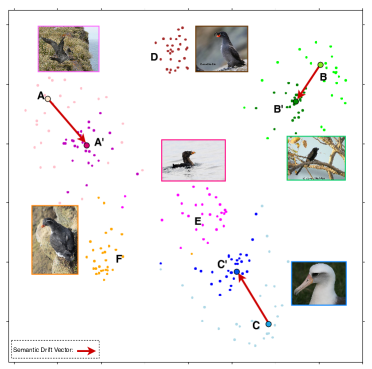
- Estimate semantic drift in previous task prototypes by analyzing the shift in current-task data relative to previously learned prototypes.
- Compensate for drift by adjusting the prototypes of previous tasks using the estimated drift vector derived from current-task features.
- Apply the compensation by re-centering or re-weighting prototypes based on the estimated drift, without requiring access to past data.
- Integrate SDC with existing regularization techniques (e.g., EWC, MAS, LwF) to enhance their performance in preventing forgetting.
- Use nearest class mean (NCM) classification with learned prototypes, and evaluate drift via distance between real class means and predicted prototypes.
Experimental results
Research questions
- RQ1Can embedding networks reduce catastrophic forgetting compared to standard classification networks in class-incremental learning?
- RQ2To what extent can semantic drift in prototypes from previous tasks be estimated using only current-task data?
- RQ3How effective is the proposed SDC method in compensating for prototype drift without storing exemplars?
- RQ4Does combining SDC with existing regularization methods (e.g., EWC, MAS) lead to consistent performance gains?
- RQ5How does SDC compare to exemplar-based and non-exemplar-based SOTA methods in terms of forgetting and accuracy?
Key findings
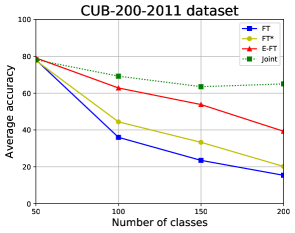
- Embedding networks suffer significantly less from catastrophic forgetting than traditional classification networks, demonstrating the advantage of metric-based learning in continual learning.
- The proposed SDC method reduces prototype drift by 30% on average compared to baseline finetuning, as shown in T-SNE visualizations and quantitative distance measurements.
- On CIFAR100, E-EWC+SDC achieves 27.6% higher average incremental accuracy than EWC and 7.1% higher than iCaRL-CNN, a strong exemplar-based method.
- On ImageNet-Subset, E-EWC+SDC achieves 35.0% higher accuracy than LwF and 15.5% higher than iCaRL-CNN, with 3.5% less average forgetting than Rebalance.
- SDC reduces average forgetting by 13.9% compared to the best exemplar-based method (Rebalance) on CIFAR100, demonstrating superior forgetting mitigation.
- The method consistently improves performance when combined with EWC, MAS, and LwF, showing strong compatibility and generalization across regularization strategies.
Read this paper
Open the full text in the Nubint reader and ask about any passage as you read.
Read this paper on NubintThis review was generated by AI from the original paper. Please check the paper before citing it.