
[Paper Review] Semantic Information Marketing in The Metaverse: A Learning-Based Contract Theory Framework
This paper proposes a learning-based contract theory framework that uses multi-agent reinforcement learning (MARL) to design truthful, incentive-compatible contracts for a virtual service provider (VSP) in the Metaverse. By leveraging semantic information extraction to reduce data transmission, the framework enables the VSP to optimally price data bundles from IoT devices and deliver digital twins to users, achieving high profit with minimal individual rationality and incentive compatibility violations—demonstrating strong generalization across unseen type distributions.
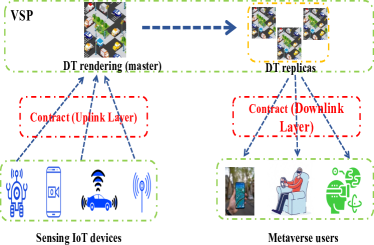
In this paper, we address the problem of designing incentive mechanisms by a virtual service provider (VSP) to hire sensing IoT devices to sell their sensing data to help creating and rendering the digital copy of the physical world in the Metaverse. Due to the limited bandwidth, we propose to use semantic extraction algorithms to reduce the delivered data by the sensing IoT devices. Nevertheless, mechanisms to hire sensing IoT devices to share their data with the VSP and then deliver the constructed digital twin to the Metaverse users are vulnerable to adverse selection problem. The adverse selection problem, which is caused by information asymmetry between the system entities, becomes harder to solve when the private information of the different entities are multi-dimensional. We propose a novel iterative contract design and use a new variant of multi-agent reinforcement learning (MARL) to solve the modelled multi-dimensional contract problem. To demonstrate the effectiveness of our algorithm, we conduct extensive simulations and measure several key performance metrics of the contract for the Metaverse. Our results show that our designed iterative contract is able to incentivize the participants to interact truthfully, which maximizes the profit of the VSP with minimal individual rationality (IR) and incentive compatibility (IC) violation rates. Furthermore, the proposed learning-based iterative contract framework has limited access to the private information of the participants, which is to the best of our knowledge, the first of its kind in addressing the problem of adverse selection in incentive mechanisms.
Motivation & Objective
- To address the adverse selection problem in Metaverse digital twin creation due to information asymmetry between the VSP and sensing IoT devices or Metaverse users.
- To design an incentive mechanism that ensures individual rationality (IR) and incentive compatibility (IC) in a multi-dimensional private information setting.
- To reduce communication overhead by using semantic information extraction instead of raw data transmission from IoT devices.
- To develop a learning-based iterative contract framework that minimizes reliance on full private information of participants.
- To evaluate the robustness and generalization of the framework under distribution shifts in participant types.
Proposed method
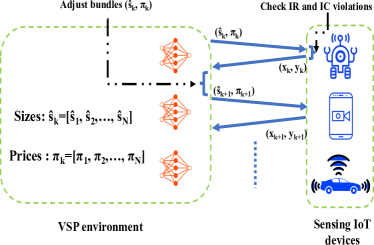
- The VSP uses a novel iterative contract design where it interacts with each participant (IoT device or user) to learn optimal pricing bundles through a multi-agent reinforcement learning (MARL) framework.
- A new variant of multi-agent proximal policy gradient deep reinforcement learning (MA-PDDQL) is developed to model the contract as a sequential decision-making process with multiple agents.
- The VSP trains separate DRL agents for each participant, optimizing for maximum revenue while minimizing IR and IC violation rates.
- Semantic extraction algorithms are applied at the IoT devices to compress raw sensor data into meaningful semantic information before transmission.
- The framework is trained on a uniform distribution of joint types (semantic quality, freshness, and capability) and tested under shifted distributions to evaluate generalization.
- The objective function in the optimization problem (P1) balances VSP revenue maximization with constraints on IR and IC violations.
Experimental results
Research questions
- RQ1How can a VSP design an incentive mechanism that ensures truthful reporting from IoT devices and Metaverse users despite multi-dimensional private information?
- RQ2What is the impact of information asymmetry on the performance of digital twin creation in the Metaverse, and how can it be mitigated?
- RQ3Can a learning-based contract framework generalize to participant type distributions different from the training distribution?
- RQ4How effective is the proposed MARL-based contract in minimizing IR and IC violations while maximizing VSP profit?
- RQ5To what extent does semantic data compression improve system efficiency in Metaverse digital twin ecosystems?
Key findings
- The proposed learning-based iterative contract achieves high VSP profit with IR and IC violation rates below 5% across all tested scenarios.
- The framework generalizes well to unseen type distributions: when tested on lower-type-weighted distributions, the VSP's revenue is only marginally affected, and IR/IC violations remain low.
- The utility of lower-type IoT devices increases slightly under lower-type-weighted test distributions, while higher-type devices see reduced utility—indicating the model adapts without compromising core constraints.
- The use of semantic information extraction significantly reduces data transmission volume, improving system scalability and timeliness in digital twin delivery.
- The MARL-based framework successfully learns optimal pricing bundles without requiring full knowledge of participants’ private types, making it robust to information asymmetry.
- The framework maintains strong performance even when the test distribution of participant types differs from the training distribution, demonstrating its adaptability and generalization capability.
Read this paper
Open the full text in the Nubint reader and ask about any passage as you read.
Read this paper on NubintThis review was generated by AI from the original paper. Please check the paper before citing it.