
[Paper Review] Semantic Uncertainty: Linguistic Invariances for Uncertainty Estimation in Natural Language Generation
The paper introduces semantic entropy, an unsupervised uncertainty measure for NLG that accounts for semantic equivalence by clustering meanings and estimating uncertainty over meanings rather than token sequences, improving predictiveness of model accuracy on QA tasks.
We introduce a method to measure uncertainty in large language models. For tasks like question answering, it is essential to know when we can trust the natural language outputs of foundation models. We show that measuring uncertainty in natural language is challenging because of "semantic equivalence" -- different sentences can mean the same thing. To overcome these challenges we introduce semantic entropy -- an entropy which incorporates linguistic invariances created by shared meanings. Our method is unsupervised, uses only a single model, and requires no modifications to off-the-shelf language models. In comprehensive ablation studies we show that the semantic entropy is more predictive of model accuracy on question answering data sets than comparable baselines.
Motivation & Objective
- Motivate the need for reliable uncertainty measures in free-form NLG where semantic meaning, not surface form, matters.
- Propose semantic entropy as an entropy over meanings rather than tokens.
- Develop a practical, unsupervised method using a single model without modifications to off-the-shelf LMs.
- Demonstrate effectiveness on open- and closed-book QA datasets (TriviaQA and CoQA) through extensive ablations.
Proposed method
- Define semantic equivalence via bidirectional entailment to cluster outputs that mean the same thing.
- Sample multiple sequences from a single model and cluster them into meaning-based equivalence classes.
- Compute semantic entropy as the entropy over the distribution of meanings by aggregating token-level probabilities within each meaning class.
- Use Monte Carlo estimation to approximate semantic entropy since not all meanings can be observed.
- Analyze sampling strategies, including temperature and method (multinomial sampling/beam sampling), and discuss length-normalisation.
Experimental results
Research questions
- RQ1Can uncertainty in NLG be meaning-focused rather than token-focused, and can we quantify it without supervision?
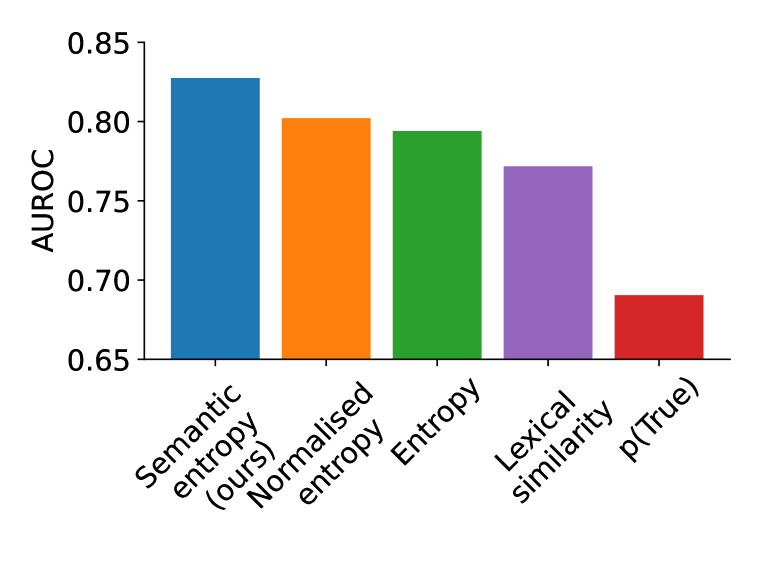
- RQ2Does semantic entropy better predict model accuracy on QA tasks than standard entropy or baselines?
- RQ3How should sampling and clustering be configured to balance diversity and accuracy in meaning-based uncertainty estimation?
- RQ4Is the approach robust across model sizes and QA datasets like TriviaQA and CoQA?
Key findings
- Semantic entropy outperforms baselines in predicting model correctness on open- and closed-book QA tasks.
- The method scales with model size and benefits from more samples, while requiring no model modifications or ensembles.
- A bidirectional entailment clustering algorithm effectively groups semantically equivalent outputs for meaning-based uncertainty.
- Optimal uncertainty performance is achieved with intermediate sampling temperature, balancing diversity and accuracy.
- Longer sentences affect joint likelihoods, motivating discussion of length-normalised entropy in certain settings.

Read this paper
Open the full text in the Nubint reader and ask about any passage as you read.
Read this paper on NubintThis review was generated by AI from the original paper. Please check the paper before citing it.