
[Paper Review] Semi-decentralized Inference in Heterogeneous Graph Neural Networks for Traffic Demand Forecasting: An Edge-Computing Approach
This paper proposes a semi-decentralized inference framework using cloudlets to accelerate heterogeneous graph neural network (hetGNN)-LSTM for real-time taxi demand and supply forecasting in large-scale urban transportation networks. By distributing computation across multiple cloudlets co-located with cellular base stations, the approach reduces inter-cloudlet communication and achieves up to a 10x reduction in inference time compared to centralized or fully decentralized GNN schemes, while supporting dynamic taxi-as-nodes modeling for improved spatiotemporal forecasting accuracy.
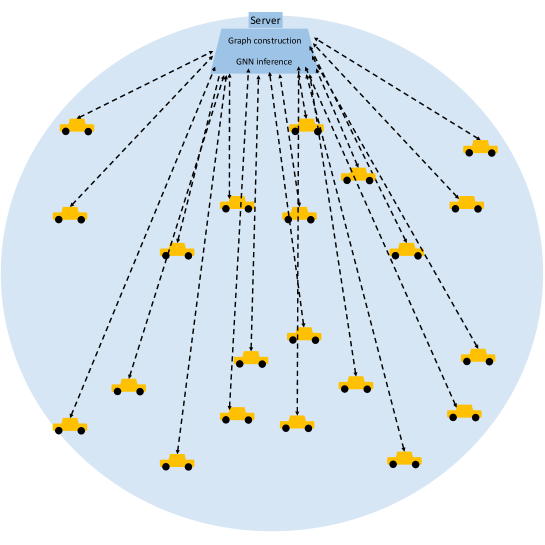
Prediction of taxi service demand and supply is essential for improving customer's experience and provider's profit. Recently, graph neural networks (GNNs) have been shown promising for this application. This approach models city regions as nodes in a transportation graph and their relations as edges. GNNs utilize local node features and the graph structure in the prediction. However, more efficient forecasting can still be achieved by following two main routes; enlarging the scale of the transportation graph, and simultaneously exploiting different types of nodes and edges in the graphs. However, both approaches are challenged by the scalability of GNNs. An immediate remedy to the scalability challenge is to decentralize the GNN operation. However, this creates excessive node-to-node communication. In this paper, we first characterize the excessive communication needs for the decentralized GNN approach. Then, we propose a semi-decentralized approach utilizing multiple cloudlets, moderately sized storage and computation devices, that can be integrated with the cellular base stations. This approach minimizes inter-cloudlet communication thereby alleviating the communication overhead of the decentralized approach while promoting scalability due to cloudlet-level decentralization. Also, we propose a heterogeneous GNN-LSTM algorithm for improved taxi-level demand and supply forecasting for handling dynamic taxi graphs where nodes are taxis. Extensive experiments over real data show the advantage of the semi-decentralized approach as tested over our heterogeneous GNN-LSTM algorithm. Also, the proposed semi-decentralized GNN approach is shown to reduce the overall inference time by about an order of magnitude compared to centralized and decentralized inference schemes.
Motivation & Objective
- To address the scalability and communication overhead challenges in large-scale graph neural network (GNN) inference for urban traffic demand forecasting.
- To enable efficient, real-time inference for dynamic taxi-level demand and supply prediction using a heterogeneous GNN-LSTM architecture.
- To reduce the quadratic message-passing delay inherent in fully decentralized GNNs through a semi-decentralized edge-computing architecture.
- To support dynamic graph modeling by treating individual taxis as nodes, enabling more accurate and responsive forecasting in evolving urban transportation systems.
Proposed method
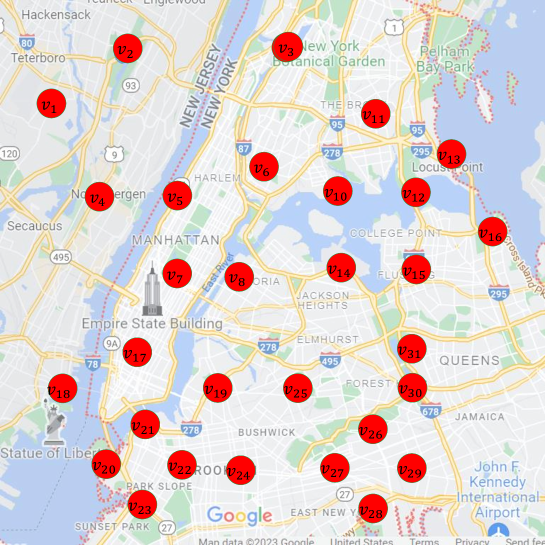
- Proposes a semi-decentralized inference framework using multiple cloudlets—moderate-capability devices integrated with cellular base stations—to distribute GNN computation across subgraphs of the transportation network.
- Introduces a heterogeneous GNN-LSTM model that treats taxis as dynamic nodes and captures complex spatiotemporal dependencies in traffic demand and supply.
- Employs a message-passing mechanism with bounded delay, where inference delay for L-hop graphs is analytically bounded using transmission ($t_s, t_r$), processing ($t_p$), and node degree ($d_i$) parameters.
- Derives theoretical delay bounds showing quadratic growth with number of hops, proving the necessity of reducing communication hops through cloudlet-based decentralization.
- Uses a computational graph model with 1-hop and 2-hop neighbor interactions to derive upper and lower bounds on total inference delay, accounting for concurrent vs. sequential message processing.
- Applies the framework to real-world taxi data, validating performance improvements in inference speed and forecasting accuracy over centralized and fully decentralized GNN approaches.
Experimental results
Research questions
- RQ1How does the communication overhead of fully decentralized GNN inference scale with the number of hops in large urban transportation graphs?
- RQ2Can a semi-decentralized architecture using cloudlets significantly reduce inference delay while maintaining scalability for large-scale traffic forecasting?
- RQ3To what extent does modeling taxis as dynamic nodes in a heterogeneous GNN improve forecasting accuracy compared to fixed-region node modeling?
- RQ4What are the theoretical bounds on inference delay in multi-hop GNN message passing, and how can they be minimized through architectural design?
- RQ5How does the proposed semi-decentralized GNN-LSTM framework compare in performance and latency to centralized and fully decentralized GNN inference schemes?
Key findings
- The proposed semi-decentralized GNN inference framework reduces overall inference time by approximately one order of magnitude (about 10x speedup) compared to both centralized and fully decentralized GNN schemes.
- Theoretical analysis shows that fully decentralized GNN inference suffers from quadratic delay growth with the number of communication hops, making it impractical for large-scale urban graphs.
- The semi-decentralized approach minimizes inter-cloudlet communication by localizing computation within cloudlet-covered subgraphs, significantly reducing message-passing overhead.
- The heterogeneous GNN-LSTM model achieves improved forecasting accuracy by modeling individual taxis as dynamic nodes, capturing real-time supply and demand shifts more effectively than static region-based models.
- Delay bounds derived for L-hop graphs show that the total inference delay is bounded by expressions involving node degrees, transmission delays, and processing times, with the upper bound growing quadratically with hops.
- Empirical evaluation on real-world taxi data confirms that the semi-decentralized framework maintains high forecasting accuracy while drastically improving inference speed, enabling real-time urban mobility management.
Read this paper
Open the full text in the Nubint reader and ask about any passage as you read.
Read this paper on NubintThis review was generated by AI from the original paper. Please check the paper before citing it.