
[Paper Review] Semi-Supervised Spoken Language Understanding via Self-Supervised Speech and Language Model Pretraining
This paper proposes a semi-supervised end-to-end spoken language understanding (SLU) framework that jointly predicts text, intent, and slot labels directly from raw speech using pretrained self-supervised ASR and BERT models. It achieves performance on par with oracle-text models on ATIS—even under noisy conditions—by leveraging unlabeled speech data through supervised or unsupervised pretraining, demonstrating strong robustness and semantic generalization with minimal labeled data.
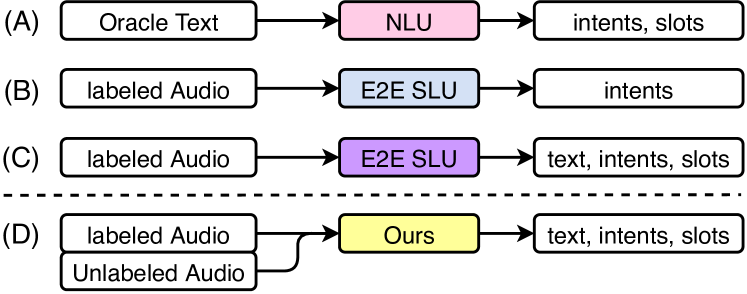
Much recent work on Spoken Language Understanding (SLU) is limited in at least one of three ways: models were trained on oracle text input and neglected ASR errors, models were trained to predict only intents without the slot values, or models were trained on a large amount of in-house data. In this paper, we propose a clean and general framework to learn semantics directly from speech with semi-supervision from transcribed or untranscribed speech to address these issues. Our framework is built upon pretrained end-to-end (E2E) ASR and self-supervised language models, such as BERT, and fine-tuned on a limited amount of target SLU data. We study two semi-supervised settings for the ASR component: supervised pretraining on transcribed speech, and unsupervised pretraining by replacing the ASR encoder with self-supervised speech representations, such as wav2vec. In parallel, we identify two essential criteria for evaluating SLU models: environmental noise-robustness and E2E semantics evaluation. Experiments on ATIS show that our SLU framework with speech as input can perform on par with those using oracle text as input in semantics understanding, even though environmental noise is present and a limited amount of labeled semantics data is available for training.
Motivation & Objective
- To address the limitations of prior SLU systems that rely on oracle text, predict only intent, or require large in-house datasets.
- To enable end-to-end SLU from raw speech using semi-supervised learning with limited labeled semantics data.
- To evaluate SLU models under realistic conditions, including environmental noise and end-to-end semantics understanding.
- To investigate the effectiveness of unsupervised speech representation learning (e.g., wav2vec) for downstream SLU tasks.
- To develop a unified framework that jointly predicts text, intent, and slots from speech without additional loss manipulation or ASR n-best hypotheses.
Proposed method
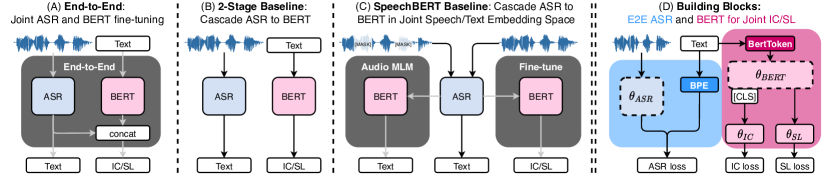
- The framework combines a pretrained end-to-end ASR model with a self-supervised language model (e.g., BERT) fine-tuned on limited labeled SLU data.
- Two pretraining strategies are evaluated: supervised ASR pretraining on transcribed speech and unsupervised pretraining using wav2vec on untranscribed speech.
- The model jointly performs text generation, intent classification, and slot labeling via a single end-to-end architecture.
- For unsupervised pretraining, context vectors (c) from wav2vec 1.0 are used as input features, with subsampling layers applied to reduce sequence length.
- Noise augmentation is applied during training using MS-SNSD noise files at multiple SNR levels (0–40 dB) to improve robustness.
- The framework avoids label projection, output serialization, or n-best hypothesis decoding, maintaining a clean and generalizable pipeline.
Experimental results
Research questions
- RQ1Can an end-to-end SLU model trained directly from speech achieve performance comparable to models using oracle text transcriptions?
- RQ2How effective is unsupervised pretraining with self-supervised speech representations (e.g., wav2vec) for SLU when limited labeled data is available?
- RQ3To what extent does noise augmentation improve the robustness of SLU models in real-world environments?
- RQ4Can a unified framework jointly predict text, intent, and slot labels from speech without requiring additional loss engineering or ASR post-processing?
- RQ5How does the performance of SLU models trained with self-supervised speech representations compare to those fine-tuned from supervised ASR pretraining?
Key findings
- The proposed end-to-end SLU framework achieves 97.4% intent F1 and 95.46% slot F1 on noisy ATIS test sets, a mere 1–2% drop from clean test, outperforming hybrid ASR+BERT by nearly 40% in noisy conditions.
- Using wav2vec 1.0 context vectors (c) with subsampling layers, the model reaches 95.67% intent F1 and 85.64% slot F1 on clean ATIS, closing the gap with supervised pretraining.
- The 2-Stage baseline with wav2vec c features achieves 89.86% intent F1 and 67.33% slot F1, showing that self-supervised speech representations can support meaningful semantic learning without transcribed text.
- Noise augmentation with five different SNR levels (0–40 dB) significantly reduces performance degradation, maintaining high accuracy even under challenging acoustic conditions.
- The end-to-end model with self-supervised pretraining performs on par with oracle-text baselines, entering the 5% 'corpus errors' range, demonstrating strong semantic generalization.
- The framework outperforms prior methods that require label projection, output serialization, or n-best ASR hypotheses, offering a cleaner and more generalizable solution.
Read this paper
Open the full text in the Nubint reader and ask about any passage as you read.
Read this paper on NubintThis review was generated by AI from the original paper. Please check the paper before citing it.