
[Paper Review] Sense Less, Generate More: Pre-training LiDAR Perception with Masked Autoencoders for Ultra-Efficient 3D Sensing
This paper proposes Radial Masked Autoencoding (R-MAE), a generative pre-training method for LiDAR perception that reduces sensing energy by masking radial angular regions and generating missing parts using a masked autoencoder. R-MAE achieves up to 5.59% mAP/mAPH gain on Waymo with 90% masking and improves small object detection by 4.37% on KITTI, demonstrating ultra-efficient 3D sensing with enhanced accuracy.
In this work, we propose a disruptively frugal LiDAR perception dataflow that generates rather than senses parts of the environment that are either predictable based on the extensive training of the environment or have limited consequence to the overall prediction accuracy. Therefore, the proposed methodology trades off sensing energy with training data for low-power robotics and autonomous navigation to operate frugally with sensors, extending their lifetime on a single battery charge. Our proposed generative pre-training strategy for this purpose, called as radially masked autoencoding (R-MAE), can also be readily implemented in a typical LiDAR system by selectively activating and controlling the laser power for randomly generated angular regions during on-field operations. Our extensive evaluations show that pre-training with R-MAE enables focusing on the radial segments of the data, thereby capturing spatial relationships and distances between objects more effectively than conventional procedures. Therefore, the proposed methodology not only reduces sensing energy but also improves prediction accuracy. For example, our extensive evaluations on Waymo, nuScenes, and KITTI datasets show that the approach achieves over a 5% average precision improvement in detection tasks across datasets and over a 4% accuracy improvement in transferring domains from Waymo and nuScenes to KITTI. In 3D object detection, it enhances small object detection by up to 4.37% in AP at moderate difficulty levels in the KITTI dataset. Even with 90% radial masking, it surpasses baseline models by up to 5.59% in mAP/mAPH across all object classes in the Waymo dataset. Additionally, our method achieves up to 3.17% and 2.31% improvements in mAP and NDS, respectively, on the nuScenes dataset, demonstrating its effectiveness with both single and fused LiDAR-camera modalities. https://github.com/sinatayebati/Radial_MAE.
Motivation & Objective
- To address the high energy consumption of active LiDAR sensors in low-power robotics and autonomous systems.
- To reduce sensing energy by generating predictable or low-impact environmental regions instead of measuring them.
- To improve 3D object detection accuracy through generative pre-training using a novel radial masking strategy.
- To enable ultra-frugal LiDAR operation by minimizing laser activation while maintaining or enhancing performance.
- To transfer robust, generalizable representations across domains such as Waymo, nuScenes, and KITTI.
Proposed method
- R-MAE employs a range-aware radial masking strategy that selectively disables laser emissions in angular sectors during on-field sensing.
- The method uses a 3D spatially sparse convolutional encoder to extract features from unmasked voxels in the LiDAR point cloud.
- A masked autoencoder reconstructs the full 3D scene by predicting voxel occupancy in masked regions via binary classification.
- The masking ratio and angular segment size are controlled to explore trade-offs between sensing energy and model performance.
- The model is pre-trained on large-scale datasets (Waymo, nuScenes, KITTI) and fine-tuned for downstream detection tasks.
- The approach leverages the fact that laser power scales with R⁴, making low-power sensing more effective when combined with generative reconstruction.
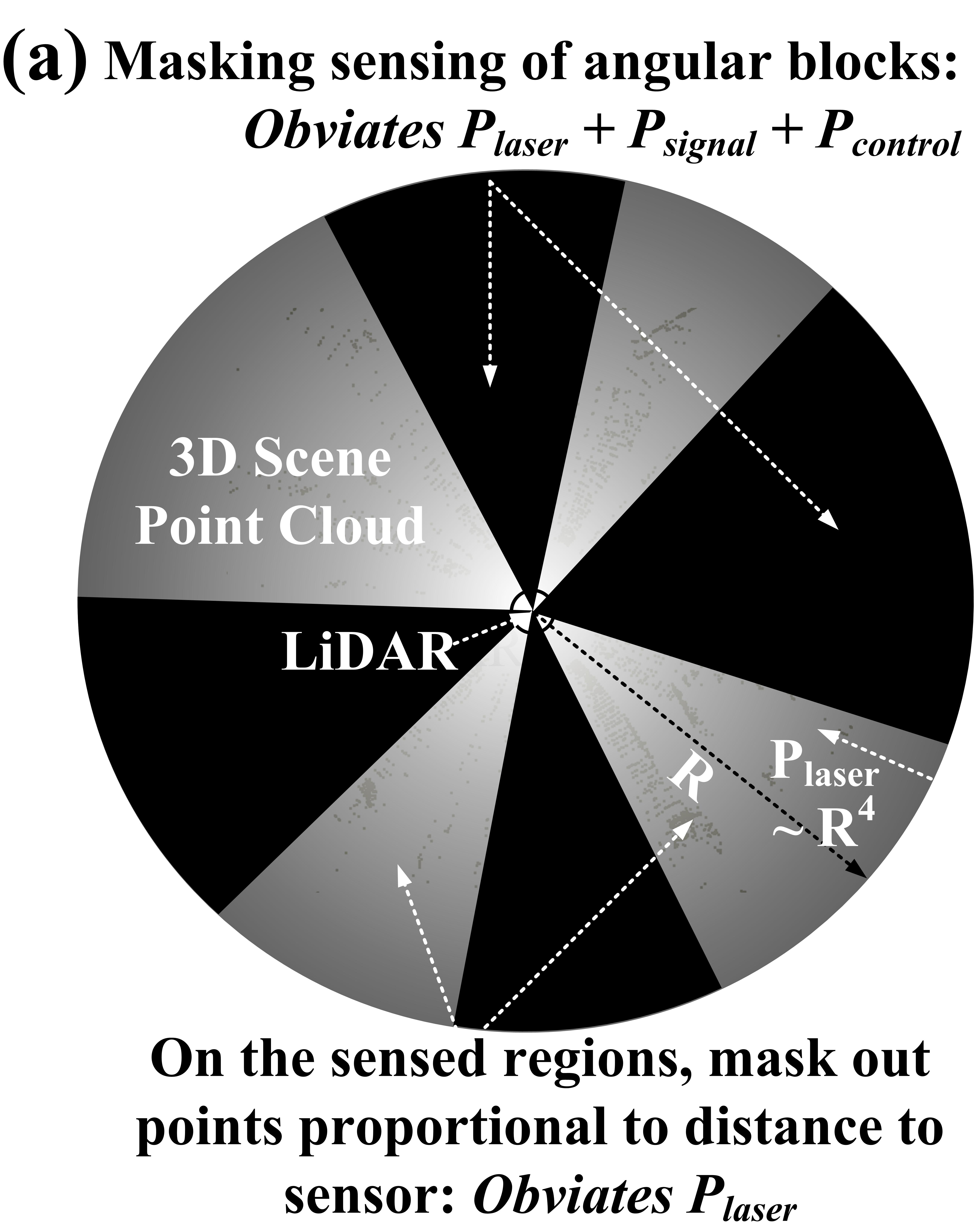
Experimental results
Research questions
- RQ1Can generative pre-training with radial masking reduce LiDAR sensing energy without degrading detection performance?
- RQ2How does radial masking compare to random patch masking in preserving spatial relationships and object distances in 3D scenes?
- RQ3To what extent can R-MAE maintain or improve detection accuracy under extreme masking ratios (e.g., 90%)?
- RQ4Does R-MAE improve domain generalization when transferring representations from Waymo or nuScenes to KITTI?
- RQ5How sensitive is R-MAE performance to the angular size of masked segments in the radial masking strategy?
Key findings
- R-MAE achieves over a 5% average precision improvement in 3D object detection across Waymo, nuScenes, and KITTI datasets.
- On the KITTI dataset, R-MAE improves small object detection by up to 4.37% in AP at moderate difficulty levels.
- With 90% radial masking, R-MAE surpasses baseline models by up to 5.59% in mAP/mAPH on the Waymo dataset.
- On the nuScenes dataset, R-MAE achieves up to 3.17% improvement in mAP and 2.31% in NDS across both single- and fused LiDAR-camera modalities.
- R-MAE shows over 4% accuracy improvement in domain transfer tasks, with gains of 4.09% for pedestrian detection when transferring from Waymo to KITTI.
- The model maintains high performance even at 92% masking ratio, indicating that only 8% of the LiDAR’s BEV needs to be sensed for effective operation.
![Figure 2 : Accuracy under varying pretraining conditions, (a) at varying masking ratios with a fixed angular range of 1 degree, and (b) at different angular ranges with a fixed masking ratio of 0.8. Results are compared against the state-of-the-art (SOTA) PointPillars [ 39 ] method.](https://ar5iv.labs.arxiv.org/html/2406.07833/assets/x2.png)
Better researchstarts right now
From reading papers to final review, dramatically reduce your research time.
No credit card · Free plan available
This review was created by AI and reviewed by human editors.