
[Paper Review] Sensor Deployment with Limited Communication Range in Homogeneous and Heterogeneous Wireless Sensor Networks
This paper proposes a novel sensor deployment framework for wireless sensor networks (WSNs) with limited communication range, introducing the Restrained Lloyd (RL) and Deterministic Annealing (DA) algorithms to jointly optimize sensing distortion and network connectivity. By modeling deployment as a source coding problem with a new distortion measure that accounts for connectivity, the methods outperform traditional Lloyd algorithms in both homogeneous and heterogeneous WSNs under realistic communication constraints.
We study the heterogeneous wireless sensor networks (WSNs) and propose the necessary condition of the optimal sensor deployment. Similar to that in homogeneous WSNs, the necessary condition implies that every sensor node location should coincide with the centroid of its own optimal sensing region. Moreover, we discuss the dynamic sensor deployment in both homogeneous and heterogeneous WSNs with limited communication range for the sensor nodes. The purpose of sensor deployment is to improve sensing performance, reflected by distortion and coverage. We model the sensor deployment problem as a source coding problem with distortion reflecting sensing accuracy. Traditionally, coverage is the area covered by the sensor nodes. However, when the communication range is limited, a WSN may be divided into several disconnected sub-graphs. Under such a scenario, neither the conventional distortion nor the coverage represents the sensing performance as the collected data in disconnected sub-graphs cannot be communicated with the access point. By defining an appropriate distortion measure, we propose a Restrained Lloyd (RL) algorithm and a Deterministic Annealing (DA) algorithm to optimize sensor deployment in both homogeneous and heterogeneous WSNs. Our simulation results show that both DA and RL algorithms outperform the existing Lloyd algorithm when communication range is limited.
Motivation & Objective
- To address the limitation of existing sensor deployment algorithms that assume infinite communication range and fail under connectivity constraints.
- To redefine sensing performance in WSNs by integrating distortion (sensing accuracy) and connectivity into a unified optimization framework.
- To develop algorithms that ensure full network connectivity while minimizing distortion in both homogeneous and heterogeneous WSNs.
- To generalize the Lloyd algorithm for heterogeneous WSNs by incorporating sensor-specific sensing accuracy and communication range.
- To validate the proposed algorithms through simulations showing superior performance compared to conventional Lloyd-based methods.
Proposed method
- Model sensor deployment as a source coding problem with a new distortion measure that penalizes disconnected sub-networks, ensuring connectivity is a design constraint.
- Introduce the Restrained Lloyd (RL) algorithm, a modified version of the Lloyd algorithm that enforces connectivity by restricting sensor movement to maintain network connectivity.
- Propose the Deterministic Annealing (DA) algorithm to escape local minima and achieve better convergence to global optima in complex deployment landscapes.
- Use weighted Voronoi diagrams to partition the sensing field based on sensor-specific weights (e.g., sensing accuracy or range), enabling optimal region assignment in heterogeneous WSNs.
- Formulate the optimization problem using a cost function that combines sensing distortion and connectivity constraints, with mathematical derivation of gradient-based update rules.
- Apply geometric analysis and star-shaped set theory to derive the partial derivatives of the objective function, enabling iterative sensor position updates.
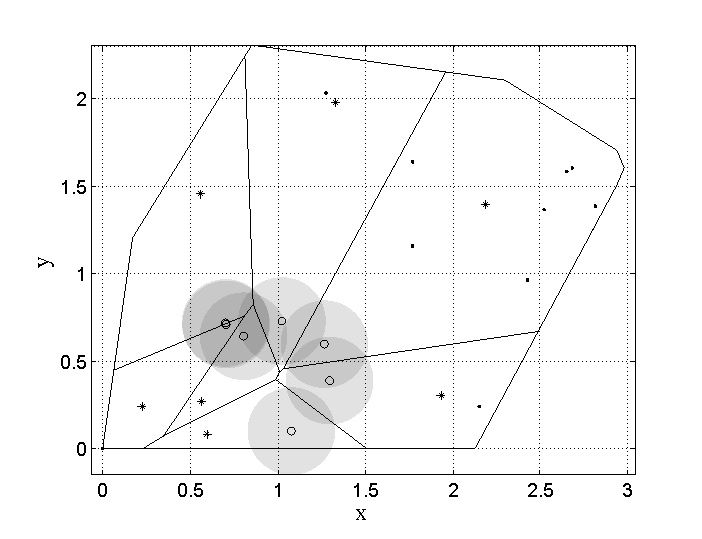
Experimental results
Research questions
- RQ1How can sensor deployment be optimized when communication range is limited, preventing full network connectivity?
- RQ2What is the necessary condition for optimal sensor deployment in heterogeneous WSNs with varying sensing and communication capabilities?
- RQ3How can distortion and connectivity be jointly minimized in WSNs under limited communication range?
- RQ4Can the Lloyd algorithm be adapted to maintain connectivity in WSNs with finite communication range, and if not, what alternative is needed?
- RQ5How do the proposed RL and DA algorithms compare to the standard Lloyd algorithm in terms of distortion and connectivity performance?
Key findings
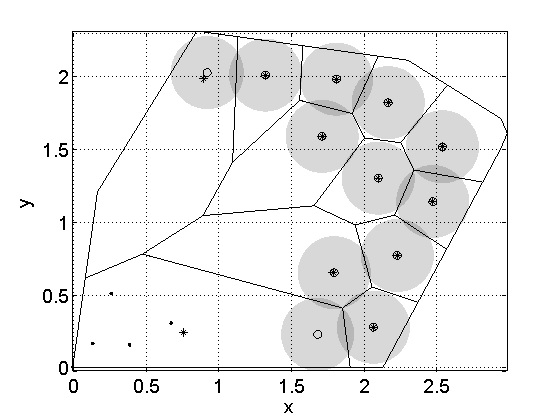
- The proposed Restrained Lloyd (RL) algorithm significantly outperforms the traditional Lloyd algorithm in minimizing distortion under limited communication range, especially in disconnected network scenarios.
- The Deterministic Annealing (DA) algorithm achieves better convergence and lower distortion than both RL and standard Lloyd algorithms by escaping local minima.
- The new distortion measure effectively captures both sensing accuracy and network connectivity, making it more suitable than conventional coverage-only metrics in disconnected WSNs.
- In heterogeneous WSNs, sensor deployment based on weighted Voronoi diagrams with sensor-specific weights leads to improved performance compared to uniform models.
- Simulation results confirm that both RL and DA algorithms maintain full network connectivity while minimizing distortion, even when sensor density is below the Critical Sensor Density (CSD).
- The theoretical analysis proves that the optimal sensor location coincides with the centroid of its optimal sensing region, extending the Lloyd principle to constrained, connected WSNs.
Read this paper
Open the full text in the Nubint reader and ask about any passage as you read.
Read this paper on NubintThis review was generated by AI from the original paper. Please check the paper before citing it.