
[Paper Review] Sentiment Analysis through LLM Negotiations
The paper proposes a multi-LLM negotiation framework where a reasoning-infused generator and an explanation-deriving discriminator iteratively negotiate sentiment decisions, achieving higher accuracy than single-LLM ICL baselines across multiple benchmarks.
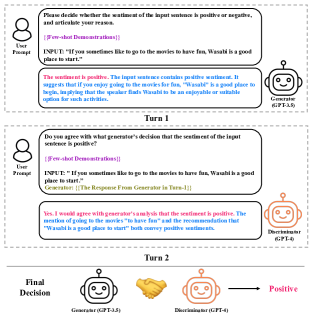
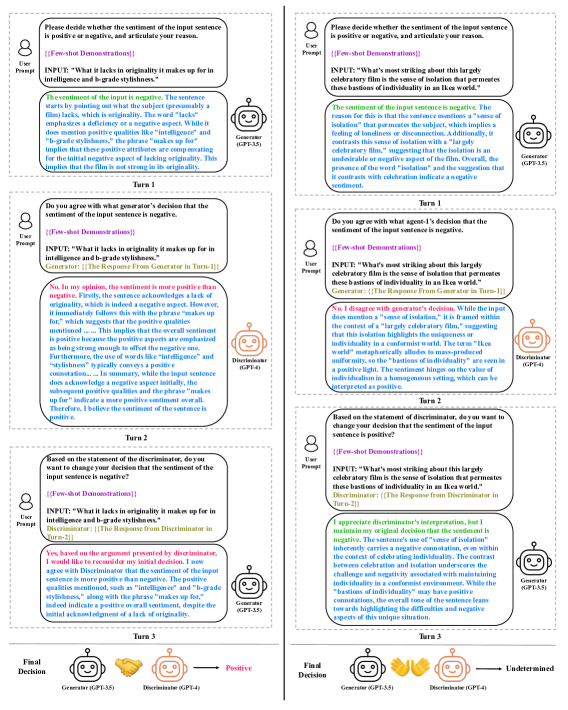
A standard paradigm for sentiment analysis is to rely on a singular LLM and makes the decision in a single round under the framework of in-context learning. This framework suffers the key disadvantage that the single-turn output generated by a single LLM might not deliver the perfect decision, just as humans sometimes need multiple attempts to get things right. This is especially true for the task of sentiment analysis where deep reasoning is required to address the complex linguistic phenomenon (e.g., clause composition, irony, etc) in the input. To address this issue, this paper introduces a multi-LLM negotiation framework for sentiment analysis. The framework consists of a reasoning-infused generator to provide decision along with rationale, a explanation-deriving discriminator to evaluate the credibility of the generator. The generator and the discriminator iterate until a consensus is reached. The proposed framework naturally addressed the aforementioned challenge, as we are able to take the complementary abilities of two LLMs, have them use rationale to persuade each other for correction. Experiments on a wide range of sentiment analysis benchmarks (SST-2, Movie Review, Twitter, yelp, amazon, IMDB) demonstrate the effectiveness of proposed approach: it consistently yields better performances than the ICL baseline across all benchmarks, and even superior performances to supervised baselines on the Twitter and movie review datasets.
Motivation & Objective
- Motivate the limitations of single-LLM sentiment analysis via in-context learning for complex linguistic phenomena (e.g., irony, negation).
- Propose a generator-discriminator multi-LLM negotiation framework to improve accuracy and robustness of sentiment classification.
- Demonstrate that collaboration between two LLMs, and optionally a third, yields better results than supervised baselines on diverse datasets.
- Show that role-flipping negotiations and rationale-based explanations improve decision quality and interpretability.
Proposed method
- We introduce a two-LLM setup with a reasoning-infused generator (G) and an explanation-deriving discriminator (D).
- G produces a sentiment decision along with a structured reasoning chain conditioned on retrieved demonstrations.
- D evaluates G's output, provides justifications, and may trigger iterative negotiations until consensus.
- Role-flipped negotiations swap roles between G and D to further refine the decision.
- If disagreements persist, a third LLM is invoked to aggregate and vote among the six negotiation results.
- Experiments use GPT-3.5, GPT-4, and InstructGPT-3.5 as backbones; RoBERTa-Large is used for KNN-based demonstration retrieval.
Experimental results
Research questions
- RQ1Can a generator-discriminator negotiation between two LLMs outperform single-LLM in-context learning for sentiment analysis?
- RQ2Does role-flipping (and optional third-LLM voting) further improve accuracy and robustness across diverse sentiment benchmarks?
- RQ3What is the impact of including explicit reasoning chains in the negotiation process on performance?
- RQ4How does the proposed approach compare to supervised baselines on standard datasets like SST-2, MR, Twitter, Yelp, Amazon, and IMDB?
Key findings
- The two-LLM negotiation framework consistently improves accuracy over vanilla ICL baselines across multiple datasets.
- Negotiations with two different LLMs outperform self-negotiation (one-LLM) setups by notable margins on MR, Twitter, and IMDB.
- Role-flipped negotiations and the addition of a third LLM further boost performance, enabling consensus-driven decisions.
- The method can surpass some supervised baselines on Twitter and Movie Review datasets and narrows the gap to RoBERTa-Large on several benchmarks.
- Reasoning-included prompts are crucial; removing the reasoning step reduces performance more in negotiation settings than in single-LLM baselines.
Read this paper
Open the full text in the Nubint reader and ask about any passage as you read.
Read this paper on NubintThis review was generated by AI from the original paper. Please check the paper before citing it.