
[Paper Review] SEPT: Towards Efficient Scene Representation Learning for Motion Prediction
SEPT uses three self-supervised masking tasks on scene inputs to pretrain a scene encoder, then finetunes for motion prediction, achieving state-of-the-art results on Argoverse 1 and 2 with a compact architecture.
Motion prediction is crucial for autonomous vehicles to operate safely in complex traffic environments. Extracting effective spatiotemporal relationships among traffic elements is key to accurate forecasting. Inspired by the successful practice of pretrained large language models, this paper presents SEPT, a modeling framework that leverages self-supervised learning to develop powerful spatiotemporal understanding for complex traffic scenes. Specifically, our approach involves three masking-reconstruction modeling tasks on scene inputs including agents' trajectories and road network, pretraining the scene encoder to capture kinematics within trajectory, spatial structure of road network, and interactions among roads and agents. The pretrained encoder is then finetuned on the downstream forecasting task. Extensive experiments demonstrate that SEPT, without elaborate architectural design or manual feature engineering, achieves state-of-the-art performance on the Argoverse 1 and Argoverse 2 motion forecasting benchmarks, outperforming previous methods on all main metrics by a large margin.
Motivation & Objective
- Motivate efficient, accurate motion prediction by learning scene understanding from traffic environments.
- Develop a self-supervised pretraining scheme that captures temporal, spatial, and interaction cues in road scenes.
- Pretrain a scene encoder with three masking-reconstruction tasks and finetune for downstream forecasting.
Proposed method
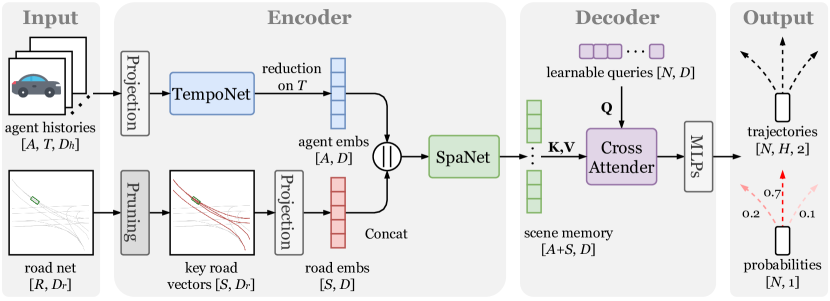
- Represent agents and road network as trajectory and road vector inputs.
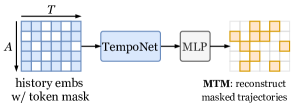
- Pretrain with three tasks: Marked Trajectory Modeling (MTM), Masked Road Modeling (MRM), Tail Prediction (TP).
- MTM masks and reconstructs trajectory waypoints to learn temporal dependencies.
- MRM masks road vector attributes to learn road topology and connectivity.
- TP predicts tail trajectory from head trajectory and road context to align temporal and spatial representations.
- Use a TempoNet (temporal encoder) and SpaNet (spatial encoder) with a Cross Attender for predictions in a unified transformer-based pipeline.
- Finetune the pretrained encoder with a downstream trajectory prediction decoder, optimizing a combined regression and classification loss.
Experimental results
Research questions
- RQ1Can self-supervised pretraining on temporal, spatial, and interaction cues improve motion forecasting performance?
- RQ2Do the MTM, MRM, and TP tasks contribute additively to downstream prediction performance?
- RQ3Is a compact, single-architecture encoder sufficient to achieve state-of-the-art results on large-scale motion forecasting benchmarks?
Key findings
- Pretraining yields consistent gains over training from scratch across main motion forecasting metrics.
- All three pretraining tasks contribute additively to performance, with Tail Prediction (TP) significantly aiding alignment between temporal and spatial representations.
- SEPT achieves state-of-the-art results on Argoverse 1 and Argoverse 2, ranking first on main metrics, with about 40% of the parameters and faster inference compared to the strongest baseline.
- On Argoverse 1, SEPT ranks first on most metrics; on Argoverse 2, SEPT ranks first on all metrics among reported methods.
- SEPT demonstrates faster inference and competitive or superior accuracy with a compact encoder architecture (about 9.6M parameters).
- Ablation shows TP is crucial for coupling TempoNet and SpaNet, with MTM and MRM providing additive improvements.
Read this paper
Open the full text in the Nubint reader and ask about any passage as you read.
Read this paper on NubintThis review was generated by AI from the original paper. Please check the paper before citing it.