
[Paper Review] Sequential Logistic Principal Component Analysis (SLPCA): Dimensional Reduction in Streaming Multivariate Binary-State System
This paper proposes Sequential Logistic Principal Component Analysis (SLPCA), an online dimensionality reduction method for streaming multivariate binary data using sequential convex optimization. It extends batch Logistic PCA (LPCA) to handle non-Gaussian, binary-state systems efficiently, demonstrating convergence to batch LPCA results and effective application in building energy end-use profiling with low regret and stable performance.
Sequential or online dimensional reduction is of interests due to the explosion of streaming data based applications and the requirement of adaptive statistical modeling, in many emerging fields, such as the modeling of energy end-use profile. Principal Component Analysis (PCA), is the classical way of dimensional reduction. However, traditional Singular Value Decomposition (SVD) based PCA fails to model data which largely deviates from Gaussian distribution. The Bregman Divergence was recently introduced to achieve a generalized PCA framework. If the random variable under dimensional reduction follows Bernoulli distribution, which occurs in many emerging fields, the generalized PCA is called Logistic PCA (LPCA). In this paper, we extend the batch LPCA to a sequential version (i.e. SLPCA), based on the sequential convex optimization theory. The convergence property of this algorithm is discussed compared to the batch version of LPCA (i.e. BLPCA), as well as its performance in reducing the dimension for multivariate binary-state systems. Its application in building energy end-use profile modeling is also investigated.
Motivation & Objective
- Address the limitations of traditional PCA in non-Gaussian, streaming multivariate binary-state systems.
- Develop an online, computationally efficient alternative to batch Logistic PCA (LPCA) for real-time data processing.
- Ensure convergence of the sequential algorithm to the batch LPCA solution under appropriate step size rules.
- Demonstrate practical utility in modeling building energy end-use profiles using binary sensor data.
- Provide theoretical guarantees on regret and target function convergence for the sequential framework.
Proposed method
- Extends batch Logistic PCA (LPCA) to a sequential online framework using online convex optimization theory.
- Employs Bregman divergence as the distance measure to handle non-Gaussian, Bernoulli-distributed data, replacing Frobenius norm in standard PCA.
- Uses a sequential update rule for the projection matrix via gradient descent on the log-likelihood of the data under the exponential family model.
- Applies diminishing and constant step sizes (e.g., $\eta_t = Ct^{-1/2}$) to ensure convergence of the average target function and regret.
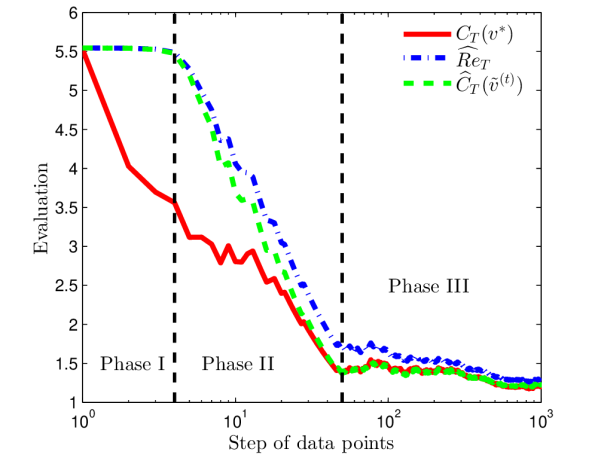
- Introduces two evaluation metrics: the average sequential target function $\widehat{C}_N(\widetilde{\mathbf{V}}^N)$ and the regret function $\widehat{Re}_N$.
- Derives theoretical bounds on the difference between the sequential and batch LPCA objectives, showing convergence within a constant bound.
Experimental results
Research questions
- RQ1Can an online variant of Logistic PCA be developed that maintains accuracy while enabling real-time processing of streaming binary data?
- RQ2How does the sequential algorithm's performance in terms of target function and regret compare to the batch LPCA baseline?
- RQ3What step size rules ensure convergence of the sequential algorithm to the batch solution?
- RQ4Can SLPCA effectively model multivariate binary-state systems such as building energy end-use profiles?
- RQ5What theoretical guarantees can be provided for the convergence of the sequential optimization process?
Key findings
- The sequential algorithm achieves convergence of the average target function $\widehat{C}_N(\widetilde{\mathbf{V}}^N)$ and regret $\widehat{Re}_N$ to within a constant bound of the batch LPCA solution.
- With diminishing step size $\eta_t = Ct^{-1/2}$, the regret difference $|\widehat{Re}_N - \widehat{C}_N(\widetilde{\mathbf{V}}^N)|$ is bounded by terms that decay as $\mathcal{O}(\frac{\log N}{\sqrt{N}})$ and $\mathcal{O}(\frac{1}{\sqrt{N}})$, with a limiting upper bound of $\frac{\gamma\Omega^2}{2}$.
- For constant step size $\eta_t = C$, the regret difference is bounded by $\gamma\Omega^2 + \Omega^2C$, indicating convergence to a constant error margin.
- Theoretical analysis confirms that both the average target function and regret converge under appropriate step size selection, ensuring stability and reliability of the online method.
- Empirical results in building energy end-use modeling demonstrate SLPCA’s capability to reduce dimensionality effectively in real-world binary-state systems.
- The method outperforms standard PCA in non-Gaussian settings and maintains computational efficiency suitable for streaming applications.

Better researchstarts right now
From reading papers to final review, dramatically reduce your research time.
No credit card · Free plan available
This review was created by AI and reviewed by human editors.