
[Paper Review] Sequential Memory with Temporal Predictive Coding
This paper introduces temporal predictive coding (tPC) for sequential memory, showing it can memorize and recall sequences with a biologically plausible neural implementation and that whitening in tPC yields a stable recall compared to classical asymmetric Hopfield networks.
Forming accurate memory of sequential stimuli is a fundamental function of biological agents. However, the computational mechanism underlying sequential memory in the brain remains unclear. Inspired by neuroscience theories and recent successes in applying predictive coding (PC) to <i>static</i> memory tasks, in this work we propose a novel PC-based model for <i>sequential</i> memory, called <i>temporal predictive coding</i> (tPC). We show that our tPC models can memorize and retrieve sequential inputs accurately with a biologically plausible neural implementation. Importantly, our analytical study reveals that tPC can be viewed as a classical Asymmetric Hopfield Network (AHN) with an implicit statistical whitening process, which leads to more stable performance in sequential memory tasks of structured inputs. Moreover, we find that tPC exhibits properties consistent with behavioral observations and theories in neuroscience, thereby strengthening its biological relevance. Our work establishes a possible computational mechanism underlying sequential memory in the brain that can also be theoretically interpreted using existing memory model frameworks.
Motivation & Objective
- Motivate and model how the brain forms memories of temporal sequences.
- Develop a temporal predictive coding framework with a biologically plausible implementation.
- Analyze theoretical properties linking tPC to asymmetric Hopfield networks with whitening.
- Demonstrate empirical advantages of tPC over traditional memory models on structured sequential data.
- Show behavioral relevance by matching known serial recall phenomena and exploring context representations.
Proposed method
- Propose temporal predictive coding (tPC) as a memory model for sequences with a temporal extension of static PC.
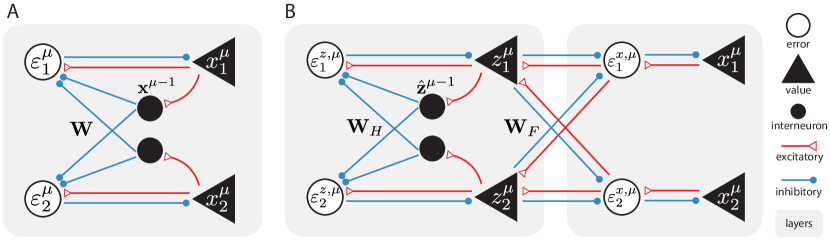
- Derive a single-layer tPC that minimizes temporal prediction error and learns via a Hebbian rule, with recall via local inference.
- Show that single-layer tPC is equivalent to a whitened dot-product form of an asymmetric Hopfield network (AHN).
- Extend to a two-layer tPC with a hidden layer that captures context and dynamics, enabling context-dependent representations.
- Provide neural-implementation sketches with value and error neuron populations and synaptic delay mechanisms for temporal prediction.
- Compare tPC to AHNs and modern continuous AHNs on structured sequential data, and relate findings to cognitive map-like representations.
Experimental results
Research questions
- RQ1Can temporal predictive coding memorize and recall sequences with temporal dependencies in a biologically plausible way?
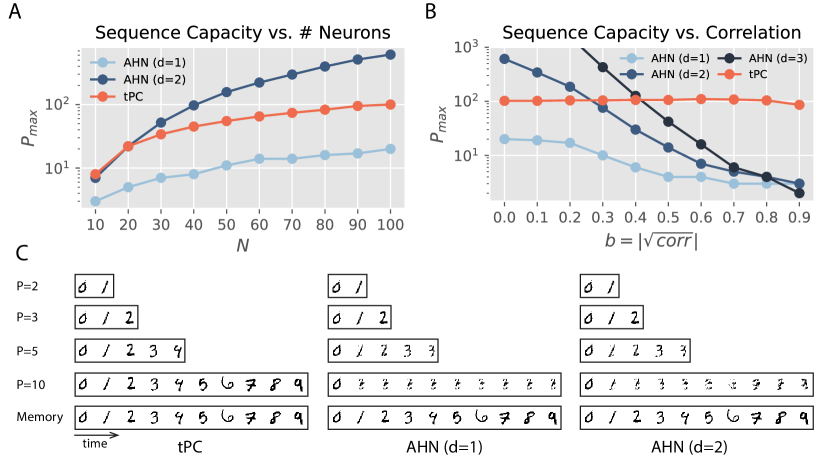
- RQ2Does tPC implicitly whiten patterns during recall, and does this whitening improve stability over classical AHNs?
- RQ3How does a hierarchical (two-layer) tPC develop context-dependent representations and generalize learned sequence dynamics?
- RQ4Do tPC models reproduce known serial recall phenomena such as primacy/recency effects and sequence-length effects?
- RQ5Can tPC provide insights into cognitive maps and context representations in sequential memory?
Key findings
- Single-layer tPC acts as a whitening-enhanced variant of AHN, improving stability on correlated or structured sequences.
- Whitening in tPC decorrelates inputs implicitly, leading to better recall capacity than basic AHN and some MCAHN variants on natural-like sequences.
- Two-layer tPC develops context-dependent representations that help disambiguate aliased inputs and support correct next-step recall.
- tPC reproduces qualitative behavioral patterns such as the impact of sequence length and primacy/recency effects in serial recall.
- The model demonstrates the potential for context representation and generalization of learned dynamics to unseen sequences, hinting at connections to cognitive maps.
Read this paper
Open the full text in the Nubint reader and ask about any passage as you read.
Read this paper on NubintThis review was generated by AI from the original paper. Please check the paper before citing it.